

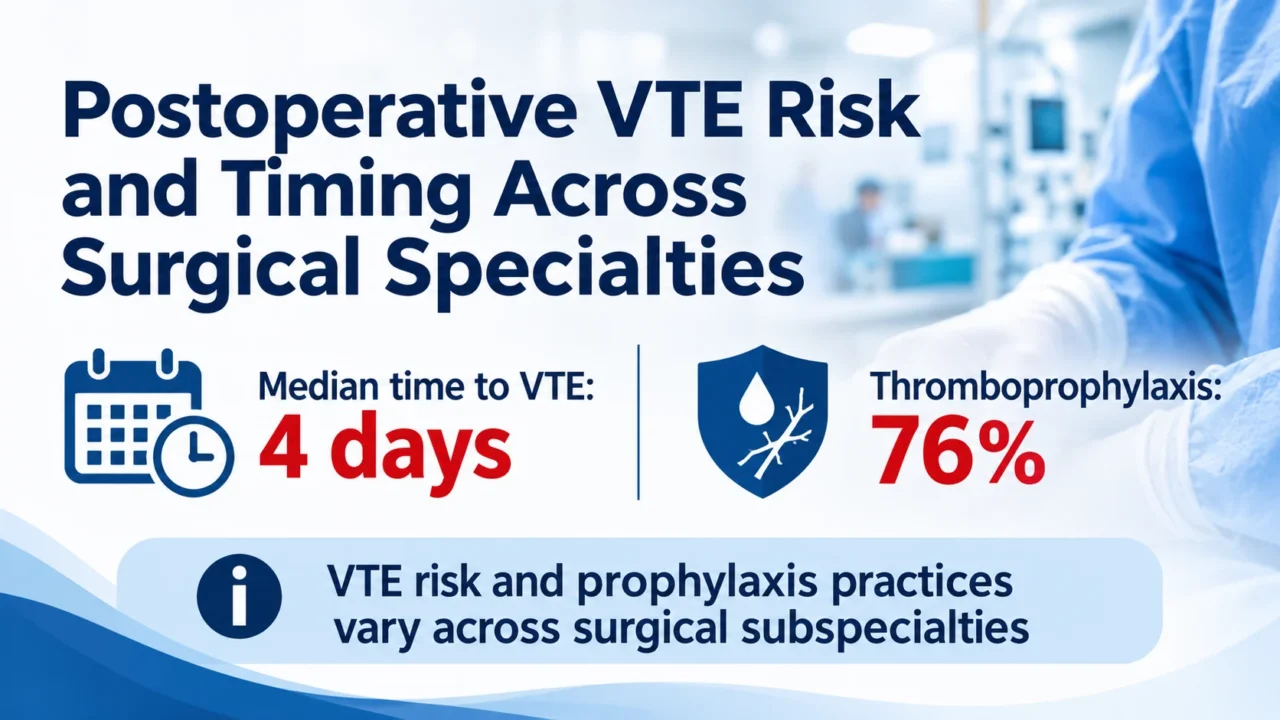
Chris Oung: Postoperative VTE Risk and Timing Across Surgical Specialties
Chris Oung, Consultant-General Surgery at Strathroy Middlesex General Hospital, shared a post on LinkedIn:
“Effect of Surgical Subspecialty on Time to Development of Postoperative Venous Thromboembolism
Journal of the American College of Surgeons, December 2026.
Abstract
Background:
Postoperative venous thromboembolism (VTE) remains a major cause of surgical morbidity despite guideline-based prophylaxis. Whether VTE timing and thromboprophylaxis patterns differ across surgical subspecialties is incompletely characterized.
Study design:
Retrospective cohort study of adults with imaging-confirmed postoperative VTE during the index admission within a multihospital healthcare system (2013 to 2019). VTE events were identified using natural language processing and confirmed by chart review.
The primary outcome was time to postoperative VTE, the secondary outcome was time to thromboprophylaxis. Kaplan–Meier analyses and multivariable Cox proportional hazards models evaluated associations across surgical specialties.
Results:
Among 1,520 patients with postoperative VTE, 24.9% had deep vein thrombosis only, 67.2% pulmonary embolism only, and 7.9% both. Median time to VTE was 4 days (interquartile range 2.0 to 8.0); pulmonary embolism occurred earlier than deep vein thrombosis (3 vs 6 days; p lower 0.001).
Neurosurgery had the highest VTE incidence (0.23% of neurosurgical cases), whereas orthopaedic surgery demonstrated the highest adjusted hazard for postoperative VTE.
Overall, 76% received postoperative thromboprophylaxis beginning a median of 1.3 days after surgery (interquartile range 0.8 to 1.7). Patients without thromboprophylaxis developed VTE earlier than those receiving prophylaxis (2.0 vs 4.0 days; p lower 0.001).
Cardiac surgery demonstrated the lowest adjusted likelihood of thromboprophylaxis, whereas thoracic surgery had the highest (hazard ratio 5.8, 95% CI 2.8 to 12.1; reference cardiac), and trauma patients were less likely to receive prophylaxis (hazard ratio 0.44, 95% CI 0.34 to 0.57).
Conclusions:
Postoperative VTE risk, timing, and thromboprophylaxis practices vary substantially across surgical subspecialties.
These findings support specialty-specific VTE risk assessment, prophylaxis strategies, and postoperative surveillance.”
Stay updated with Hemostatis Today.
-
Nov 20, 2026, 14:25Sameer A.: When Heparin Triggers Thrombosis – A Case of HIT
-
Nov 20, 2026, 14:17Melissa Pickett: HIT Detection Can Miss a Critical Platelet Decline
-
Nov 20, 2026, 14:02Hasan Burak İşleyen։ Thrombocytopenia and Mortality in Critically Ill Cancer Patients
-
Nov 20, 2026, 13:50Louise Maes: CONVINCE Trial Imaging Studies Reveal New Insights Into Carotid Plaque and Vascular Risk
-
Nov 20, 2026, 13:50Lara Kurdi: A Presentation of Triple-Positive Antiphospholipid Syndrome
-
Nov 20, 2026, 13:46Rahul Bohra: Beyond Platelet Counts – The Lived Experience of ITP
-
Nov 20, 2026, 13:34Yohei Hisada: How Well Do Mouse Leukemia Models Reflect Human Disease?
-
Nov 20, 2026, 13:20Ilenia Calcaterra: The Inferior Thyroid Arteries as a Window Into Cardiovascular Risk
-
Nov 20, 2026, 13:03Does Being Fit Protect Against VTE? – RPTH Journal