


Edward Barnard: New Study Identifies an Association Between O Negative Blood Group and Trauma Mortality
Edward Barnard, Defence Professor of Emergency Medicine at UK Ministry of Defence, Consultant Emergency Physician at Cambridge University Hospitals NHS Foundation Trust, shared a post on LinkedIn about a recent article he and his colleagues co-authored, published in Injury, adding:
“Is blood group a hidden confounder in trauma outcomes?
Our paper is now out in Injury, free to read.
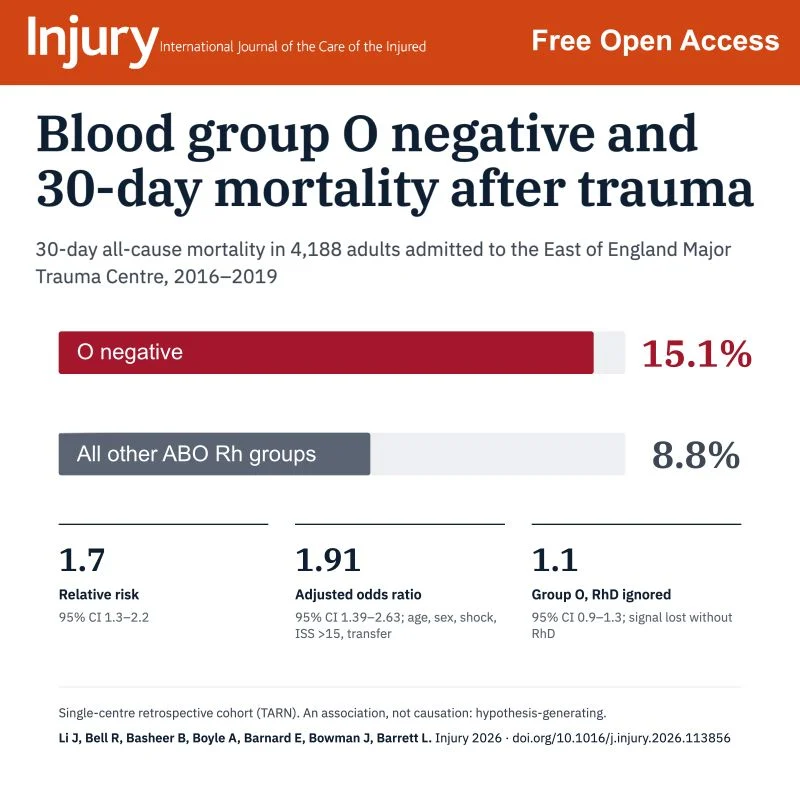
We examined 4,188 adult trauma patients admitted to the East of England Major Trauma Centre (2016–2019) and compared 30-day mortality across all eight ABO RhD groups.
Earlier studies, mostly from Japan and the US, have looked at ABO or RhD separately and reached conflicting conclusions.
Patients who were O negative had higher 30-day mortality than all other groups combined: 15.1 percent versus 8.8 percent (RR 1.7, 95 percent CI 1.3–2.2).
The association held after adjustment for age, sex, shock, ISS more than 15 and secondary transfer (OR 1.91, 95 percent CI 1.39–2.63).
Age, injury severity and admission PT/aPTT were similar between groups.
The signal only appears when ABO and RhD are considered together.
For group O as a whole, the relative risk was 1.1 (95 percent CI 0.9–1.3).
This is a single-center retrospective study.
We had no data on ethnicity, TXA or anticoagulants, and no hemostatic phenotyping beyond PT and aPTT.
The finding is hypothesis-generating, and we do not know the mechanism.
Transfusion was not recorded, so some patients grouped after massive transfusion with O negative cells may have has been misclassified – particularly for Rh.
There are two practical implications.
Trauma trials should report ABO RhD group as a baseline characteristic.
Prospective studies should pair registry data with viscoelastic testing, VWF/FVIII and endothelial biomarkers, and adjudicated cause of death.
Thanks to Jane Li, Rachel Bell, Bushry Basheer, Adrian Boyle, Jacques Bowman and Liam Barrett, and to Cambridge University Hospitals NHS Foundation Trust and University of Cambridge.”
Title: The association of ABO Rh blood groups with 30-day mortality following traumatic injury – a retrospective observational study in the East of England
Authors: Jane Li, Rachel Bell, Bushry Basheer, Adrian Boyle, Edward Barnard, Jacques Bowman, Liam Barratt

Stay updated on all scientific advances with Hemostasis Today.
-
Nov 3, 2026, 14:15Rhiannon Morris: Awarded CASS Foundation Travel Grant to Present Research at ASH 2026
-
Nov 3, 2026, 14:05Paula Escarcena Fernández: Selective Genicular Artery Embolization for Complex Regional Pain Syndrome of the Knee
-
Nov 3, 2026, 13:55Heiko Tschauner: New NOM-253 Standard Sets Higher Requirements for Blood Services in Mexico
-
Nov 3, 2026, 13:51The Future of Coagulation Diagnostics From Laboratory Testing to Better Patient Care
-
Nov 3, 2026, 13:45Keiyona Coots: Patient Blood Management as a Cornerstone of Safer Healthcare
-
Nov 3, 2026, 13:37Godfred Oduro: Engaging Young Students in Thalassemia and Sickle Cell Disease Awareness
-
Nov 3, 2026, 13:37Saskia Middeldorp: The Use of LMWH in Women With Pregnancy Complications
-
Nov 3, 2026, 13:31Nita Radhakrishnan: MRI T2 Reveals Hidden Cardiac and Hepatic Iron Overload in Thalassemia
-
Nov 3, 2026, 13:26Chancellor Donald: Bridging Hematology Innovation and Entrepreneurship to Advance Patient Care