


Edward Lee Carter: Breakthrough Stroke Beyond ‘DOAC Failure’ – Risk Stratification Insights from ASPERA-R
Edward Lee Carter, Clinical Pharmacist Practitioner at U.S. Department of Veterans Affairs, shared on LinkedIn:
“Finding a potential contributor after breakthrough stroke may do more than explain the event.
It may identify a patient at greater risk of another stroke within 90 days.
Previously, I argued that ischemic stroke during anticoagulation should initiate a diagnostic workup – not simply be labeled ‘DOAC failure.’
The ASPERA-R study adds an important clinical consequence to that framework.
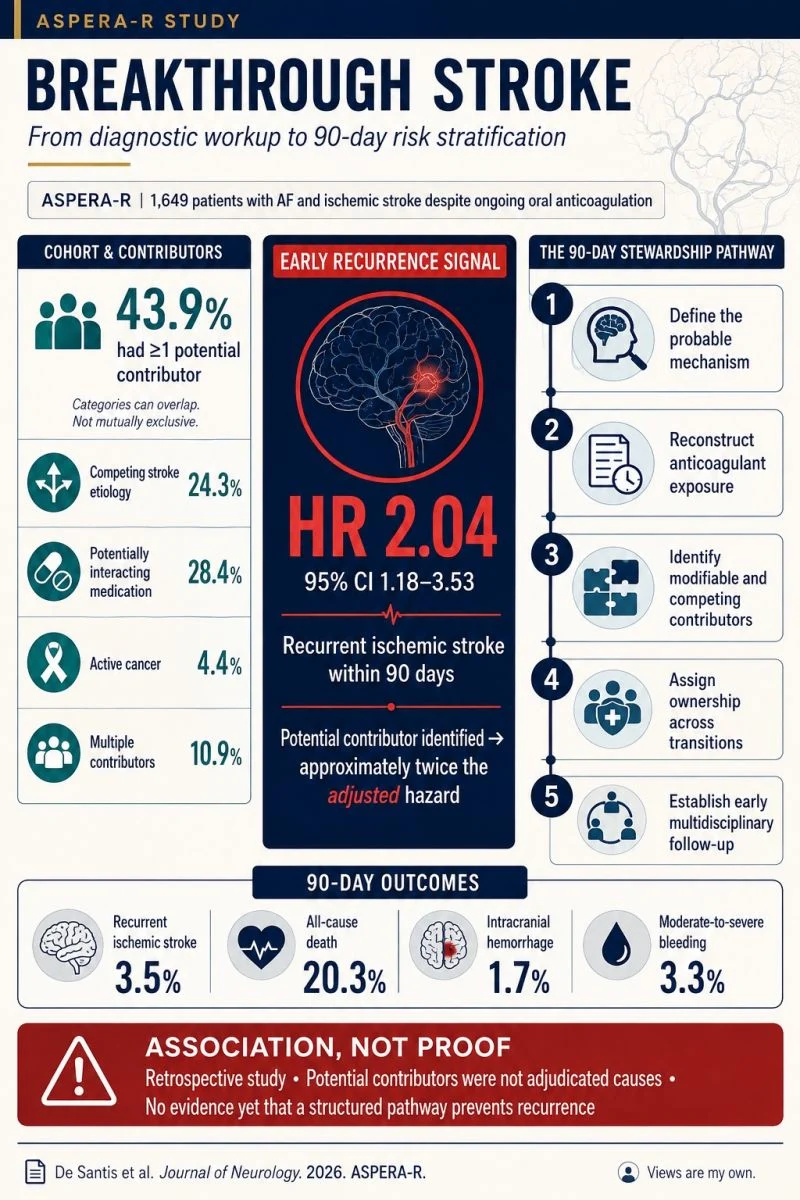
Investigators evaluated 1,649 patients with atrial fibrillation who experienced ischemic stroke despite ongoing oral anticoagulation. Patients with poor adherence or inappropriate DOAC dosing were excluded.
At least one potential contributor was identified in 43.9%:
- Competing stroke etiology: 24.3%
- Potentially interacting medication: 28.4%
- Active cancer: 4.4%
- Multiple potential contributors: 10.9%
The critical finding was their association with early recurrence.
Patients with at least one potential contributor had approximately twice the adjusted hazard of recurrent ischemic stroke within 90 days:
HR 2.04; 95% CI, 1.18–3.53
This reframes the breakthrough-stroke evaluation.
The workup is not merely retrospective – an attempt to explain why anticoagulation appeared to fail. It may also function as early risk stratification.
A structured 90-day pathway could:
- Define the probable stroke mechanism
- Reconstruct anticoagulant exposure
- Identify modifiable and competing contributors
- Assign ownership across transitions of care
- Establish early multidisciplinary follow-up
ASPERA-R was retrospective.
Its categories represent potential contributors – not adjudicated causes – and residual confounding remains possible.
The study did not test whether correcting an identified factor prevents recurrence.
The medication-interaction category also requires restraint: it was dominated by proton pump inhibitors and was not independently associated with recurrent ischemic stroke in the weighted analysis.
Still, the broader signal is clinically meaningful:
Breakthrough stroke may be both a diagnostic event and a prognostic event.
The question is no longer only:
‘Why did this stroke occur?’
It may also be:
‘What must happen during the next 90 days?’
Should ischemic stroke during anticoagulation automatically trigger a structured 90-day anticoagulation-stewardship pathway?”
Stay updated with Hemostasis Today.
-
Oct 16, 2026, 13:10Emanuel Sueldo: CAHT 2026 Celebrates Scientific Progress and Team Achievements
-
Oct 16, 2026, 13:05Maha Othman: Queen’s Health Sciences Advances CAT Risk Models and Pediatric ISTH-BAT Cut-Offs
-
Oct 16, 2026, 13:03Thrombosis Awareness Must Lead to Timely Action – Roche
-
Oct 16, 2026, 12:49Wolfgang Miesbach: 5-Year CBDR Data Confirms Emicizumab Safety and Efficacy in Hemophilia A
-
Oct 16, 2026, 12:40Edward Lee Carter: How Factor XI Inhibition Could Transform Anticoagulation Therapy
-
Oct 16, 2026, 12:40Marc Carrier: Looking Ahead to ISTH 2027 in Vancouver
-
Oct 16, 2026, 12:30Bob Lempke: How One Blood Donation Can Save Up to Three Lives
-
Oct 16, 2026, 12:30Why VWF Therapies Belong on the EU Critical Medicines List – EHC
-
Oct 16, 2026, 12:17Exploring Endothelial Cells, Genetic Fate Mapping, and Revascularization – ISTH