

ASH 2026 Guideline on ITP: Evolving Treatment Strategies
The American Society of Hematology (ASH) has published a focused 2026 update to its immune thrombocytopenia (ITP) guidelines, introducing a more proactive treatment strategy for adults with primary ITP.
The update conditionally favors combining corticosteroids with either rituximab or a thrombopoietic agent as initial therapy, while strongly recommending thrombopoietic agents for patients whose disease does not respond adequately to corticosteroids.
The recommendations represent an important evolution from the 2019 guideline. Treatment selection is moving beyond short-term platelet-count correction toward earlier, individualized disease control, reduced corticosteroid exposure, and shared decision-making.
Why the guideline matters
ITP is an acquired autoimmune disorder characterized by immune-mediated platelet destruction and impaired platelet production.
Although the platelet count remains clinically important, bleeding risk, bleeding phenotype, comorbidities, age, treatment toxicity, patient preferences, and access to therapy all influence management decisions.
The 2026 document is a focused update rather than a complete replacement of every recommendation in the 2019 ASH guideline.
It addresses initial treatment of adults with primary ITP, second-line treatment after failure of first-line corticosteroids, switching between thrombopoietic agents, and the role and timing of splenectomy.
The guideline panel included clinicians, methodologists, and patient representatives. Evidence reviews were updated through July 19, 2025, and recommendations were developed using the GRADE approach, including evidence-to-decision frameworks and public comment.
The major change: earlier combination therapy
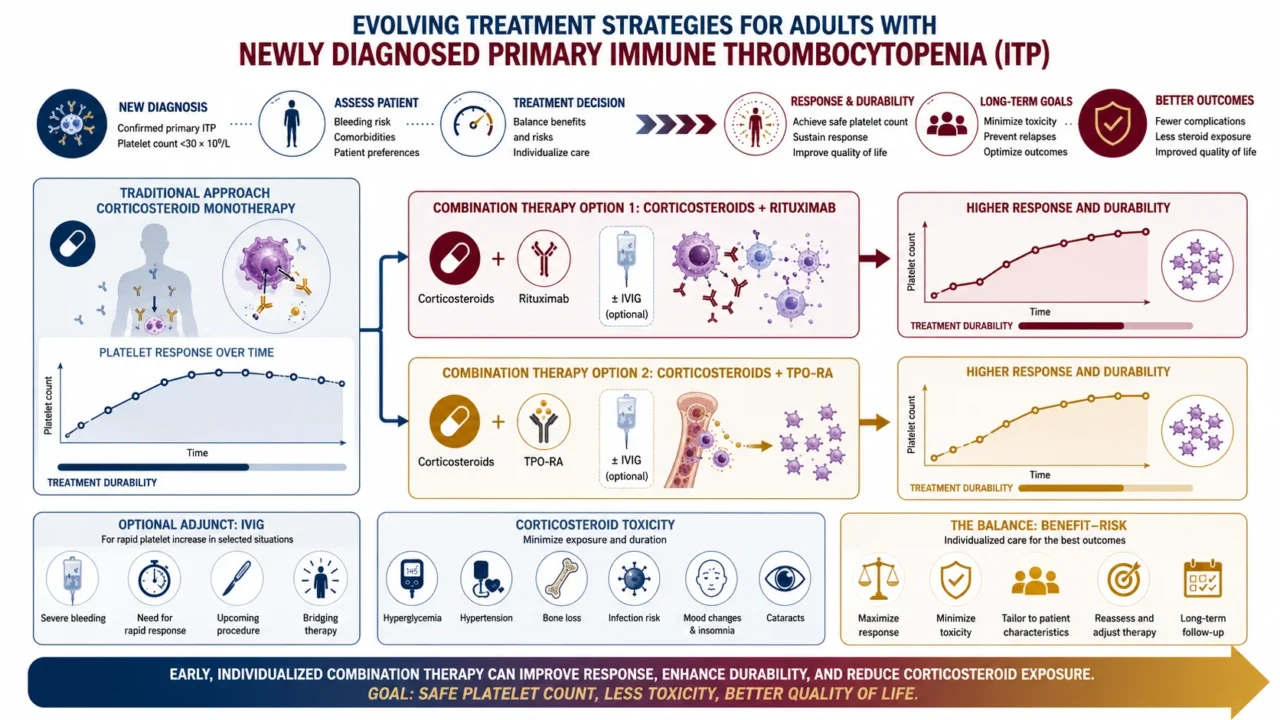
For adults with newly diagnosed primary ITP who require treatment, ASH 2026 conditionally suggests either rituximab plus corticosteroids, with or without intravenous immunoglobulin, or a thrombopoietic agent plus corticosteroids, with or without IVIG, rather than corticosteroid monotherapy.
This is a conditional recommendation, reflecting uncertainty in the comparative evidence and the importance of individual patient factors. It does not mean that every patient should automatically receive combination therapy.
Instead, it signals that clinicians should discuss the potential benefits and disadvantages of adding a disease-modifying or platelet-stimulating treatment at the outset.
Historically, corticosteroids were commonly used alone as initial therapy, with additional treatment reserved for relapse or inadequate response.
The updated approach recognizes several limitations of steroid-only treatment.
Initial platelet responses may not be durable, repeated or prolonged corticosteroid exposure can cause clinically important toxicity, and relapse may require urgent rescue treatment. Persistent thrombocytopenia can also affect quality of life, employment, invasive procedures, and decisions regarding anticoagulant or antiplatelet therapy.
The guideline therefore places greater emphasis on balancing response durability and treatment burden rather than treating the platelet count in isolation.
Corticosteroids remain important – but exposure should be limited
The 2026 recommendations retain corticosteroids as a central component of initial therapy. However, the overall direction remains consistent with limiting corticosteroid exposure and avoiding prolonged courses whenever possible.
Common approaches include a short course of prednisone or prednisolone, dexamethasone pulses, and IVIG when a rapid platelet increase is needed or when bleeding risk is high.
Dexamethasone is commonly administered at 40 mg daily for 4 days, repeated for a limited number of cycles when clinically appropriate.
Available summaries of the guideline describe a target of keeping total corticosteroid exposure to no more than approximately 6 weeks.
The practical implication is that corticosteroids should generally serve as a rapid-acting component of treatment rather than an indefinite maintenance strategy. C
linicians should monitor for hyperglycemia, hypertension, mood and sleep disturbance, infection, osteoporosis, gastrointestinal complications, and other steroid-related adverse effects.
Second-line therapy after corticosteroid failure
The strongest new treatment recommendation concerns adults who require additional therapy after first-line corticosteroids.
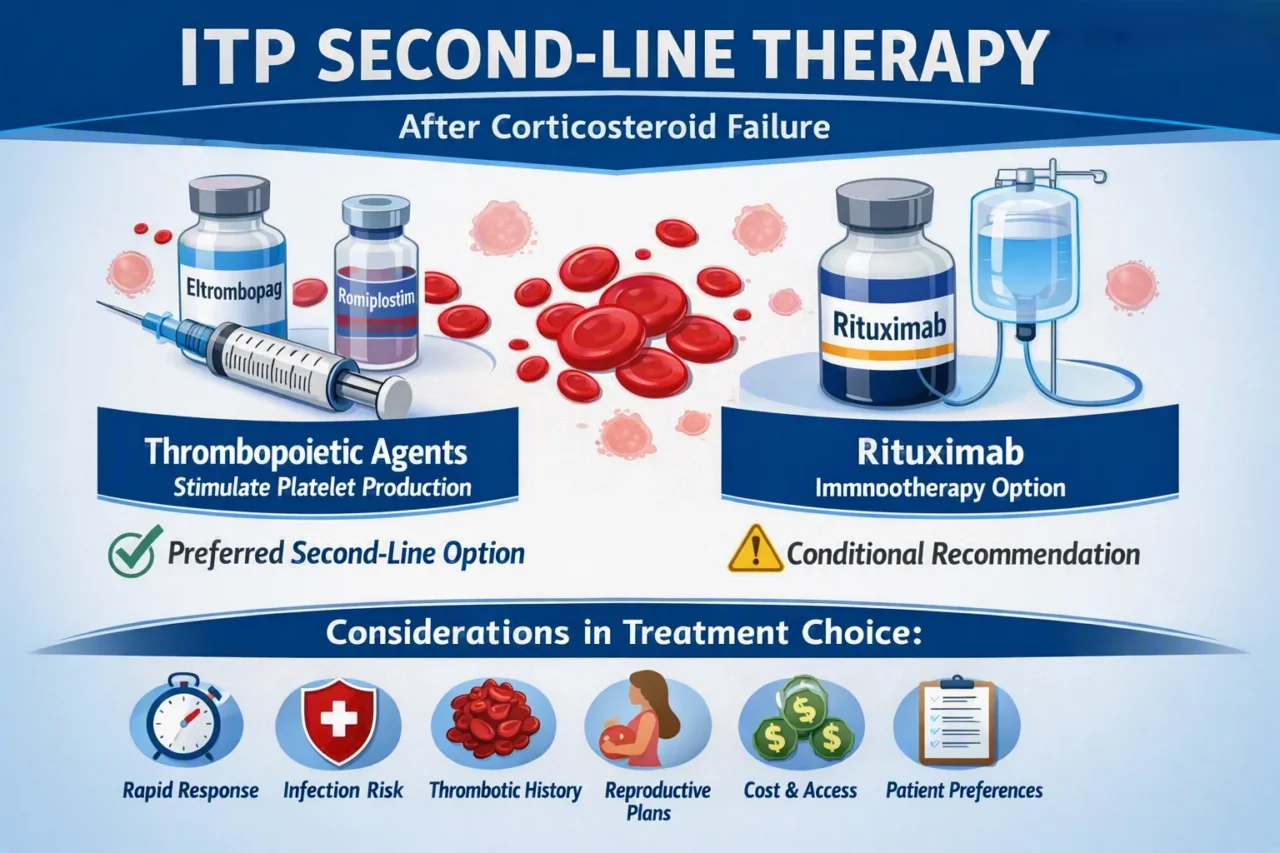
ASH strongly recommends a thrombopoietic agent over no thrombopoietic agent in this setting. The recommendation is supported by moderate-certainty evidence.
Rituximab is conditionally recommended as another option, based on lower-certainty evidence.
Thrombopoietic agents include eltrombopag, romiplostim, and other approved thrombopoietin-receptor agonists, depending on local availability and regulatory status.
These agents stimulate platelet production and can provide effective platelet-count support in persistent or chronic ITP.
Their use requires attention to thrombotic risk, liver function where relevant, drug interactions, adherence, and the need to maintain the platelet count at a hemostatically appropriate—not necessarily normal—level.
Treatment selection should consider the need for a rapid response, the patient’s desire to avoid immunosuppression, infection risk, vaccination status, thrombotic history, adherence, cost, access, reproductive plans, and individual treatment preferences.
IVIG and corticosteroids may be useful when an immediate platelet increase is required.
A thrombopoietic agent may be preferred in some patients who wish to avoid immunosuppression, whereas rituximab may be attractive to patients who prefer a finite treatment course rather than ongoing oral or injectable therapy.
Patients with a history of thrombosis or multiple thrombotic risk factors require particularly careful assessment before initiating a TPO-receptor agonist.
The role of rituximab
Rituximab remains an important treatment option, but the 2026 guideline places it in a conditional rather than strongly preferred position after corticosteroid failure.
Its potential advantages include a finite treatment course and the possibility of a sustained response in a subset of patients. It may also allow patients to avoid prolonged treatment with a platelet-stimulating agent.
Important limitations include delayed or incomplete response, infusion-related reactions, increased susceptibility to infection, reduced vaccine responses, hepatitis B reactivation risk in susceptible individuals, and potential difficulty managing future infections or immunizations.
When rituximab is considered, clinicians should review vaccination status and infection risks. Guideline summaries indicate that vaccination at least 2 weeks before treatment should be considered when feasible.
Emerging and alternative treatments
For patients who remain symptomatic or thrombocytopenic after corticosteroids and require additional therapy, the guideline identifies other treatments that may be considered. These include Bruton tyrosine kinase inhibitors, mycophenolate mofetil, spleen tyrosine kinase inhibitors, and azathioprine in selected circumstances.
These options are not positioned as universal replacements for thrombopoietic agents or rituximab. Treatment should be guided by toxicity, access, cost, comorbidities, the patient’s treatment goals, and the clinician’s experience.
This hierarchy reflects the expanding ITP treatment landscape. It also highlights a continuing challenge: newer therapies may offer mechanistically distinct approaches, but comparative evidence across drug classes remains limited. In many cases, treatment sequencing must therefore be individualized rather than rigidly protocol-driven.
Switching between thrombopoietic agents
The guideline includes a good practice statement supporting a switch from one thrombopoietic agent to another when the first agent is ineffective, poorly tolerated, difficult to administer, or unsuitable for the patient’s circumstances.
A lack of response to one TPO-receptor agonist does not necessarily mean that the entire class will be ineffective.
Switching may be reasonable because available agents differ in their route and frequency of administration, pharmacokinetic characteristics, drug–food or drug–mineral interactions, hepatic considerations, thrombotic profile, and practical treatment burden.
The timing of switching should take into account the expected time to response, the severity of thrombocytopenia, bleeding status, and the need for rescue therapy.
Splenectomy: effective, but usually delayed
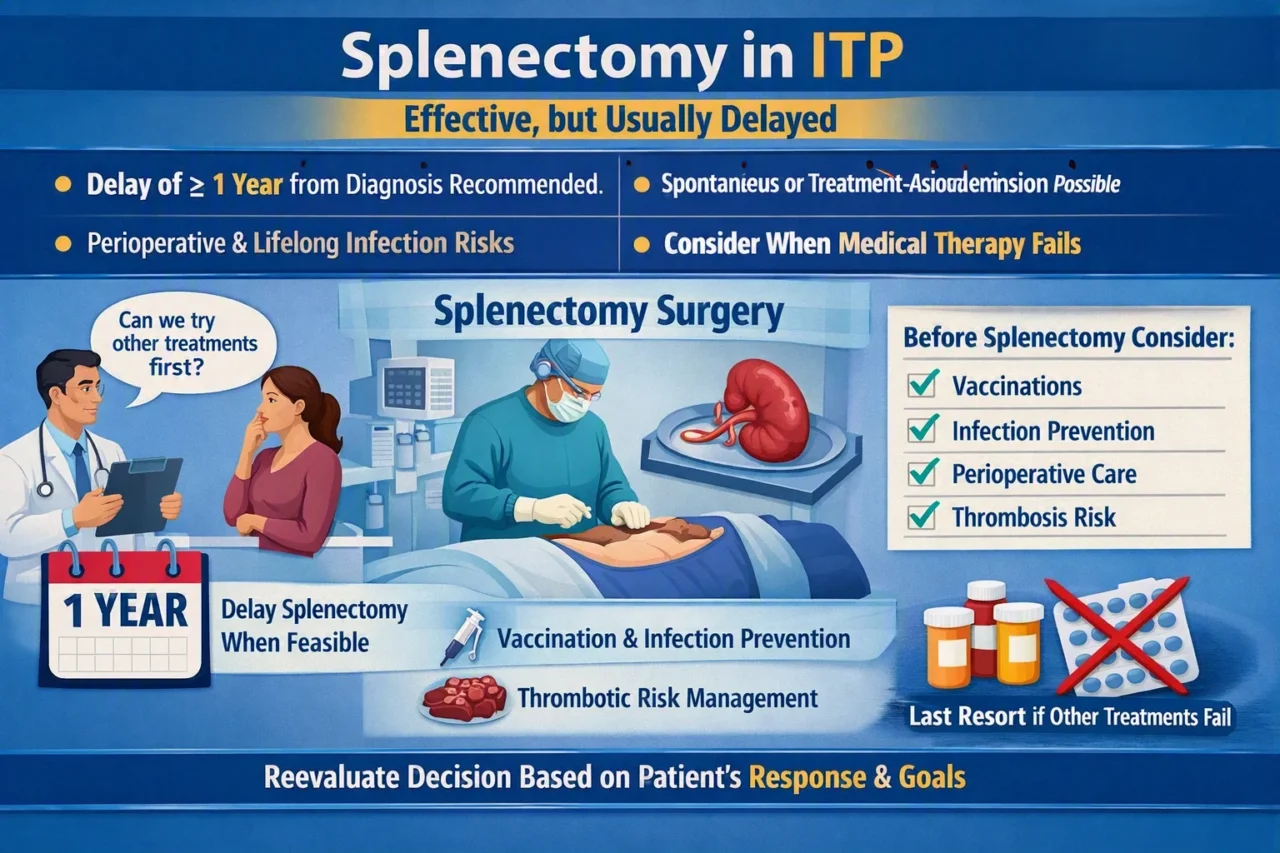
Splenectomy remains a potentially durable treatment for selected patients with ITP, but the updated guidance supports delaying it when feasible, particularly early after diagnosis.
A delay of at least 1 year from diagnosis is described in guideline summaries as a reasonable approach when clinically feasible.
The rationale is that some patients achieve spontaneous or treatment-associated remission over time, while splenectomy carries perioperative and lifelong infection risks. Patients may also prefer to defer an irreversible intervention when several effective medical treatments are available.
Before splenectomy, clinicians should address vaccination, infection prevention, perioperative management, and thrombotic risk. The decision should be revisited if medical therapy is ineffective, poorly tolerated, inaccessible, or inconsistent with the patient’s long-term goals.
Emergency management of critical bleeding
The 2026 ASH publication program also includes guidance addressing critical bleeding in adults and children with ITP. This emergency guidance is distinct from the focused adult initial- and second-line-treatment update.
For life-threatening or otherwise critical ITP bleeding, the panel strongly recommends the combined use of high-dose corticosteroids, high-dose IVIG, platelet transfusion, tranexamic acid, and a thrombopoietin-receptor agonist.
These recommendations are strong despite very low or low certainty of evidence because withholding treatment in critical bleeding carries an immediate risk of death or severe morbidity.
The emergency strategy uses complementary mechanisms. Corticosteroids suppress immune-mediated platelet destruction, while IVIG can produce a rapid but temporary increase in platelet count.
Platelet transfusion provides immediate, although often short-lived, hemostatic support. Tranexamic acid reduces fibrinolysis and may help stabilize newly formed clots. A TPO-receptor agonist supports platelet production, although its effect is not immediate.
Critical bleeding requires urgent hematology involvement, intensive monitoring, source control, supportive transfusion care, and management in an appropriate emergency or critical-care setting. The guideline should not be interpreted as support for routine use of all these therapies in patients without critical bleeding.
A practical interpretation for clinicians
A clinically useful interpretation of the ASH 2026 update begins with confirming the diagnosis and assessing bleeding.
Clinicians should exclude pseudothrombocytopenia, review medications, evaluate for secondary causes, and characterize the type and severity of bleeding.
The platelet count should be interpreted together with bleeding symptoms, comorbidities, age, planned procedures, anticoagulant or antiplatelet use, and patient-specific bleeding risk.
Not every patient with a low platelet count requires immediate pharmacologic treatment. Observation may be appropriate in selected patients with no or minimal bleeding and a sufficiently safe platelet count, provided that follow-up and clear return precautions are arranged.
When treatment is indicated, short-course corticosteroids remain an important initial component. Prednisone-based therapy or dexamethasone pulses may be selected according to clinical urgency, comorbidities, prior response, and patient preference. IVIG can be added when a rapid response is needed.
For adults requiring initial therapy, clinicians should discuss either rituximab plus corticosteroids or a thrombopoietic agent plus corticosteroids rather than automatically using corticosteroids alone. The choice should reflect the patient’s bleeding risk, treatment goals, comorbidities, thrombotic risk, infection risk, preferences, and access to care.
After corticosteroid failure, a TPO-receptor agonist is the strongly recommended second-line option, while rituximab remains a conditional alternative. Other therapies, including BTK inhibitors, mycophenolate mofetil, or SYK inhibitors, may be considered according to patient-specific factors and local access.
Throughout treatment, response should be reassessed using bleeding control, platelet trajectory, adverse effects, quality of life, thrombotic risk, treatment burden, and patient preferences. The objective is not necessarily to normalize the platelet count, but to achieve a safe and sustainable level with the least treatment-related harm.
What the update means for practice
The ASH 2026 guideline reflects three broad changes in ITP management.
First, treatment is becoming more individualized. The same platelet count may lead to different decisions in a young patient with no bleeding, an older adult taking anticoagulation, or a patient preparing for urgent surgery.
Second, corticosteroid minimization is now a central therapeutic objective. The guideline’s emphasis on combination treatment acknowledges that repeated steroid exposure can be harmful and that durable disease control may require an additional agent.
Third, the treatment pathway is increasingly personalized and mechanism-based. TPO-receptor agonists, B-cell-directed therapy, BTK inhibition, SYK inhibition, and immunomodulatory approaches provide clinicians with more options, but they also make treatment sequencing and shared decision-making more important.
Remaining uncertainties
Several questions remain incompletely answered. These include which patients benefit most from upfront combination therapy, whether early combination treatment increases treatment-free remission, the optimal duration of TPO-receptor agonist therapy, and how thrombotic risk should be balanced against the need to raise platelet counts.
Further uncertainty concerns the preferred use of emerging agents after failure of established second-line therapies and the adaptation of recommendations for pregnancy, older adults, secondary ITP, malignancy-associated ITP, and autoimmune disease.
The conditional nature of several recommendations is important. It indicates that the evidence does not yet support a single treatment algorithm for all patients and that future clinical trials may change the preferred sequencing of therapies.
Conclusion
The ASH 2026 ITP guideline marks a shift from corticosteroid-centered treatment toward earlier, individualized combination strategies.
For adults with primary ITP who require treatment, rituximab plus corticosteroids or a thrombopoietic agent plus corticosteroids may be considered from the outset, while a thrombopoietic agent is strongly recommended after corticosteroid failure.
For clinicians, the central message is to minimize steroid toxicity, match therapy to bleeding risk and patient priorities, reassess response early, and use the expanding range of medical and surgical options strategically. The guideline provides a framework, but the final treatment decision remains a shared clinical judgment.
Frequently Asked Questions
1. What is the main focus of the ASH 2026 ITP guideline?
It updates initial and second-line treatment recommendations for adults with primary ITP, including combination therapy, thrombopoietic agents, rituximab, treatment switching, and splenectomy.
2. What is the most important change?
ASH conditionally favors rituximab plus corticosteroids or a thrombopoietic agent plus corticosteroids over corticosteroids alone for initial treatment when therapy is required.
3. Are corticosteroids still recommended as first-line treatment?
Yes. Corticosteroids remain central to initial therapy, but prolonged exposure should be avoided. Treatment is generally limited to 6 weeks or less, including tapering.
4. When should a thrombopoietic agent be considered?
ASH strongly recommends a thrombopoietic agent for adults needing additional treatment after corticosteroid failure. It may also be used with corticosteroids as initial combination therapy.
5. What is the role of rituximab?
Rituximab remains an option both as initial combination therapy and as second-line treatment. Infection risk, hepatitis B reactivation, vaccination response, and other safety considerations should be assessed.
6. What if one thrombopoietic agent does not work?
Switching to another thrombopoietic agent is a reasonable option. Lack of response to one agent does not necessarily mean another will be ineffective.
7. Is mycophenolate mofetil preferred as initial therapy?
No. The guideline favors rituximab plus corticosteroids or a thrombopoietic agent plus corticosteroids over mycophenolate mofetil plus corticosteroids.
8. What is the current position on splenectomy?
Splenectomy remains an effective option for selected patients, but ASH recommends delaying it when feasible, particularly for at least 1 year after diagnosis.
9. How is critical bleeding addressed?
For critical bleeding, ASH strongly recommends high-dose corticosteroids, IVIG, platelet transfusion, tranexamic acid, and a thrombopoietin-receptor agonist, alongside urgent specialist care.
10. Is there one treatment algorithm for every patient?
No. Treatment should be individualized according to bleeding risk, comorbidities, thrombosis risk, treatment burden, access, and patient preferences.
Written by Anna Stepanyan, MD
Stay updated with Hemostasis Today.
-
Oct 12, 2026, 21:51Sam Botchey: Orthobiologics Are Advancing but the Evidence Must Keep Pace
-
Oct 12, 2026, 21:50Serum Vitamin D, Platelet Function, and Bleeding in Primary ITP – Platelets Journal
-
Oct 12, 2026, 21:30Nika Samadzadeh Tabrizi: Looking Forward to the PACeS Trial on Anticoagulation for POAF
-
Oct 12, 2026, 21:28Michael Megaly: Does Coronary Ectasia Affect Outcomes in Acute Coronary Syndromes?
-
Oct 12, 2026, 21:25Vitor Borin P. de Souza: Think Twice Before Anticoagulating an Isolated Subsegmental PE
-
Oct 12, 2026, 20:43Jazlyn A Selvasingh: Excited to Share Our Research at AAO-HNSF 2026 in Los Angeles
-
Oct 12, 2026, 20:31Natalia Kovtun: Higher Ferritin Cutoffs Now Define Iron Deficiency
-
Oct 12, 2026, 19:39Edward Loftus: Using Low-Dose Aspirin in Pregnant Women With IBD
-
Oct 12, 2026, 19:32Shruti Sachdeva: Strengthening the Fight against Anemia