


Edward Lee Carter: NOTION-4 – HALT and Clinical Outcomes
Edward Lee Carter, Clinical Pharmacist Practitioner at U.S. Department of Veterans Affairs, shared on LinkedIn:
“A valve can look better on CT without a patient feeling better.
That question is at the center of NOTION-4, a randomized trial of antithrombotic therapy after TAVR in patients without another indication for oral anticoagulation.
Researchers compared single antiplatelet therapy (SAPT) with a DOAC for 3 months, followed by SAPT.
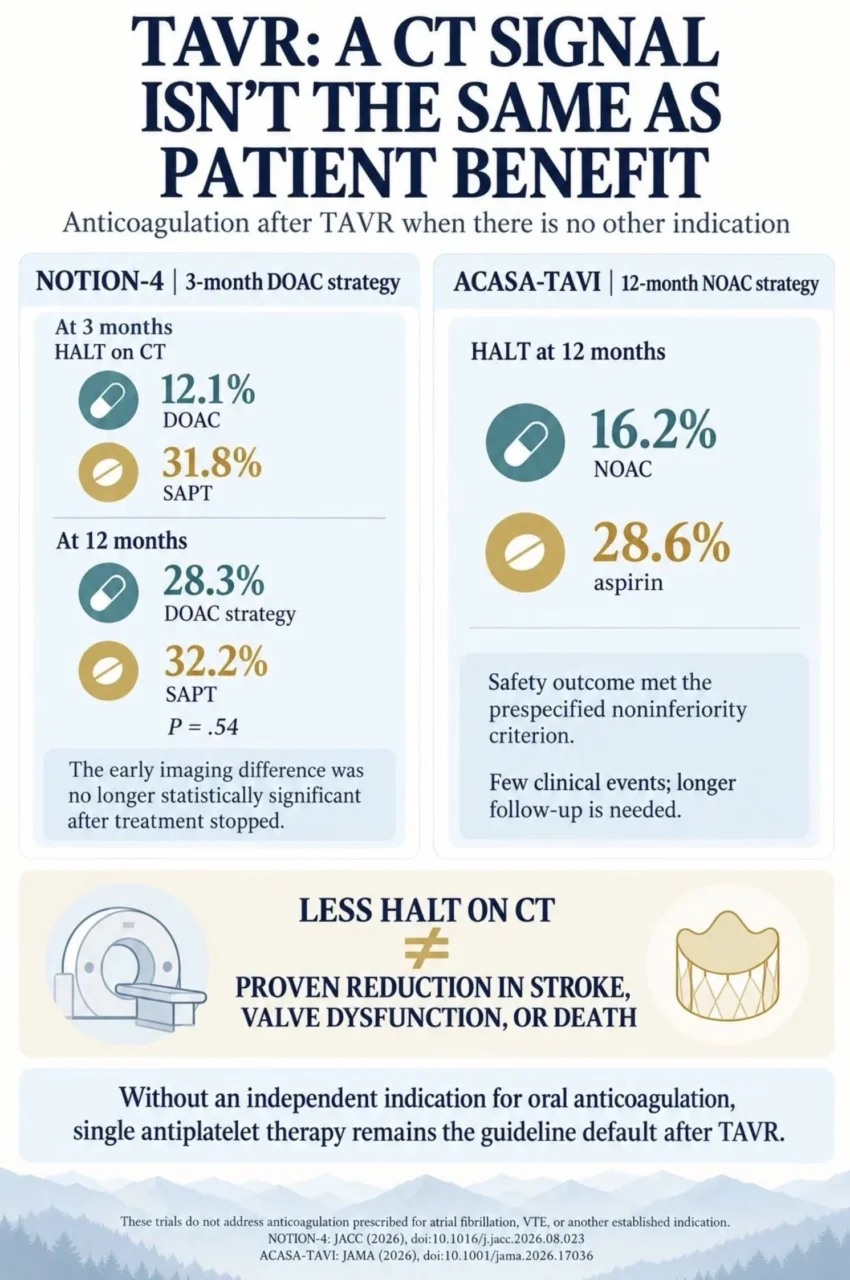
At 3 months, hypoattenuated leaflet thickening (HALT)—a CT finding associated with subclinical leaflet thrombosis-was seen in 12.1% of the DOAC group versus 31.8% with SAPT.
The primary endpoint was HALT at 12 months. By then, 9 months after the DOAC had stopped, rates were 28.3% versus 32.2% (P equal to .54).
The early imaging difference was no longer statistically significant.
The trial did not establish that reducing HALT improves stroke risk, valve function, or survival.
At 12 months, the composite of death, stroke, or major/life-threatening bleeding occurred in 8.2% with the DOAC strategy versus 2.3% with SAPT.
This difference favored SAPT, but the trial was small and event numbers were limited.
It is a safety signal to consider-not a precise estimate of harm or proof about any individual outcome.
A separate trial, ACASA-TAVI, tested 12 months of DOAC monotherapy and also found less HALT at one year (16.2% vs 28.6%).
Its composite safety outcome met the prespecified noninferiority criterion.
These were separate trials with different designs and treatment durations, so we cannot conclude that duration explains their different results.
Neither trial shows that less HALT leads to better long-term outcomes for patients.
The clinical question is specific: should anticoagulation be added solely to prevent a CT finding in someone with no other indication?
Current guidelines favor single antiplatelet therapy after TAVR in that setting.
This does not challenge anticoagulation for atrial fibrillation when indicated by stroke risk, VTE, or another established reason.
Those decisions rest on the independent indication-not CT appearance alone.
A useful medication-stewardship reminder: a surrogate can respond to treatment without proving that the patient benefits.
How should future TAVR studies connect imaging findings with outcomes that matter to patients-stroke, bleeding, valve function, and survival?
The views expressed are my own and do not represent the Department of Veterans Affairs.”
Stay updated with Hemostasis Today.
-
Oct 4, 2026, 15:06Vasiliki Gkalea: Journal of Clinical Medicine Launches Special Issue on Hematologic Thrombosis and Bleeding
-
Oct 4, 2026, 14:55Quentin Brebant: What Defines a High-Quality Red Blood Cell Concentrate?
-
Oct 4, 2026, 14:47Rana Al-Hrout: Recognizing Non-Anemic Iron Deficiency – Why Iron Matters Beyond Hemoglobin
-
Oct 4, 2026, 14:41David McIntosh: International Plasma Awareness Week 2026 – Closing the Global Plasma Gap
-
Oct 4, 2026, 14:33Pete Stibbs: CleanerVac Real-World Study Presented at VIVA and The VEINS 2026
-
Oct 4, 2026, 13:56Maria Elisa Mancuso: EHC 2026 Highlights the Unmet Needs of Women with Bleeding Disorders
-
Oct 4, 2026, 13:53Nirmal Shaji George: Individualizing Anticoagulation in Complex APS and Thrombocytopenia
-
Oct 4, 2026, 13:5210 Posts Not to Miss This Week
-
Oct 4, 2026, 13:45Suswapna Singh Rawat: The Clinical Significance of Coronary Plaque Stability