

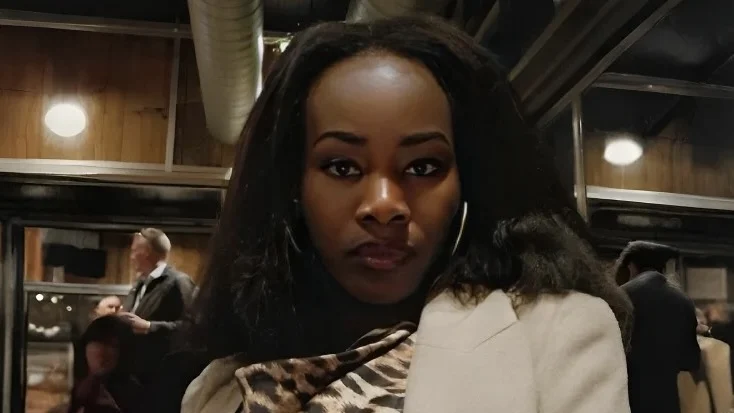
Ifeanyichukwu Ifechidere: The Overlooked Diagnosis of VWD in Young Girls With Menorrhagia
Ifeanyichukwu Ifechidere, Specialist Biomedical Scientist at Sheffield Teaching Hospitals NHS Foundation Trust, shared a post on LinkedIn:
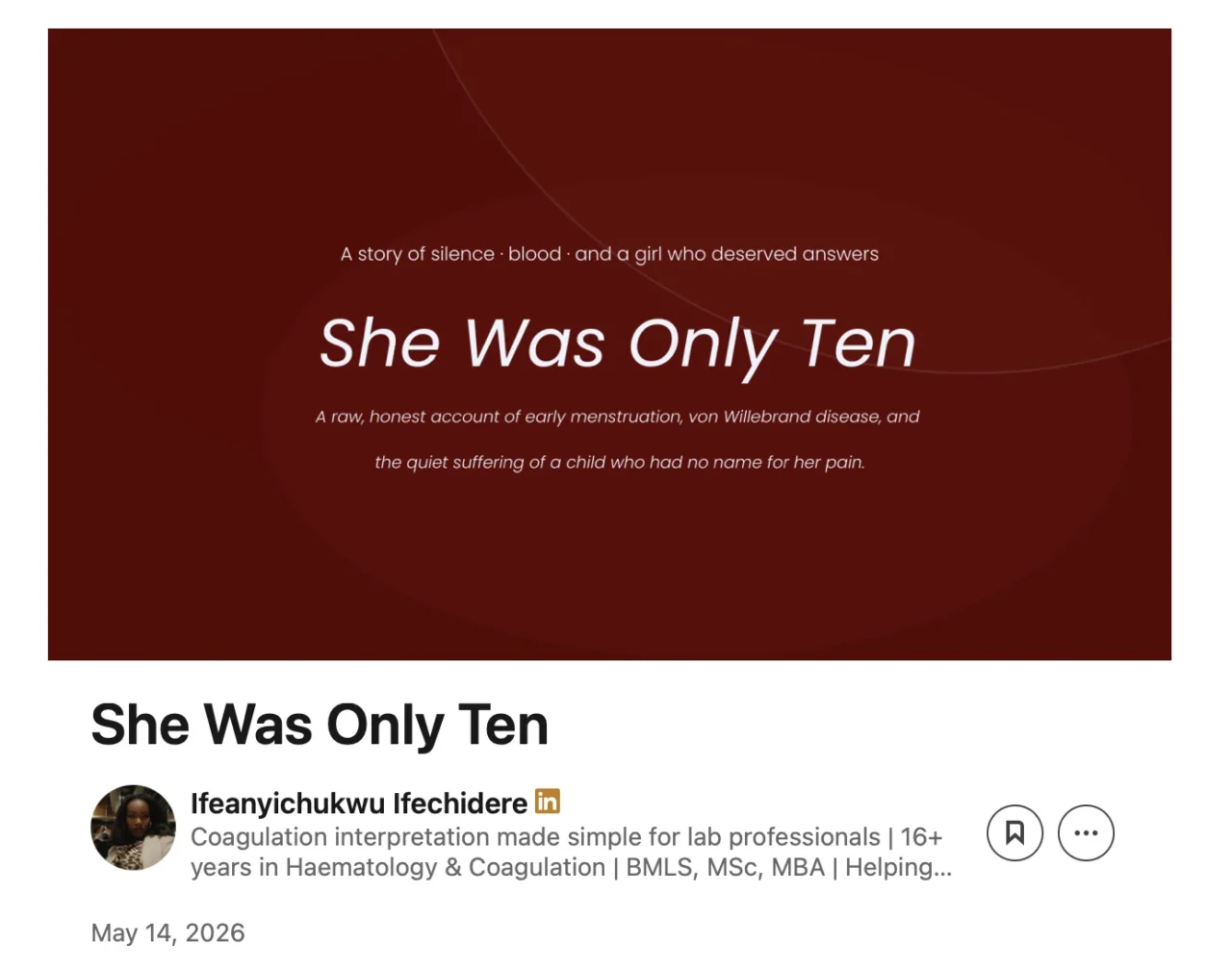
“This story takes us deep into the challenging life of a young girl with early menstruation and Von Willebrand Disease.
‘She thought she was dying. She was not. But no one had told her there was a name for what was happening to her body.’
The Morning Everything Changed
Ada was ten years old when she woke up to find blood on her sheets. It was a Tuesday in October — she remembers because there was a test at school she had been preparing for all week.
She stood in the pale morning light of the bathroom, staring at the dark red stain on her pyjamas, her heart hammering against her small ribs. She did not understand what it was. She thought she had been hurt in the night.
She was not hurt. Her body had simply begun something it was not supposed to begin this soon – not at ten, not while she still played with the neighbourhood children after school, not while she was still figuring out long division and losing her milk teeth.
But biology does not wait for permission. Menarche — a girl’s first menstrual period — had arrived years before anyone expected it.
Her mother wrapped her in a hug and told her gently that she had become a woman. She did not feel like a woman. She felt frightened, and very small.
More Blood Than There Should Be
Most girls who experience early menstruation — a condition called precocious or early puberty — can eventually adjust. The body settles. The cycles, while overwhelming at first, find a rhythm.
But Ada’s body did not settle. From the very first month, something was different. The bleeding was not just heavy. It was relentless.
She would soak through a pad within an hour. She passed clots the size of her small palm. She bled through her school uniform on a day she was presenting a project on the solar system — she had worked on it for two weeks.
She sat at the back of the class, frozen, feeling the warm spread of blood beneath her and counting the minutes until the bell rang. That presentation she never gave.
‘She counted the minutes until the bell rang. That presentation she never gave.’
Her mother changed her sheets almost every night that first month. Buckets of cold water and salt became a nightly ritual. Ada watched the water turn the colour of rust and wondered, quietly, if something was deeply wrong with her.
She asked her mother once. Her mother told her some girls just bleed more. She tried to believe it.
The Tiredness Nobody Saw
By her third cycle, Ada was exhausted in a way that a ten-year-old should never be exhausted. She fell asleep during class. She stopped raising her hand — not because she did not know the answers, but because lifting her arm felt like lifting stone.
Her teacher noted in her report that Ada seemed ‘withdrawn and inattentive.’ What the teacher could not see was that Ada’s haemoglobin was quietly falling, that her iron stores were being drained month after month with every flood of blood, that her body was consuming itself.
She had developed iron-deficiency anaemia — a common and devastating consequence of chronic, uncontrolled menstrual blood loss. Her lips were pale. Her nails, once pink and healthy, turned concave and brittle.
She would stand up too fast and the world would tilt sideways, forcing her to grip the nearest wall. Her mother bought her vitamins. They helped a little. But they could not stop the source.
No one had yet asked the right question.
The Name Nobody Gave Her
It was a nurse at a follow-up clinic — a quiet woman with reading glasses and careful hands — who finally paused during an examination and said: ‘Has anyone ever tested this child for a bleeding disorder?’
No one had.
The blood tests came back weeks later. Ada sat beside her mother in a doctor’s office that smelled of antiseptic and paper files, swinging her legs because she was still small enough that her feet did not reach the floor. The doctor said the words carefully: von Willebrand disease.
Ada did not know what that meant. She looked at her mother, who was very still in her chair.
Understanding von Willebrand Disease
Von Willebrand disease (VWD) is the most common inherited bleeding disorder, affecting an estimated 1% of the global population — though many remain undiagnosed.
It occurs when the blood is missing or has reduced levels of von Willebrand factor — a protein essential for normal clotting.
In girls and women, the most visible symptom is often heavy menstrual bleeding (menorrhagia), which can be mistaken for ‘normal’ variation for years.
When combined with early menstruation, the consequences — anaemia, fatigue, school absenteeism, and psychological distress — can be severe.
VWD is frequently missed because healthcare providers do not routinely screen for bleeding disorders when a young girl presents with heavy periods.
With accurate diagnosis and proper management, girls with VWD can lead full, active lives. The tragedy lies in the years lost before they receive that diagnosis.
The World She Began to Shrink
After the diagnosis, Ada understood why her body did what it did. But understanding did not take away the fear. If anything, it sharpened it. Because now she knew it had a name, and it was real, and it was going to come back. Every month. Reliably. Brutally.
She began to plan her life around her cycle in the way that soldiers plan around the weather — avoiding exposure, calculating risk. She checked the calendar obsessively. She stopped going to birthday parties in the week before her period was due.
She quit the school netball team because she could not bear the thought of bleeding through her sports kit in front of her teammates. She started refusing invitations, making excuses, pulling back from the ordinary business of being a child.
‘She began to plan her life around her cycle the way soldiers plan around the weather — avoiding exposure, calculating risk.’
She packed emergency supplies in her school bag: extra pads, extra underwear, dark trousers. She sat near the door in class so she could leave quickly without being watched.
She learned to read her own body for warning signs — the low cramping ache that meant it was beginning, the particular heaviness that meant she needed to move, now, before it was too late.
She was ten, and then eleven, carrying the knowledge and the logistics and the fear that many grown women carry — except she carried it without years of preparation, without the slow accumulation of coping strategies, without anyone around her who truly understood what her body was doing to her.
What School Looked Like
In her first year of secondary school, Ada missed fourteen days of classes.
Not because she was lazy. Not because she did not love learning — she had always loved learning, had always been the girl with her hand up, with questions at the end of lessons, with books borrowed from the library and returned with careful pencil annotations.
She missed school because on certain days the bleeding was so heavy and the pain so consuming that she could not sit upright for long periods, could not walk the distance from her home to the school gate without stopping to breathe through cramps that clenched her abdomen like a fist.
Her teachers received absence notes. Some were understanding. Others were not. One told her mother, in a parent-teacher meeting, that Ada needed to ‘push through’ and that ‘girls manage.’
Her mother did not know how to explain, in that fluorescent-lit office, what ‘managing’ looked like when your daughter’s blood does not clot correctly. She smiled tightly and said she would see what she could do.
On the days Ada was present, she was often operating on a haemoglobin level that would have concerned a physician. She was running on empty in the most literal possible sense — her red blood cells depleted, her body short of the oxygen that makes thinking clear and limbs strong.
And yet she sat in those classrooms, trying to concentrate on algebra, trying to be a normal child, trying not to let anyone see the cost.
The Invisible Weight
What is rarely spoken about — in clinical waiting rooms, in healthcare pamphlets, in conversations between mothers — is what heavy bleeding does to a child’s sense of self.
The shame is corrosive and silent. It attaches to the body early, before a girl has the language or the emotional scaffolding to resist it.
Ada hated her body for years. She hated it for being unpredictable and excessive and embarrassing. She hated it for making her different at an age when nothing is more important than sameness.
She hated the way it announced itself without warning, the way it refused to be managed, the way it had taken away her netball team and her birthday parties and her unselfconscious joy in moving through the world.
She did not tell her friends what she was experiencing. How do you explain to an eleven-year-old girl, whose own period has not yet arrived, that yours floods through overnight pads and clots and leaves you pale and shaking? You do not. You smile and say you have a headache and stay home again.
‘Shame is the shadow that heavy bleeding casts on a child long before she has the language to name it.’
The Long Road to Being Seen
It took nearly a year from Ada’s first period for anyone to think to look for a bleeding disorder. A year is a long time when you are ten. It is months of school missed, iron lost, confidence quietly eroded.
It is the difference between a child who believes her body is something to be trusted and one who has learned, at an age when that trust is forming, to be afraid of it.
Ada’s story is not unusual. Studies suggest that girls with von Willebrand disease wait an average of several years before receiving a correct diagnosis.
In many parts of the world — particularly in resource-limited settings — that wait is longer still, or the diagnosis never comes at all. Girls are told they are ‘just heavy bleeders.’
Women are told it is ‘hormonal.’ The question of why the blood does not clot, of whether there is an underlying condition, is not always asked.
This silence has a cost. The cost is measured in school days and sports days and iron transfusions and anaemia-related developmental consequences. It is measured in girls who grow into women who have never known what it is to move through a month without bracing for the flood.
What Ada Needed — And What Every Girl Like Her Needs
Ada eventually received treatment. A specialist in haematology discussed options with her family — including medications that could help stabilise her von Willebrand factor during her period, reducing the severity of bleeding.
She was given iron supplementation and monitored regularly. The school was contacted. Reasonable accommodations were made.
It helped. Significantly. The periods remained heavy — they likely always will be — but they became manageable in a way they had never been before. She rejoined a sports team at thirteen. Small thing. Everything thing.
But what Ada needed, more than medication — what she needed from the very beginning — was for someone to take her seriously.
For a clinician to see a ten-year-old with heavy periods and ask not just ‘is this normal for her?’ but ‘could something else be happening?’ For the adults around her to understand that excessive menstrual bleeding in a child is not something to normalise.
It is a symptom. It is a signal. It asks to be investigated.
This Is a Call to See Her
There are girls like Ada in every school, in every neighbourhood, in every clinic waiting room. They are sitting quietly, managing what they have been told is simply the way things are. They are pale and tired and shrinking their worlds to match their bodies’ limits.
They do not need to be.
If you are a parent: heavy periods in a young girl are not always ‘just genetics.’ Ask the question. Seek a haematology referral. Advocate loudly.
If you are a healthcare provider: every adolescent presenting with menorrhagia deserves a structured bleeding history and consideration of an underlying bleeding disorder. VWD is common. It is diagnosable. It is treatable.
If you are an educator: a child who misses school around the same days every month may not be avoiding class. She may be in pain, in shame, and in need of your compassion and practical support — not your scepticism.
And if you are a girl like Ada, reading this and recognising yourself in these words: you are not dramatic. You are not weak. Your pain is real, and it has a name, and there are people who can help you carry it.
Ada is a composite character — her story drawn from the real, documented experiences of girls and women living with von Willebrand disease and early menstruation worldwide. Her pain is not fiction. Only her name is.
Written in the spirit of awareness, compassion, and the right of every girl to be fully seen by medicine. Because silence is not the same as strength.”
Other posts featuring Ifeanyichukwu Ifechidere on Hemostasis Today.
-
Oct 5, 2026, 15:31Irma Bagdoniene: Multidisciplinary Management of High-Risk Familial Hypercholesterolaemia and CAD
-
Oct 5, 2026, 15:00Serena Williams and Pulmonary Embolism: From Personal Crisis to Lessons in Venous Thromboembolism
-
Oct 5, 2026, 14:55Marco Moscarelli: 3D Reconstruction Enhances Volumetric Assessment of Post-TAVI Thrombosis
-
Oct 5, 2026, 13:24Abdul Muqtadir Abbasi: Diagnostic Pearls for Evaluating Isolated Thrombocytopenia in Residents
-
Oct 5, 2026, 13:16Katerina Pavenski: Rethinking What ‘Normal’ Means for Iron Deficiency
-
Oct 5, 2026, 13:09Rick Matthews: Balancing Established VTE Partnerships with Innovative Interventional Technologies
-
Oct 5, 2026, 13:01Nawsherwan Mohammad: Recognizing TTP Before the ADAMTS13 Result Arrives
-
Oct 5, 2026, 12:51Bruno Pougault: The Hidden Challenges Behind Anti Xa Testing
-
Oct 5, 2026, 12:41Syed Huzaifa Khan: Rethinking CTRP12 as a Biomarker for In Stent Restenosis