


Ifeanyichukwu Ifechidere: DOACs Are Not the Answer to Every Anticoagulation Question
Ifeanyichukwu Ifechidere, Specialist Biomedical Scientist at Sheffield Teaching Hospitals, shared a post on LinkedIn:
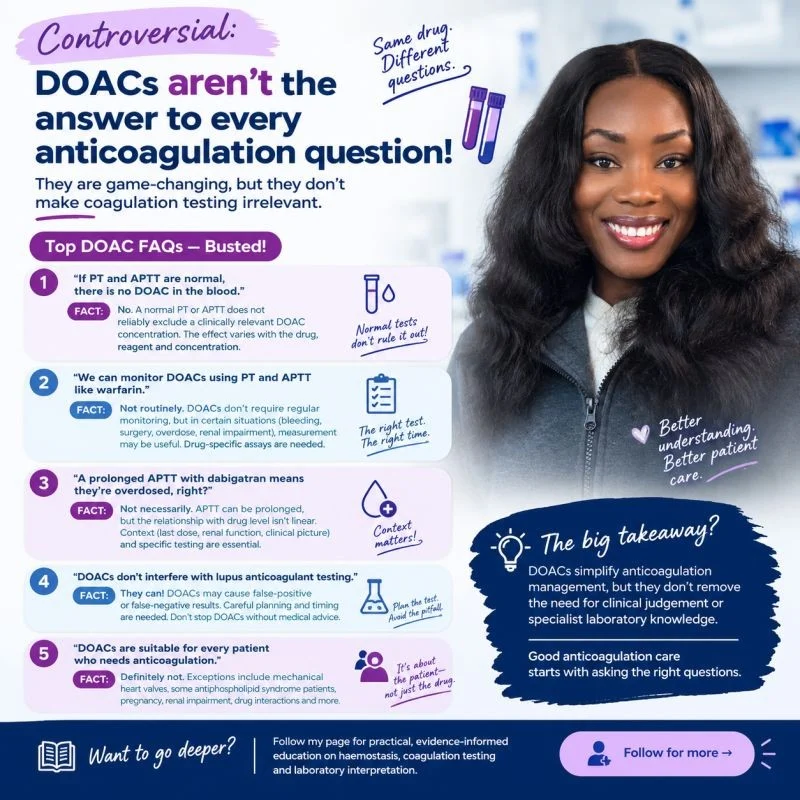
“Controversial: DOACs are Not the answer to every anticoagulation question. And they don’t make coagulation testing irrelevant!
Direct oral anticoagulants (DOACs) have transformed anticoagulation management. But how much do we really understand about their effects on coagulation tests?
Let’s clear up 5 common misconceptions.
1.Normal PT and APTT mean there is no DOAC in the blood.
False!
Normal PT or APTT does not reliably exclude clinically relevant DOAC levels.
The effect depends on the drug, concentration and laboratory reagent.
Remember: Routine coagulation tests cannot reliably rule out DOAC presence.
2. Can we monitor DOACs like warfarin using PT and APTT?
Not routinely!
DOACs generally don’t require routine coagulation monitoring. However, testing may be useful in situations such as major bleeding, urgent surgery, suspected overdose or impaired drug clearance.
Drug-calibrated anti-Xa assays can measure apixaban or rivaroxaban. Dabigatran may be assessed using specialised tests such as dilute thrombin time or ecarin-based assays.
3. A prolonged APTT in a patient taking dabigatran means overdose.
Not necessarily!
Dabigatran can prolong APTT, but the relationship between APTT and drug concentration is not linear. A prolonged result alone cannot establish overdose or accurately quantify the drug level.
Consider the last dose, renal function, clinical presentation and appropriate drug-specific testing.
4. DOACs can interfere with lupus anticoagulant testing?
Absolutely!
DOACs can interfere with phospholipid-dependent assays, potentially producing false-positive or false-negative results.
This can complicate investigations for antiphospholipid syndrome.
Testing must be carefully planned with the laboratory and clinical team. Patients should never stop anticoagulation without appropriate medical advice.
5. DOACs are suitable for everyone who needs anticoagulation.
Definitely Not!
DOACs are not recommended for patients with mechanical heart valves. They may also be unsuitable for certain patients with antiphospholipid syndrome, particularly those with high-risk profiles.
Pregnancy, renal function, drug interactions and the indication for anticoagulation also matter.
The big takeaway
DOACs may simplify anticoagulation management, but they don’t eliminate the need for sound clinical judgement or specialist laboratory knowledge.
For biomedical scientists, understanding DOAC interference is essential when interpreting unexpected results.
For clinicians, knowing the limitations of routine tests helps prevent false reassurance and inappropriate conclusions.
Get access to my live course on anticoagulation interference for more understanding on DOACs intereferences.”
More posts featuring Ifeanyichukwu Ifechidere on Hemostasis Today.
-
Oct 20, 2026, 04:04Sadia Kamal: Honored to Receive the Outstanding Abstract Award at the 20th Midwest Platelet Conference
-
Oct 20, 2026, 04:03Yu-Hsuan Chen: One Antibody, Two Diseases from FcRn Biology to Clinical Translation
-
Oct 20, 2026, 03:49Domenico Simone Castiello: Rethinking Prolonged DAPT in Multivessel PCI – Insights from the DAPT-MVD Trial
-
Oct 20, 2026, 03:37Rucha Patil: Scaling POC Diagnostics for Haemophilia A and VWD Across India
-
Oct 20, 2026, 03:31Zena Vexler: Targeting Neutrophil Elastase and NETosis to Mitigate Infection-Triggered Childhood Stroke
-
Oct 20, 2026, 03:24Chaza Alaji: Diagnosing Protein C and Protein S Deficiency
-
Oct 20, 2026, 03:24Mou Nandi: How Maternal Health During Pregnancy May Shape Infant Development
-
Oct 20, 2026, 03:13Sumyea Kabir: Pre-Analytical Quality in Phlebotomy – Preventing In Vitro Hemolysis
-
Oct 20, 2026, 02:37M. Sekip Altunkan: Can Anticoagulation Be Safely Stopped After AF Ablation?