


Markus Müller: ABO Blood Groups and the Rare Bombay Phenotype
Markus Müller, President (Rector) at University of Vienna, Member of the Board of Trustees at Austrian National Library, President of the Supreme Medical Council at Federal Ministry of Labour, Social Affairs, Health, Care and Consumer Protection, Chairman of the Supervisory Board at University Hospital AKH Vienna, shared a post on LinkedIn:
“Blood type A, B, AB, or 0. Actually quite simple, right?
Recently, we Biomedical Sciences students from the Faculty of Life Sciences at Hochschule Reutlingen visited our laboratory with Jeannette Hübener-Schmid.
With a tour of the lab, I was hopefully able to provide a brief overview of what is important when working in a clinical laboratory.
We are fortunate to offer and showcase all areas of laboratory medicine, from clinical chemistry and immunology to microbiology, hematology, coagulation, and transfusion medicine.
In addition to these brief insights into our daily work, the students were also able to gain a practical insight into blood group determination themselves.
Everyone probably knows blood types A, B, AB, and O. But how do these actually arise?
The basis is the so-called H-antigen, in whose formation the sugar fucose plays a crucial role.
In blood group A, N-acetylgalactosamine is added, and in blood group B, galactose is added. Both antigens occur in AB. In blood group O, the H antigen remains unchanged.
The rare Bombay phenotype is particularly interesting. These people lack the H-antigen on their erythrocytes.
For simple blood group determination, they may therefore initially appear as blood type 0.
The crucial difference, however, is that they can produce anti-H antibodies.
Therefore, even normal erythrocyte concentrates of blood group 0 are intolerable.
People with the classic Bombay phenotype require erythrocyte concentrates from donors with the same rare phenotype.
A good example that immunohematology is actually a bit more complicated than you might initially think.
I always enjoy giving insight into our diverse work in laboratory medicine, and of course, I am also pleased to see how the Kreiskliniken Reutlingen gGmbH and the Hochschule Reutlingen support and complement each other.”
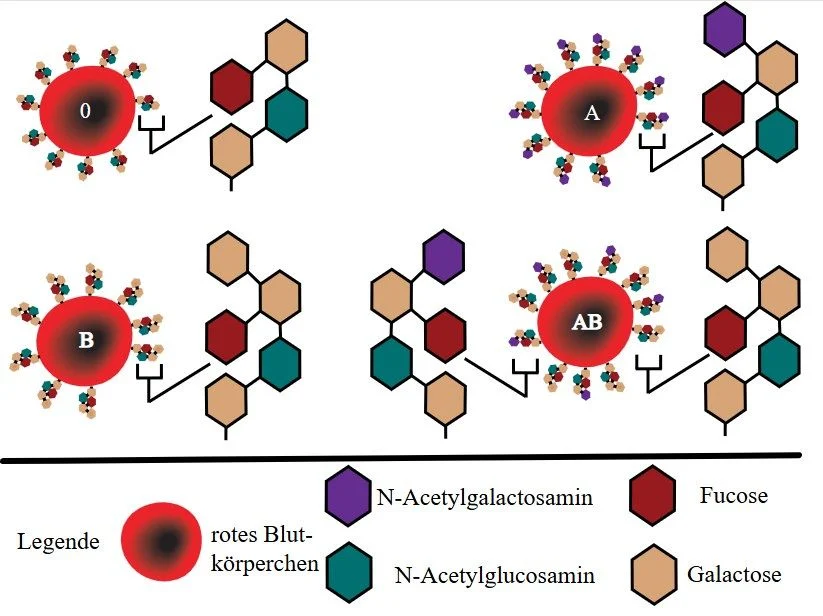
Image source: InvictaHOG / Matt, Wikimedia Commons, public domain.
See more in the gallery.
Stay updated with Hemostasis Today.
-
Nov 20, 2026, 05:57Lance Reed: Specialized Blood Components and Clinical Samples for Research and Diagnostics
-
Nov 20, 2026, 05:41Sundas Anjum: Community Engagement and Blood Donation for Thalassemia Care
-
Nov 20, 2026, 05:24A Celebration of Unity and Dedication in Hemophilia Care – Hemophilia Society Mumbai Chapter
-
Nov 20, 2026, 05:09Farhad Sheikh: Prasugrel vs Ticagrelor in Acute Coronary Syndromes
-
Nov 20, 2026, 05:02Jason Acker: Appointed as the Next Editor-in-Chief of Vox Sanguinis
-
Nov 20, 2026, 04:58Sabri Kemahli: International Society of Hematology Celebrates 80 Years of Hematology with Special Webinar
-
Nov 20, 2026, 04:46Alessandra Bosch: Swiss Haemophilia Network Wins Research Grant
-
Nov 20, 2026, 04:41Courtney Lawrence: HLA Antibodies and Platelet Transfusion Refractoriness in Hispanic Patients
-
Nov 20, 2026, 04:24Kamand Haeri: Platelet Function Testing by Flow Cytometry in Patients with BDUC at SOHC 2026