


Pablo César Spada: Prevention of Venous Thromboembolism After Total Hip or Knee Replacement
Pablo César Spada, Head of Cardiology at Morón Municipal Hospital, shared a post on LinkedIn:
“Prevention of Venous Thromboembolism After Total Hip or Knee Replacement
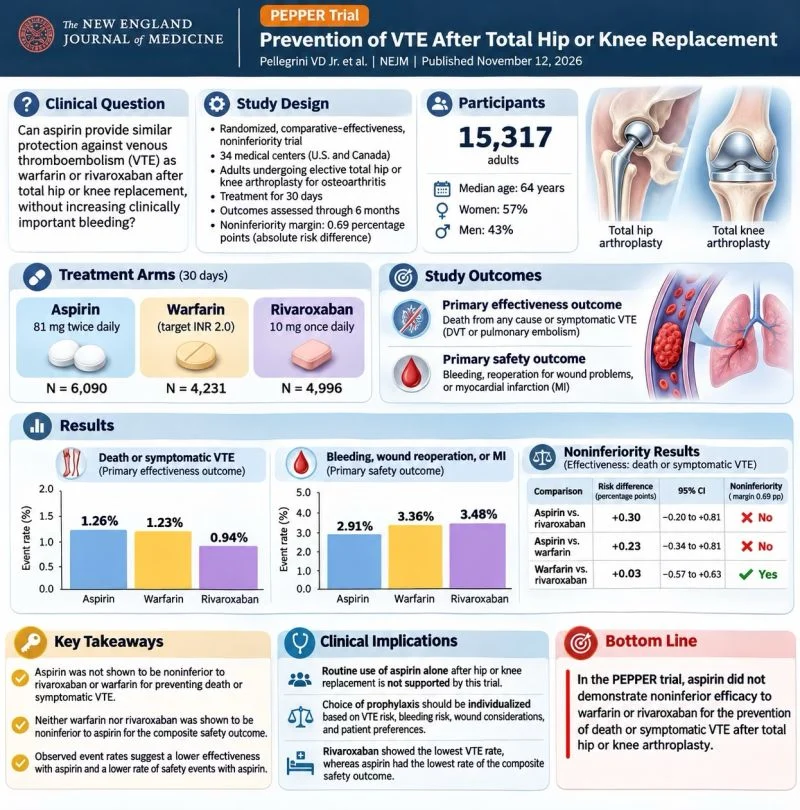
Pellegrini VD Jr. et al. | NEJM | November 12, 2026
This is a large, randomized, comparative-effectiveness trial evaluating three strategies for preventing venous thromboembolism (VTE) after elective total hip or knee arthroplasty.
The central clinical question is:
Can aspirin provide similar protection against postoperative VTE as warfarin or rivaroxaban, without increasing clinically important bleeding?
Why is this trial important?
Total hip and knee replacement are associated with an increased risk of deep vein thrombosis (DVT) and pulmonary embolism (PE).
Pharmacological thromboprophylaxis is standard practice, but the optimal agent remains controversial.
- Aspirin: inexpensive, convenient, and generally associated with a low bleeding risk.
- Warfarin: effective anticoagulant, but requires INR monitoring and dose adjustments.
- Rivaroxaban: direct factor Xa inhibitor with predictable anticoagulation and no routine INR monitoring.
Previous comparisons have produced conflicting results, particularly regarding the effectiveness of aspirin.
Clinical interpretation
The PEPPER trial suggests that aspirin cannot be assumed to provide equivalent effectiveness to anticoagulants after hip or knee replacement.
However, the absolute differences were small, and the safety findings favor careful individualization.
For clinical practice, I would emphasize three points:
Rivaroxaban had the lowest observed rate of the effectiveness endpoint.
Aspirin had the lowest observed rate of the composite safety endpoint.
Selection should consider baseline VTE risk, bleeding risk, wound complications, and patient characteristics.
One important limitation is that the safety composite is broader than major bleeding alone. Therefore, its results should not be interpreted as major bleeding rates.
PEPPER does not establish aspirin as noninferior to rivaroxaban or warfarin for preventing death or symptomatic VTE after hip or knee arthroplasty.
Conversely, neither anticoagulant demonstrated noninferiority to aspirin for the composite safety outcome.
For a cardiology journal club, the most interesting question is whether an absolute difference of approximately 0.3 percentage points in effectiveness justifies routine anticoagulation when safety events may increase.”
Stay updated with Hemostasis Today.
-
Nov 15, 2026, 23:30Eshal Amir: Factor XI Inhibitors in AFib and Aortic Mortality Trends
-
Nov 15, 2026, 23:19Hamza Bashir: Adding Endovascular Therapy to Anticoagulation Cuts Moderate-to-Severe PTS in Half
-
Nov 15, 2026, 23:06Lanre Tunji-Ajayi: 2 Days of Deliberative Dialogue Hosted by the Network of Rare Blood Disorder Organizations
-
Nov 15, 2026, 23:00Fanny Delettre: Looking Back at Volunteer Blood Donor Friends Day
-
Nov 15, 2026, 20:56Victoria Adedoyin Adisa-Thomas: What I Learned About SCD During My Genetic Counselling Rotation
-
Nov 15, 2026, 20:55Martin Holst Lange: One Step Closer to a Potential New Treatment for Sickle Cell Disease
-
Nov 15, 2026, 20:53Bontha Babu: Health-Related Quality of Life Among Adults with Sickle Cell Disease in India
-
Nov 15, 2026, 20:52Miguel Ángel Herrera Rojas: A First-Line ITP Approach Presented at ASH in 2013 Now Reflected in the 2026 Guidelines
-
Nov 15, 2026, 20:50Asmaa Beltagy: Efficacy and Safety of Eltrombopag in SLE-Associated Immune Thrombocytopenia