


Sandra Revill Tremulis: The Lp(a)HORIZON Topline Results Raise Important Questions Beyond Simply ‘Does Lowering Lp(a) Work?’
Sandra Revill Tremulis, Marketing Consultant at Tremulis Stractical Marketing Consulting and Founder of the Lipoprotein(a) Foundation, shared a post on LinkedIn:
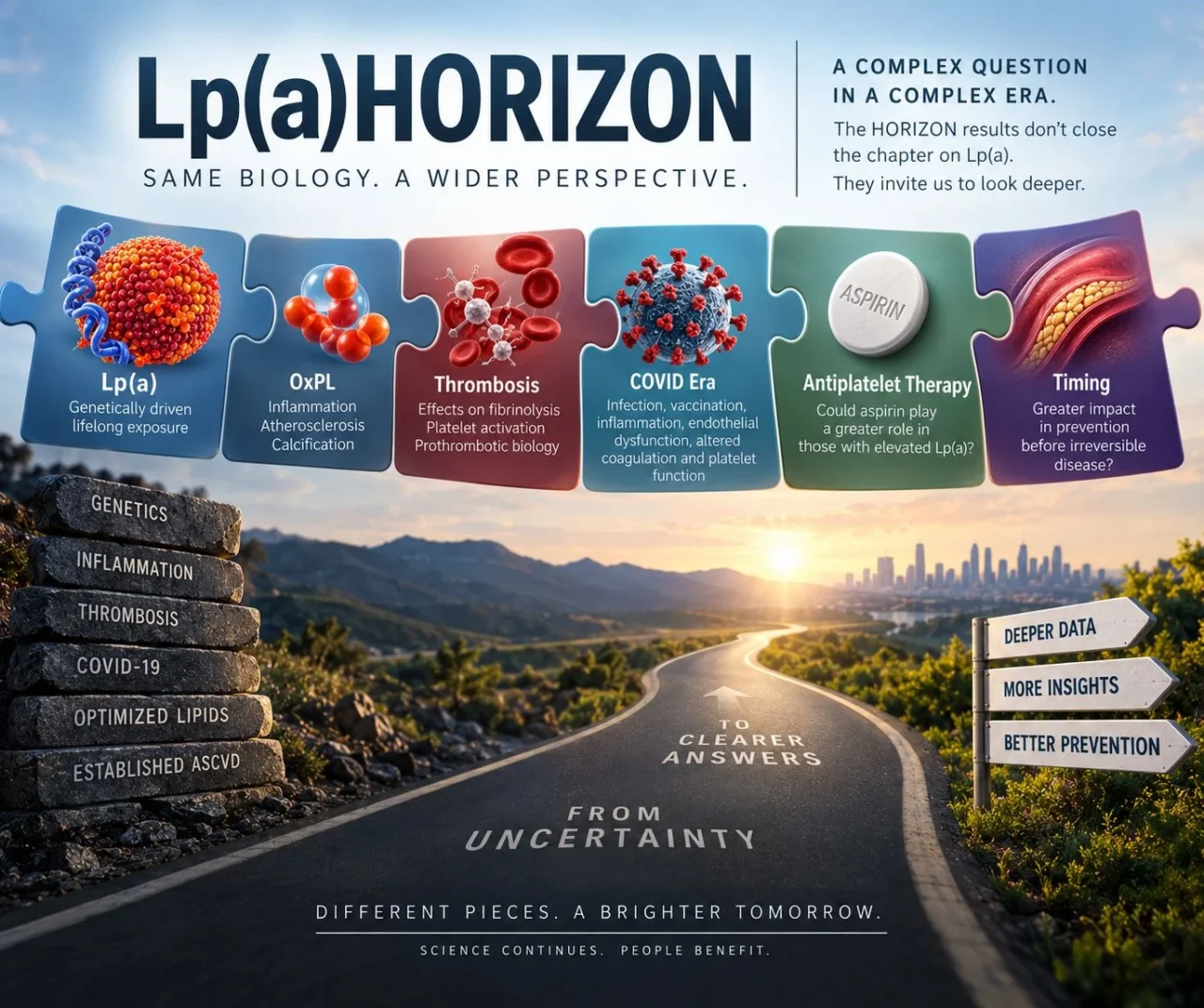
“The Lp(a)HORIZON topline results raise important questions beyond simply ‘Does lowering Lp(a) work?’
HORIZON began in December 2019 and was conducted largely during the COVID era – an extraordinary period of infection, reinfection, vaccination and changes in cardiovascular care.
That matters because Lp(a) biology extends beyond cholesterol. Lp(a) carries oxidized phospholipids (OxPL) and has potential pro-inflammatory, pro-atherogenic and prothrombotic effects, including possible effects on fibrinolysis and platelet activity.
COVID infection also affects endothelial function, inflammation, coagulation and platelet activation. Importantly, platelet count and platelet function are not the same thing: mild reductions in platelet count do not necessarily mean reduced thrombotic activity.
This makes the full HORIZON dataset particularly interesting.
Could outcomes have differed according to COVID history, platelet measures, aspirin/antiplatelet use, inflammatory status or OxPL burden?
Vaccination status is also worth examining as part of the COVID-era dataset – not because there is evidence it affected the HORIZON result, but because potential confounders deserve appropriate analysis.
And then there is aspirin.
Previous studies have suggested that individuals with elevated Lp(a) may derive greater cardiovascular benefit from aspirin, potentially providing another clue to Lp(a)’s thrombotic biology.
Perhaps HORIZON is asking us to look beyond one number.
How early should we lower Lp(a)?
How important is OxPL?
And how much of Lp(a)-associated risk is atherosclerotic versus inflammatory and thrombotic?
A negative primary endpoint doesn’t necessarily end the Lp(a) hypothesis.
It may tell us we need to ask better questions.”
Stay updated with Hemostasis Today.
-
Oct 16, 2026, 17:32Shruthi Narayan: STORM-PE and STRIKE-PE Studies Advance Understanding of Recovery After Pulmonary Embolism
-
Oct 16, 2026, 17:22Wolfgang Miesbach։ What a Near-Perfect FISH Score Fails to See
-
Oct 16, 2026, 17:06Troels Wienecke: Connecting Myeloproliferative Disease and Ischemic Stroke
-
Oct 16, 2026, 17:03Only 5 Days Left to Submit Your Research for EAHAD 2027
-
Oct 16, 2026, 16:48Abdul Rahman: Reticulocyte Count and Bone Marrow Activity
-
Oct 16, 2026, 16:44DOAC Adherence in Stroke Patients With Atrial Fibrillation – International Journal of Stroke
-
Oct 16, 2026, 16:22Shannon Farmer: Driving Patient Blood Management Forward in Australia and New Zealand
-
Oct 16, 2026, 16:01Obi Light Ogbonnia: The Greatest Reward Is Changing Lives, Not Winning Awards
-
Oct 16, 2026, 15:18Carmine Liberatore: Limited Accuracy of VTE Risk Scores in Multiple Myeloma