


Shadi Tabibian: Improving Outcomes Through Accurate VWD Subclassification
Shadi Tabibian, Deputy of research at Blood Diseases Research Centers in Iran University of Medical Sciences, shared a post on LinkedIn:
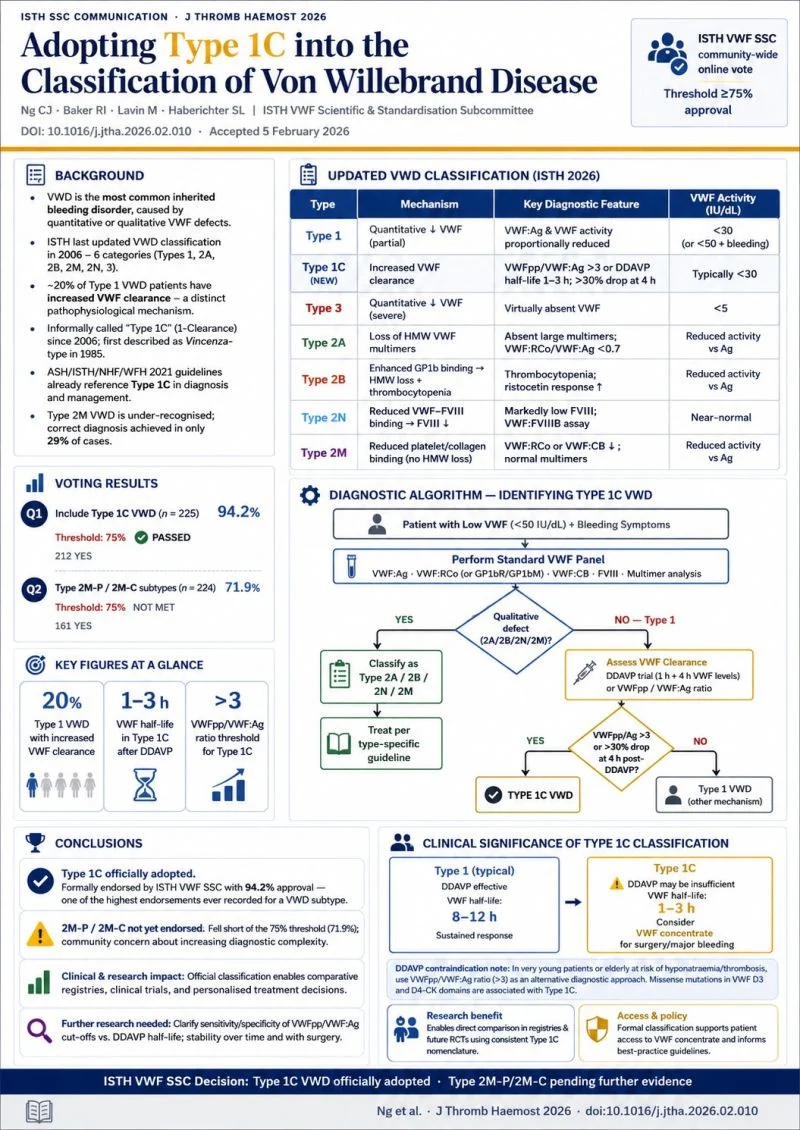
“Type 1C von Willebrand disease has now been formally incorporated into the updated VWD classification following strong endorsement by the ISTH VWF SSC.
This important step recognizes increased VWF clearance as a distinct pathophysiological mechanism and may improve diagnostic precision, treatment selection, clinical research, and patient access to appropriate therapies.
Key clinical implications include:
- VWF half-life of approximately 1–3 hours after DDAVP
- VWFpp/VWF: Ag ratio greater than 3 as a supportive diagnostic marker
- Potentially inadequate or short-lived response to DDAVP
- Consideration of VWF concentrate for major bleeding or surgery
A standardized Type 1C classification provides a clearer framework for diagnosis, registries, clinical trials, and personalized management of patients with von Willebrand disease.”
Other posts featuring Shadi Tabibian on Hemostasis Today.
-
Sep 24, 2026, 12:56Maria Helena Parrinello: A New Score for Chronic GvHD Risk Assessment at the SIE Congress
-
Sep 24, 2026, 12:44Shehab Mohamed: TP53 Mutations and Outcomes in Myeloproliferative Neoplasms
-
Sep 24, 2026, 12:34Francesca Palandri: Is There Still a Place for Splenectomy in ITP in the Modern Era?
-
Sep 24, 2026, 12:15Cedric Hermans: RPTH Illustrated Review on Von Willebrand Disease
-
Sep 24, 2026, 11:48Factor XII Inhibition and the Future of Contact Pathway Targeting
-
Sep 24, 2026, 08:55Andres Gudino: Clot Characterization Through Hounsfield Units in Ischemic Stroke
-
Sep 24, 2026, 06:52Gina Sado: Screening-Detected Atrial Fibrillation Carries High Risk of Heart Failure
-
Sep 24, 2026, 06:33Benjamin Vipler: Optimal Oral Anticoagulation Choice in Atrial Fibrillation and Advanced CKD
-
Sep 24, 2026, 06:08Christopher Salerno: AI-Powered At-Home Anemia Screening Advances Telehealth Access