


Sumedha Dash: What Happens Before a Blood Bag Reaches the Patient?
Sumedha Dash, Transfusion Medicine specialist at Institute of Medical Sciences and Sum Hospital, shared a post on LinkedIn:
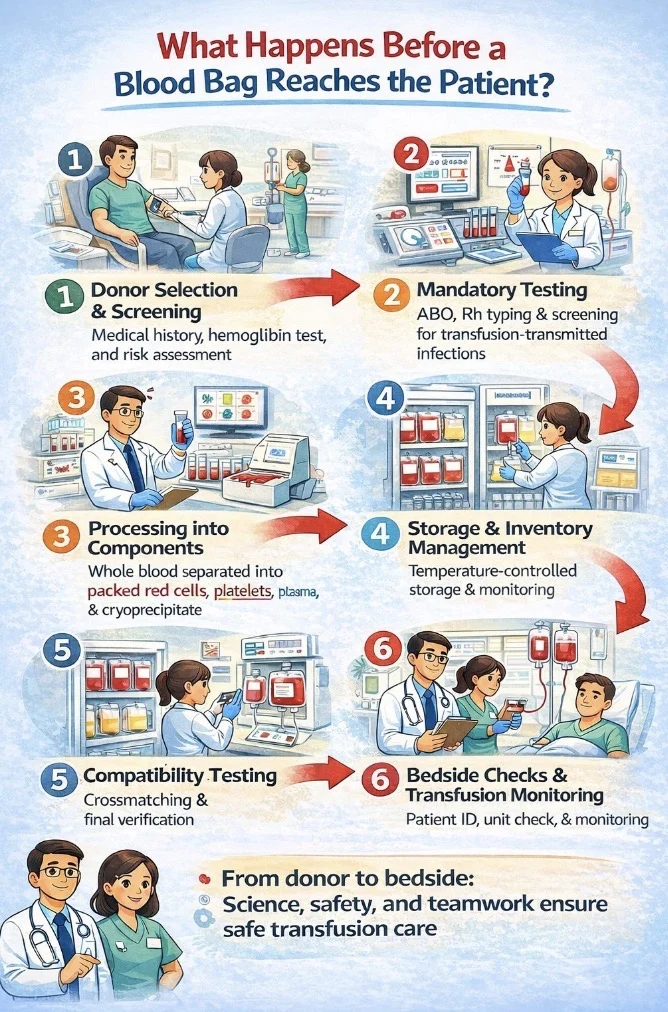
“What Happens Before a Blood Bag Reaches the Patient?
A blood transfusion may take minutes at the bedside-but the journey of that blood begins long before it reaches the patient.
- Step 1: Donor selection and screening
Every donor is carefully evaluated through medical history, hemoglobin testing, and risk assessment to ensure donor and recipient safety. - Step 2: Mandatory testing
Each unit undergoes rigorous testing for ABO and Rh typing, antibody screening, and transfusion-transmitted infections such as HIV, hepatitis B and C, syphilis, and malaria-before it is ever released. - Step 3: Processing into components
Whole blood is separated into packed red cells, platelets, plasma, and cryoprecipitate, allowing one donation to benefit multiple patients through targeted therapy. - Step 4: Storage and inventory management
Blood components are stored under strict temperature-controlled conditions, with continuous monitoring to maintain potency and safety. Quality control. - Step 5: Compatibility testing
Before issue, each unit undergoes crossmatching and final verification to ensure compatibility with the intended recipient. - Step 6: Bedside checks and transfusion monitoring Even at the bedside, safety continues-with patient identification, unit verification, and close monitoring for transfusion reactions.
At IMS and SUM Hospital, Transfusion Medicine department, blood components are stored using dedicated, component-specific storage systems, ensuring strict temperature control and regulatory compliance. Red cell units are stored separately from plasma, platelets, and cryoprecipitate, with plasma maintained in independent deep freezers to preserve clotting factor activity.
This structured approach strengthens transfusion safety, inventory management, and rapid availability of the right component for the right patient.
What reaches the patient is not just a blood bag-it is the outcome of science, systems, vigilance, and teamwork, all designed to deliver safe and effective transfusion care.”
Stay updated with Hemostasis Today.
-
Sep 17, 2026, 09:56Marianne Yee: MySCDstory Expands Access to Multilingual Sickle Cell Education
-
Sep 17, 2026, 09:36Enewa Onoja: Platelet Satellitism Phenomenon, Three Misleading Counts
-
Sep 17, 2026, 09:22Emmanuel J Favaloro: Hemostasis and Thrombosis in Exercise and Athletes
-
Sep 17, 2026, 09:18Updated Iron Deficiency Diagnostic Guidelines – American Society of Hematology
-
Sep 17, 2026, 09:14Angela Weyand: ASH 2026 Iron Deficiency Guidelines
-
Sep 17, 2026, 08:18Anirban Sen Gupta: From Flow to Clot Insights Into Hemostasis and Thrombosis
-
Sep 17, 2026, 08:03Aya Sherif: HEMO COP – Building a Collaborative Future for Hemophilia Care
-
Sep 17, 2026, 07:50Applications Are Now Open for the 2026 WFH IHTC Fellowships
-
Sep 17, 2026, 07:37Jim Hoffman: Could NET Removal Help Restore Vascular Homeostasis?