

Sumyea Kabir: Optimizing Plasma Selection for Therapeutic Plasma Exchange in TTP
Sumyea Kabir, Assistant Professor at Zainul Haque Sikder Women’s Medical College and Hospital, shared a post on LinkedIn:
“O-negative patient plus TTP plus Plasma exchange.
Does every plasma donor need to be O-negative?
- Scenario: 27-year-old ICU patient
- Suspected: TTP
- Treatment: Therapeutic Plasma Exchange (TPE)
- Challenge: Multiple sessions requiring large volumes of plasma
The practical question: If the patient is O-negative, must all plasma donors also be O-negative?
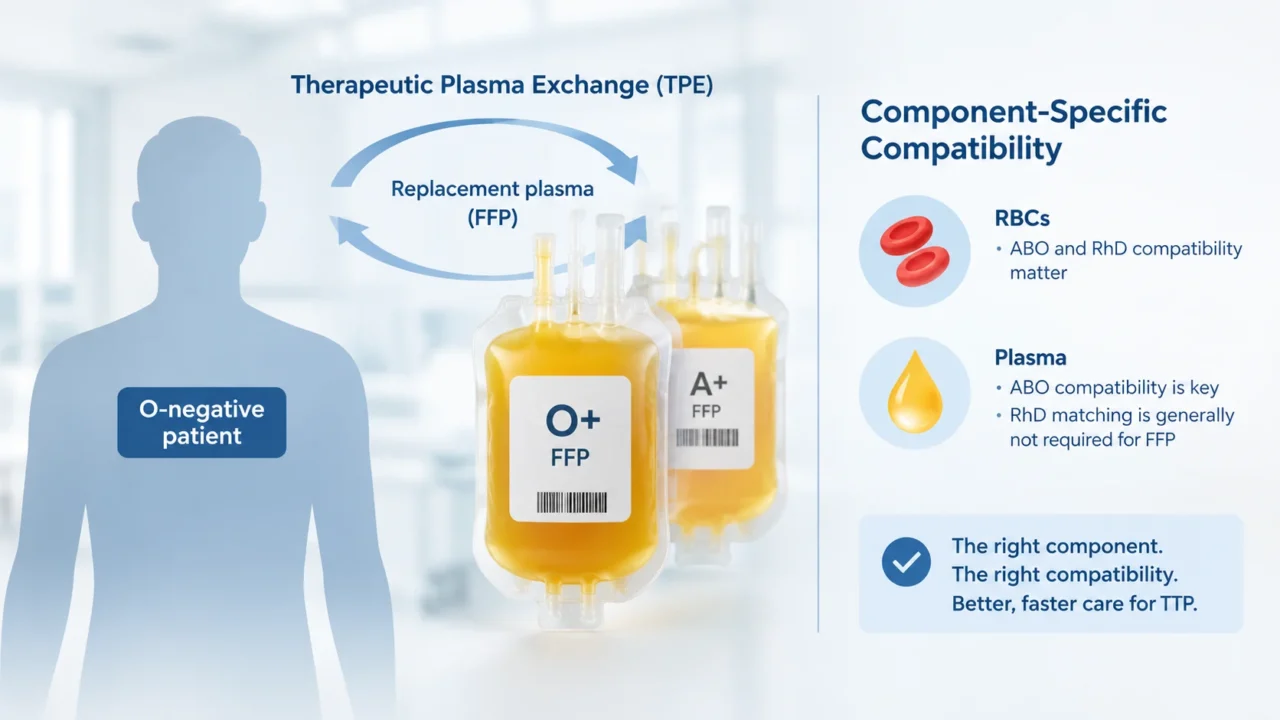
Component-Specific Compatibility.
RBCs
- Donor RBCs are transfused – ABO and RhD compatibility matter.
Plasma
- Plasma contains antibodies, not a significant mass of donor RBCs.
- ABO compatibility is the major consideration.
- RhD matching is generally not required for FFP.
Therefore, an O-negative patient does not automatically require O-negative FFP.
What about O-positive FFP?
- Properly prepared FFP contains only minimal residual RBCs.
- RhD-positive FFP can generally be considered for an RhD-negative recipient when clinically appropriate and permitted by local policy.
- Absolute zero residual RBCs cannot be guaranteed.
How can RBC contamination be minimized?
- Follow a validated component-preparation SOP
- Use validated centrifugation parameters
- Avoid disturbing the RBC–plasma interface
- Control plasma expression carefully
- Inspect components before issue
- Quarantine/investigate units with suspected significant RBC contamination
Avoid arbitrary rules such as a ’20 mL rule’ unless validated for the specific bag system and preparation method.
Why is this important in TTP?
- TTP can be rapidly life-threatening.
- TPE may require substantial volumes of replacement plasma.
- Timely access to compatible plasma is critical.
- O-negative donors are relatively uncommon.
- Unnecessarily restricting plasma donors may make urgent component availability more difficult.
Take-Home message
- Blood group ≠ identical component requirement
- RBC compatibility ≠ plasma compatibility
- O-negative patient ≠ automatically O-negative FFP
- RhD-positive FFP may be acceptable for an RhD-negative recipient
- Select compatibility according to the component being transfused
- Always follow validated SOPs and local transfusion policy
- Coordinate closely with haematology, apheresis and transfusion teams during urgent TPE.
References
- ISTH Guidelines – TTP
- ISTH 2025 Focused Update – TTP, J Thromb Haemost. 2025
- Canadian Blood Services
A useful reminder: Select the right component, apply the right compatibility principle, and avoid unnecessary barriers to urgent treatment.”
Stay updated with Hemostasis Today.
-
Oct 4, 2026, 13:31Swati Raikwar: Microplastics as a Threat to Cerebral Blood Flow
-
Oct 4, 2026, 13:18Maria Elisa Mancuso: EHC 2026 Opens with Focus on Haemophilia Care, Access and Rare Disorders
-
Oct 4, 2026, 13:16Anita Brikman: Inside the Plasma Donation Journey
-
Oct 4, 2026, 13:13Overcoming FVIII Inhibitors With Efanesoctocog Alfa – JTH
-
Oct 4, 2026, 13:04World Federation of Hemophilia Invites Global Community to GPAS 2026
-
Oct 4, 2026, 12:57Tooth Extraction in Patients with Haemophilia – RPTH Journal
-
Oct 4, 2026, 12:36Maia Meier: Advancing Hemophilia Care in Nepal – Project Elevate Her Visits Civil Service Hospital
-
Oct 4, 2026, 12:30Shailaja Kota Amplifies World Inherited Blood Disorders Month and Global Action Network’s Call to Action
-
Oct 4, 2026, 12:21Davide Pallucci: How Altered Platelet Metabolism Can Drive Changes in their Reactivity in Human and Mouse MASLD