

Tagreed Alkaltham: Why Can Some Apheresis Donors Donate More Frequently?
Tagreed Alkaltham, Transfusion Medicine Lab Supervisor at KSMC, shared a post on LinkedIn:
“Donation Intervals
Why Can Some Apheresis Donors Donate More Frequently?
One of the most misunderstood areas in blood donation is donation intervals.
Many people assume all donations require the same recovery time.
But in transfusion medicine, donation intervals depend heavily on:
- What component is collected
- How much is removed
- How the body recovers afterward.
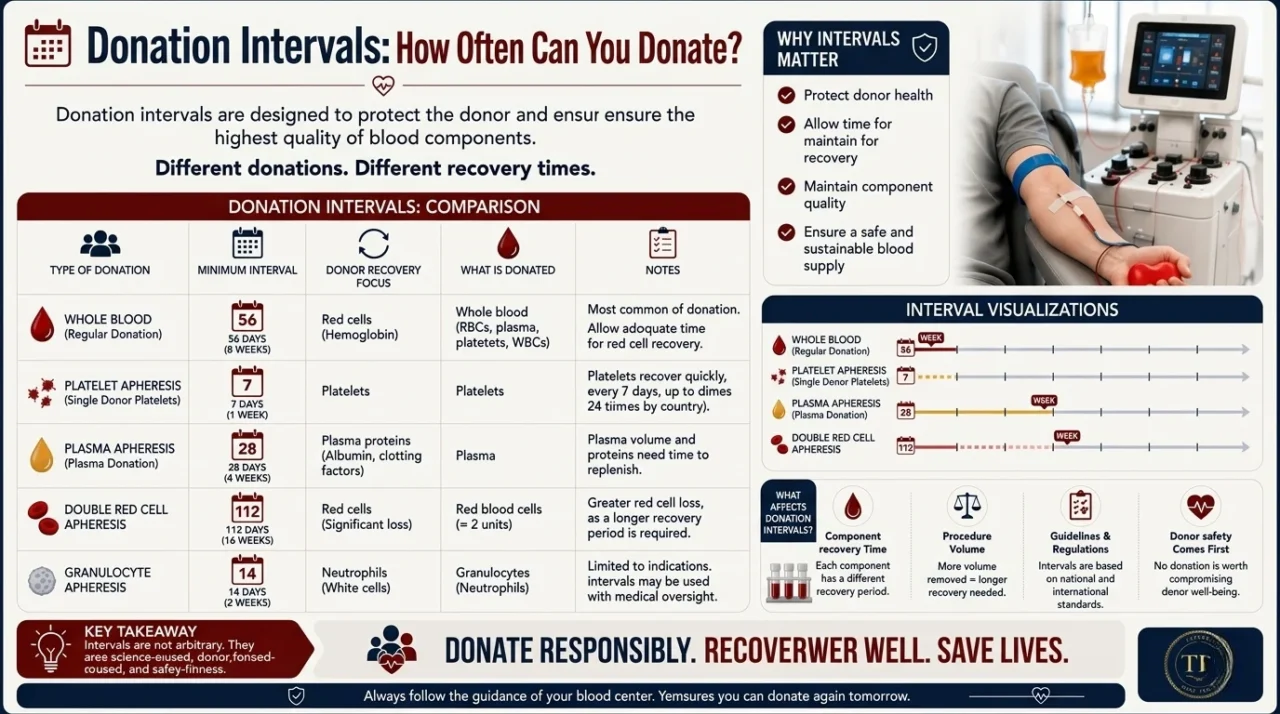
Whole Blood Donation:
In whole blood donation, red cells, plasma, and platelets are all removed together.
Because red cell recovery takes time, donation intervals are generally longer.
Typical interval:
- nearly 56 days (8 weeks) in many systems
The goal is to allow adequate hemoglobin and iron recovery before the next donation.
Platelet Apheresis:
Platelets recover much faster than red blood cells.
During platelet apheresis, most red cells are returned to the donor while platelets are selectively collected.
Because of this, platelet donors may often donate more frequently than whole blood donors.
Typical interval:
- Nearly 7 days minimum in many systems
(with annual maximum limits depending on local regulations)
Plasma Apheresis:
In plasma donation, plasma volume and proteins recover differently from red cells.
Since red cell loss is limited, plasma donors may sometimes donate more frequently than whole blood donors depending on national regulations.
Typical interval:
- Nearly 4 weeks, varies widely by country and regulation
Double Red Cell Apheresis:
Double red cell procedures remove a larger red cell volume than standard whole blood donation.
Because of this increased red cell loss, recovery periods are usually longer.
Typical interval:
- Nearly 112 days (16 weeks) in many systems
Granulocyte Apheresis:
Granulocyte donation is highly specialized and used under specific clinical indications.
Donation frequency is carefully controlled and depends on:
- Clinical protocols
- Medications used
- Donor safety requirements.
Nearly 2 weeks
Why do intervals differ?
Because each blood component recovers differently.
The body restores:
- Platelets
- Plasma volume
- Proteins
- Red cells
at different rates.
That is why donation intervals are not arbitrary.
They are designed around:
- Donor safety
- Physiologic recovery
- Component quality
- Sustainable blood supply practices.
The important principle is this:
A donor should never be viewed only as a source of collection.
Protecting donor recovery is part of protecting the entire blood supply system.
Because safe donation is not defined by how often someone can donate.
It is defined by how responsibly the donation process is managed.
Different components.
Different recovery times.
Different intervals.
But the same priority: donor safety first.”
Other posts featuring Tagreed Alkaltham on Hemostasis Today.
-
Oct 11, 2026, 22:40Bahram Alamdary Badlou: Platelets as First Responders in Hemostasis, Immunity, and Inflammation
-
Oct 11, 2026, 22:22Vipin Singh: New Publication on Hippo-YAP Signaling and Platelet Activation
-
Oct 11, 2026, 22:21Trygve Berge: New AFNOR Paper on AF-related Stroke in Norway
-
Oct 11, 2026, 22:09Omar Alomari: Our New Publication on Apixaban vs Rivaroxaban for VTE
-
Oct 11, 2026, 21:22Shayan Roshan: Happy to Share Two Research Milestones in Trauma Care and Pancreatic Cancer
-
Oct 11, 2026, 21:16Chokri Ben Lamine: Anemia in Myelofibrosis – Multiple Mechanisms, Limited Responses
-
Oct 11, 2026, 21:03Carmela Walker: Supporting Warriors Living With SCD Through Dental Care and Advocacy
-
Oct 11, 2026, 21:00Rishdha Roshad: Intraoperative Cell Salvage – Turning Blood Loss into an Opportunity for Recovery
-
Oct 11, 2026, 20:59Anthony R. Sloan: Honored to Share Our Work at the 20th Midwest Platelet Conference