

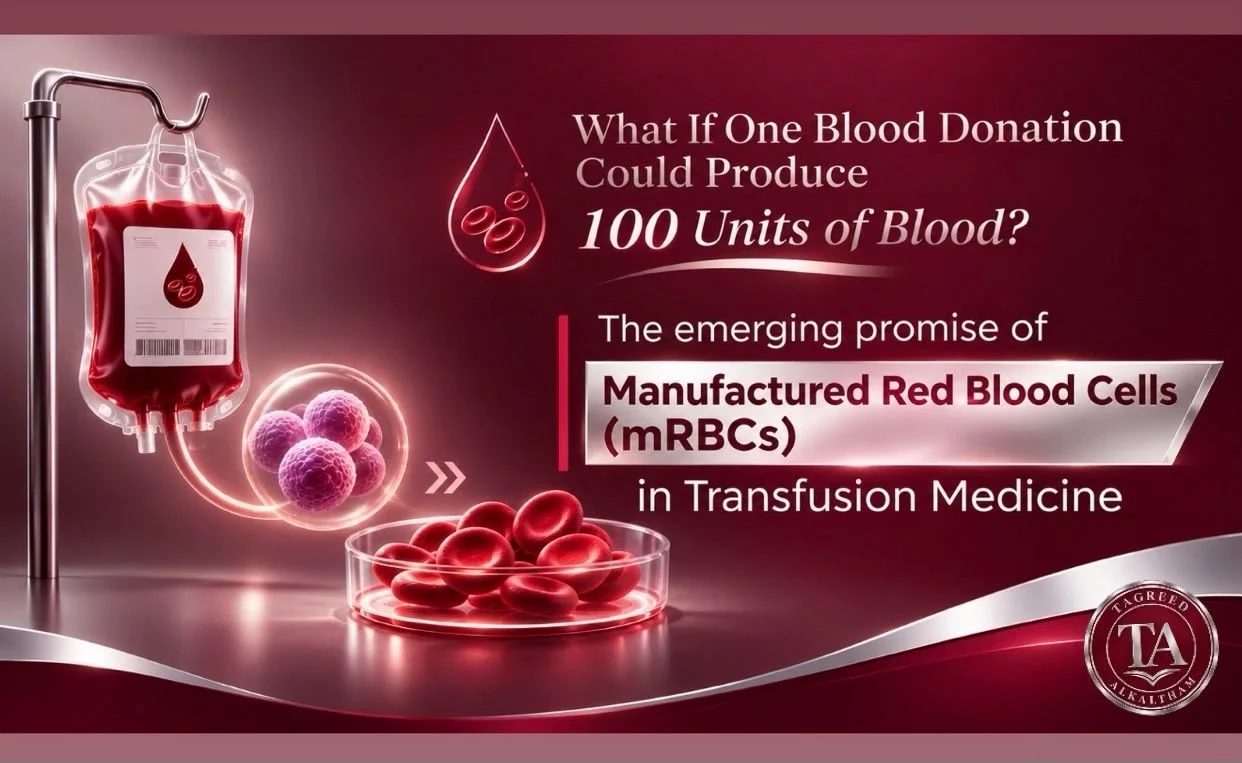
Tagreed Alkaltham: What If One Blood Donation Could Produce Units Of Blood?
Tagreed Alkaltham, Transfusion Medicine Lab Supervisor at KSMC, shared a post on LinkedIn:
“What if one blood donation could produce units of blood?
Could 2017 mark a turning point in transfusion medicine?
Imagine a future where a single blood donation could become the starting point for producing 100 units of red blood cells.
While this number remains hypothetical, the science behind laboratory grown blood is moving closer to clinical reality.
In an article published by AABB in October 2026, promising advances in Manufactured Red Blood Cells (mRBCs) were highlighted, including their potential applications in sickle cell disease, neonatal transfusions, and other high-need clinical indications.
The technology involves manufacturing red blood cells by expanding and differentiating hematopoietic progenitor cells derived from mobilized peripheral blood or umbilical cord blood under controlled laboratory conditions.
This emerging technology has the potential to produce multiple units of red blood cells from a single donation, with plans to initiate clinical trials in 2027.
This topic holds a special interest for me. During my master’s studies in Hematology, I explored this concept through a theoretical research project. Seeing how far the science has advanced since then makes these developments particularly fascinating.
For decades, blood banking has relied on collecting, testing, processing, and distributing donated blood.
But what if we could also grow blood?
The potential is extraordinary.
Manufactured red blood cells could one day help address blood shortages, support patients with rare blood types, reduce challenges associated with alloimmunization in chronically transfused patients, and provide specialized transfusion support for neonates.
Of course, important challenges remain, including manufacturing scalability, cost, safety, and clinical effectiveness.
Yet the possibilities are remarkable.
We may be witnessing the early foundations of a new era in Transfusion Medicine, where blood banks evolve beyond collection and storage into advanced cellular manufacturing.
Perhaps the future of blood banking is not only about collecting more blood, but also about discovering how to produce more from every donation.
The future of blood may not only be donated. It may also be grown.”
Stay updated with Hemostasis Today.
-
Nov 13, 2026, 16:17Shailendra Singh: Bombay Hospital Jaipur Inaugurates New Facility with Voluntary Blood Donation Camp
-
Nov 13, 2026, 16:10Minka Zivkovic: UMC Utrecht Announces Research Analyst Vacancy in Thrombosis and Haemostasis
-
Nov 13, 2026, 16:02Rounak Dubey: Elsevier’s Upcoming Handbook Explores Digitalization in Transfusion Medicine
-
Nov 13, 2026, 15:50Maha Othman: CanVECTOR 2026 Highlights Research on Immunothrombosis and Cancer-Associated Thrombosis
-
Nov 13, 2026, 15:48Cedric Hermans: Advances in Gene Therapy for Haemophilia A
-
Nov 13, 2026, 15:45Strengthens Global Collaboration in Thrombosis and Hemostasis for 2027 – ISTH
-
Nov 13, 2026, 15:42David McIntosh: The Global Blood Shortage Crisis and the Urgent Need for National Action
-
Nov 13, 2026, 15:41JTH Highlights Future Directions in Thromboprophylaxis for Hospitalized Children
-
Nov 13, 2026, 15:21Wolfgang Miesbach։ Gene Therapy for Haemophilia B Is Cheaper Than Lifelong Factor IX Prophylaxis in Sweden