


Tareq Abadl: Why the Kell Blood Group System Matters
Tareq Abadl, Medical Laboratory Specialist and Director of the Blood Bank at Dr. Abdelkader Al-Mutawakkil Hospital, shared a post on LinkedIn:
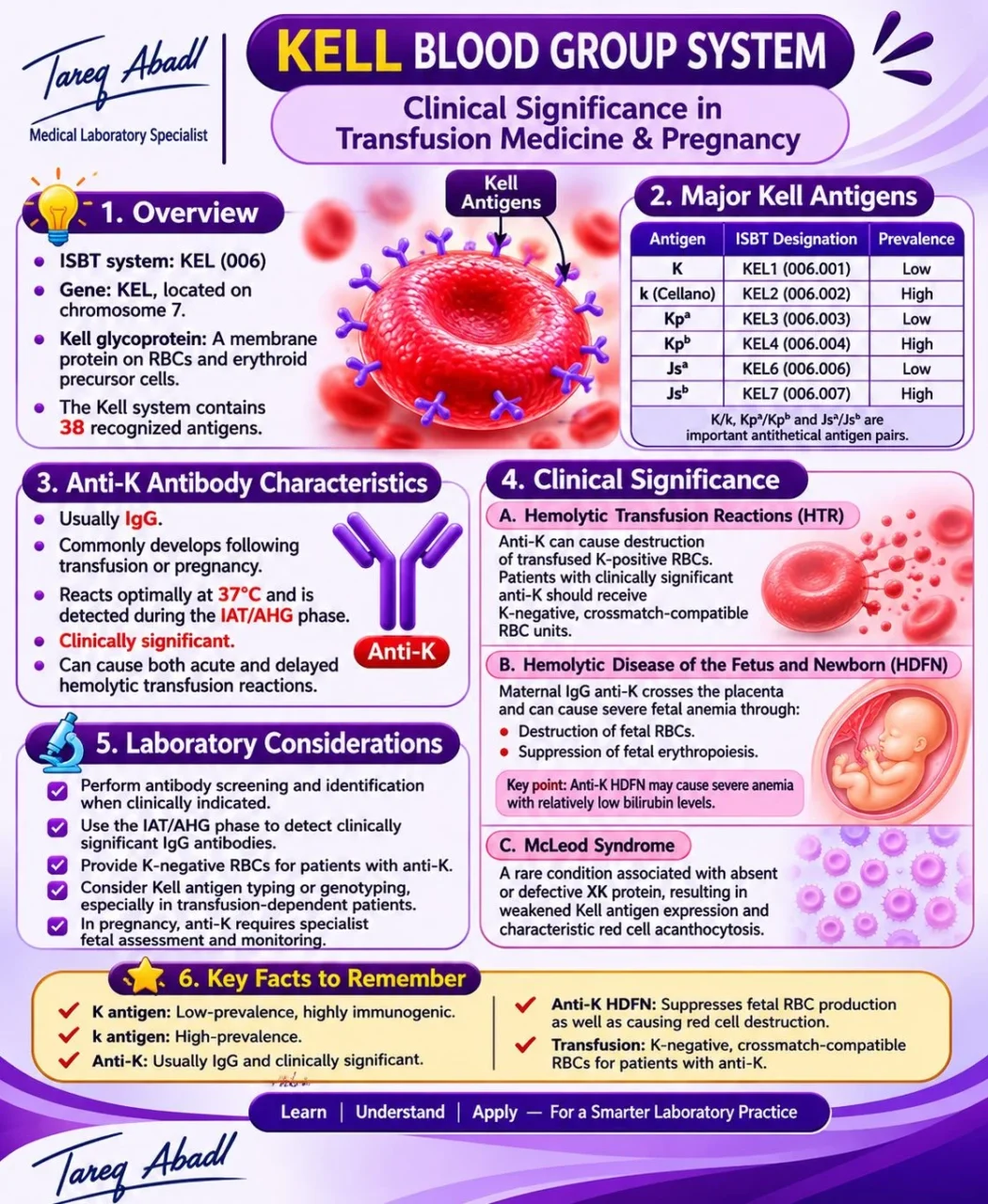
“Kell Blood Group System: More Than Just K and k!
In Immunohematology, some blood group antigens have a major impact on transfusion safety and pregnancy outcomes.
Why is the Kell Blood Group System clinically important?
It includes several clinically significant antigens, including K, k, Kpᵃ, Kpᵇ, Jsᵃ, and Jsᵇ.
Anti-K antibodies are usually IgG and can develop following transfusion or pregnancy.
In Transfusion Medicine: Anti-K can cause acute or delayed hemolytic transfusion reactions. Patients with Anti-K should receive K-negative, crossmatch-compatible red blood cell units.
In Pregnancy: Maternal Anti-K can cross the placenta and cause severe Hemolytic Disease of the Fetus and Newborn (HDFN).
What makes Anti-K particularly important?
Unlike many other antibodies, Anti-K can cause fetal anemia not only through red blood cell destruction but also by suppressing fetal red blood cell production (erythropoiesis).
Key Takeaway: Understanding the Kell Blood Group System is essential for accurate antibody identification, safe blood transfusion, and effective management of pregnancies at risk of HDFN.”
 Other posts featuring Tareq Abadl on Hemostasis Today.
-
Nov 16, 2026, 10:40TIF in China – Advancing Regional Cooperation in Thalassaemia Prevention and Care
-
Nov 16, 2026, 10:40Dhargam Aljebouri: A Milestone for Transfusion Medicine in Iraq
-
Nov 16, 2026, 10:35Arisha Patel: Why a Normal Blood Count Can Miss Iron Deficiency
-
Nov 16, 2026, 10:29Maxime Dely: The Needle Behind Every Donation
-
Nov 16, 2026, 10:29Marilena Vrana: Building a Resilient Plasma Ecosystem in Europe
-
Nov 16, 2026, 10:24Hichem Selatna: Advancing Hematology Laboratory Automation
-
Nov 16, 2026, 10:20Erin Harris: CRISPR Gene Therapy in Children
-
Nov 16, 2026, 10:19Beverley Hunt: PE Knows No Age – Isaac’s Story
-
Nov 16, 2026, 10:08Abdul Mannan: When Normal Blood Counts Hide Iron Deficiency