


Tareq Abadl: Not Every Rh-Positive or Rh-Negative Result is That Simple
Tareq Abadl, Medical Lab Specialist, shared a post on LinkedIn:
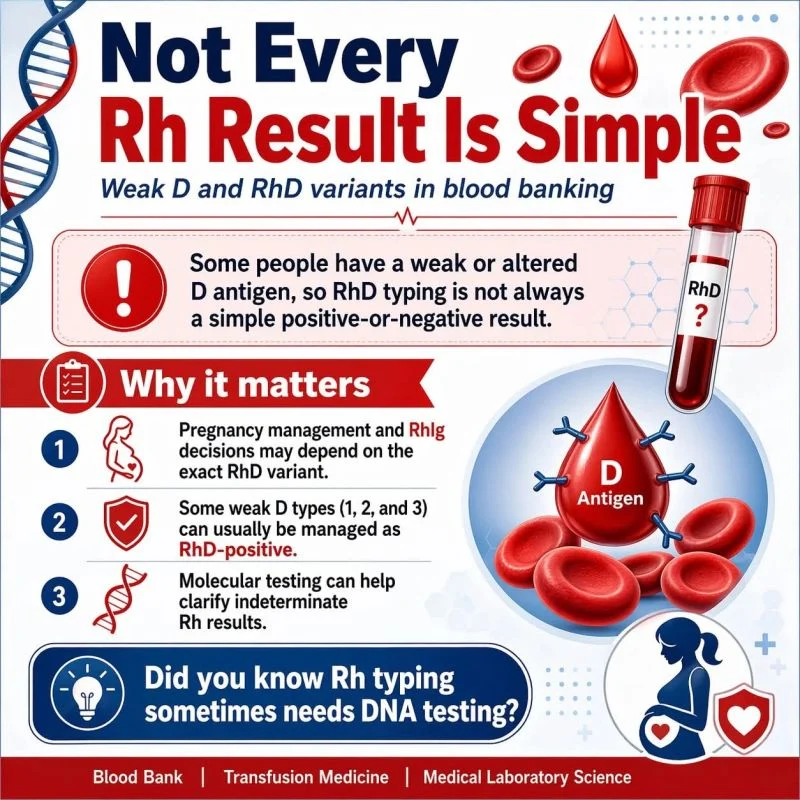
“Not every ‘Rh-Positive’ or ‘Rh-Negative’ result is that simple!
Most people think RhD typing is a clear yes or no — but in transfusion medicine, it’s not always that straightforward.
Some individuals have what’s called a weak D or other RHD variants.
This means the D antigen is present, but expressed at very low levels, structurally altered or reacts inconsistently in routine testing.
Because of this, standard serologic typing may give uncertain or misleading results.
Why does this matter?
In blood banking, especially during pregnancy, this distinction is critical.
The American Red Cross notes that weak or altered D expression can produce a serologic weak D phenotype.
The AABB recommends molecular (genotyping) testing when RhD results are unclear.
Why? Because management decisions can change.
- Weak D types 1, 2, and 3 – can be safely treated as RhD-positive.
- Other variants (like partial D) – may still form anti-D – managed as RhD-negative
Key clinical impact this directly affects:
- Rh immune globulin (RhIg) use.
- Blood transfusion selection.
- Risk of alloimmunization.
Without genotyping, patients may: receive unnecessary RhIg or be given Rh-negative blood unnecessarily (a limited resource).
Even donor testing is more detailed than people expect: The Canadian Blood Services confirms that first-time donors typed as Rh-negative are often retested for weak D to ensure accurate classification.
Newer Insight (Important): Recent practice is shifting toward
- Routine RHD genotyping in pregnant patients with weak D.
- Better standardization of interpretation across labs.
- Reducing variation between hospitals in RhIg decisions.”
Other posts featuring Tareq Abadl on Hemostasis Today.
-
Sep 23, 2026, 16:04Monia Ezzalfani: Advancing Patient-Centered Care in Hemophilia A and B
-
Sep 23, 2026, 15:49Bilge Başak: How Activated PRP Modulates Osteoarthritic Chondrocyte Function
-
Sep 23, 2026, 14:50Mbonjo Bitsie Dora: Strengthening Sickle Cell Care Through Education, Awareness and Innovation
-
Sep 23, 2026, 13:58The New B12 Diagnostic Algorithm: From Serum Cobalamin to Functional Deficiency
-
Sep 23, 2026, 13:56Noha Soror: Preparing for Hematology and Medical Oncology Board Certification
-
Sep 23, 2026, 13:46Ugochi Ogu: What Can Platelet Proteomics Reveal about Pain and Neurocognitive Vulnerability in Sickle Cell Disease?
-
Sep 23, 2026, 13:42Melissa Hollo: Connecting Obesity and Anemia for Earlier Maternal Risk Intervention
-
Sep 23, 2026, 13:16Beverley Hunt: Advances in Haemostatic Management of Postpartum Haemorrhage
-
Sep 23, 2026, 13:13Ioanna Mela: Recruiting a Research Associate on DNA nanotechnology