


Thirunavukkarasu Angappan/LinkedIn
Nov 18, 2026, 12:46
Thirunavukkarasu Angappan: Fibrinogen in Postpartum Haemorrhage
Thirunavukkarasu Angappan, Vice President of Operations and Manufacturing at PopVax, shared a post on LinkedIn:
“Three trials gave fibrinogen to bleeding mothers. What did they find?
Fibrinogen builds the fibre net of a clot. In postpartum haemorrhage (PPH, heavy bleeding after birth), levels can fall, so giving plasma-derived fibrinogen concentrate seems logical. Three randomised trials tested it.
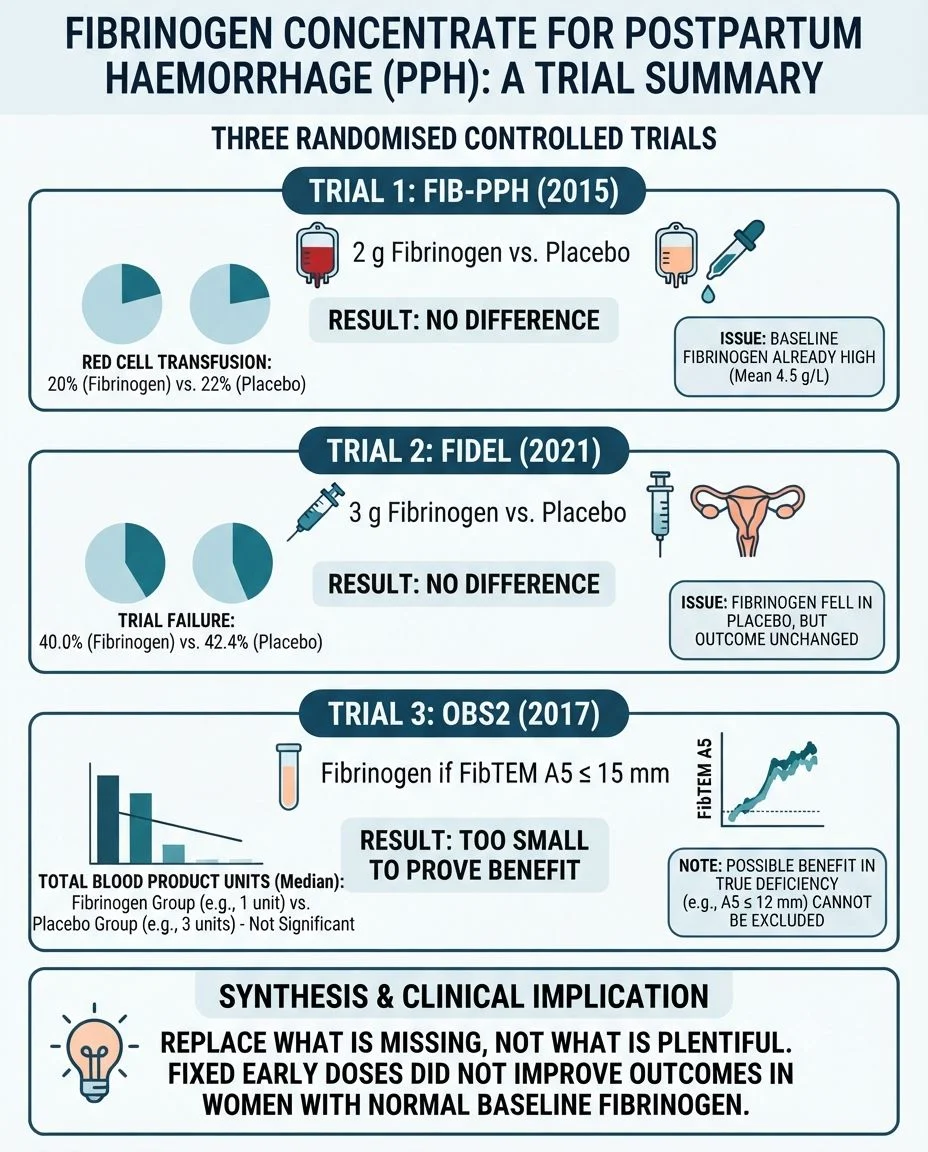
- Trial 1, FIB-PPH (2015): 249 women with severe PPH, double-blind: 2 g of fibrinogen concentrate (about 26 mg/kg) or placebo. Red-cell transfusion up to 6 weeks: 20% (25) versus 22% (26); relative risk 0.95 (95% confidence interval, CI, 0.58 to 1.54; P = 0.88). No thromboembolic events․
- Why no gain: fibrinogen rose only 0.40 g/L more than with placebo (CI 0.15 to 0.65), and women were not short of it: mean baseline 4.5 g/L, mean blood loss 1,459 mL at inclusion.
- Trial 2, FIDEL (2021): 437 women at 30 French hospitals with persistent bleeding after vaginal birth, given 3 g or placebo within 30 minutes of starting prostaglandins.
Failure (haemoglobin drop of 4 g/dL or more, or 2 or more red-cell units within 48 hours): 40.0% versus 42.4%; adjusted odds ratio 0.99 (0.66 to 1.47; P = 0.96). - What FIDEL changed: baseline fibrinogen was 4.1 g/L. At 2 hours it was unchanged with treatment but fell 0.56 g/L with placebo. Better number, no better outcome. No thromboembolic events with fibrinogen; two adverse events with placebo.
- Trial 3, OBS2 (2017): 663 women with PPH of 1,000 to 1,500 mL were enrolled, but only 55 were randomised: treatment required ongoing bleeding and a weak bedside clot-strength test (FibTEM A5 of 15 mm or less). Primary outcome, units of red cells, plasma, cryoprecipitate and platelets: adjusted incidence rate ratio 0.72 (0.3 to 1.7; P = 0.45). One thrombotic event in each group.
- OBS2 is too small to prove anything. With FibTEM A5 of 12 mm or less, the fibrinogen group used a median 1 unit versus 3, not significant. The authors suggest replacement may be unnecessary above A5 12 mm or Clauss fibrinogen 2 g/L, but cannot exclude benefit below.
- Targets: Godier et al. note guidelines mostly advise keeping fibrinogen above 1.5 to 2 g/L in severe bleeding on weak evidence, and argue that higher targets are unsupported: no benefit shown, cost, and possible thrombotic risk.
- Not shown: that fibrinogen is useless in true deficiency; mean baseline levels in FIB-PPH and FIDEL were high.
- Open question: three triggers (two fixed early doses, one bedside test); none helped on average, but benefit in a truly deficient mother is not excluded. Trials limited to proven low levels would test it.
Synthesis: replace what is missing, not what is plentiful. In the two larger trials, fixed early doses did not improve outcomes.
Does your PPH protocol give fibrinogen by a measured level, or by habit?”
Other posts featuring Thirunavukkarasu Angappan on Hemostasis Today.
-
Nov 18, 2026, 01:45Shikha Jha: My Takeaways from the 4th GANSID International Congress
-
Nov 18, 2026, 01:34Zeeshan Ahmed Khattak: Treatment of Fever and Neutropenia in Hematology/Oncology and Hematopoietic Cell Transplant Patients
-
Nov 17, 2026, 23:45Cajetan Reichardt: LAAO vs. OAC in AF – Balancing Nonprocedural Bleeding and Ischemic Stroke Risk
-
Nov 17, 2026, 23:42Brian Tegtmeyer: Expanding Pre-Hospital Administration of Low-Titer O Positive Whole Blood
-
Nov 17, 2026, 23:41Mansi Kala: Advancing Hematology – From Evidence to Clinical Excellence
-
Nov 17, 2026, 23:40Nathan Connell: Registered for the WFH Comprehensive Care Summit 2027 in Prague
-
Nov 17, 2026, 23:38Yaariv Khaykin: Does Reducing AF Burden After Ablation Change the Need for Anticoagulation?
-
Nov 17, 2026, 23:38Amos Gitonga Mbaabu: Strengthening Care and Advocacy for Haemophilia and SCD across Southern Africa
-
Nov 17, 2026, 23:35Muhammad Sameed Altaf: A Decade of Working Together for Thalassemia Awareness and Patient Support