


Thirunavukkarasu Angappan: From Donated Plasma to Life – Saving Medicines
Thirunavukkarasu Angappan, Vice President of Operations and Manufacturing at PopVax, shared a post on LinkedIn:
“One litre of plasma, six medicines: where does India lose the rest?
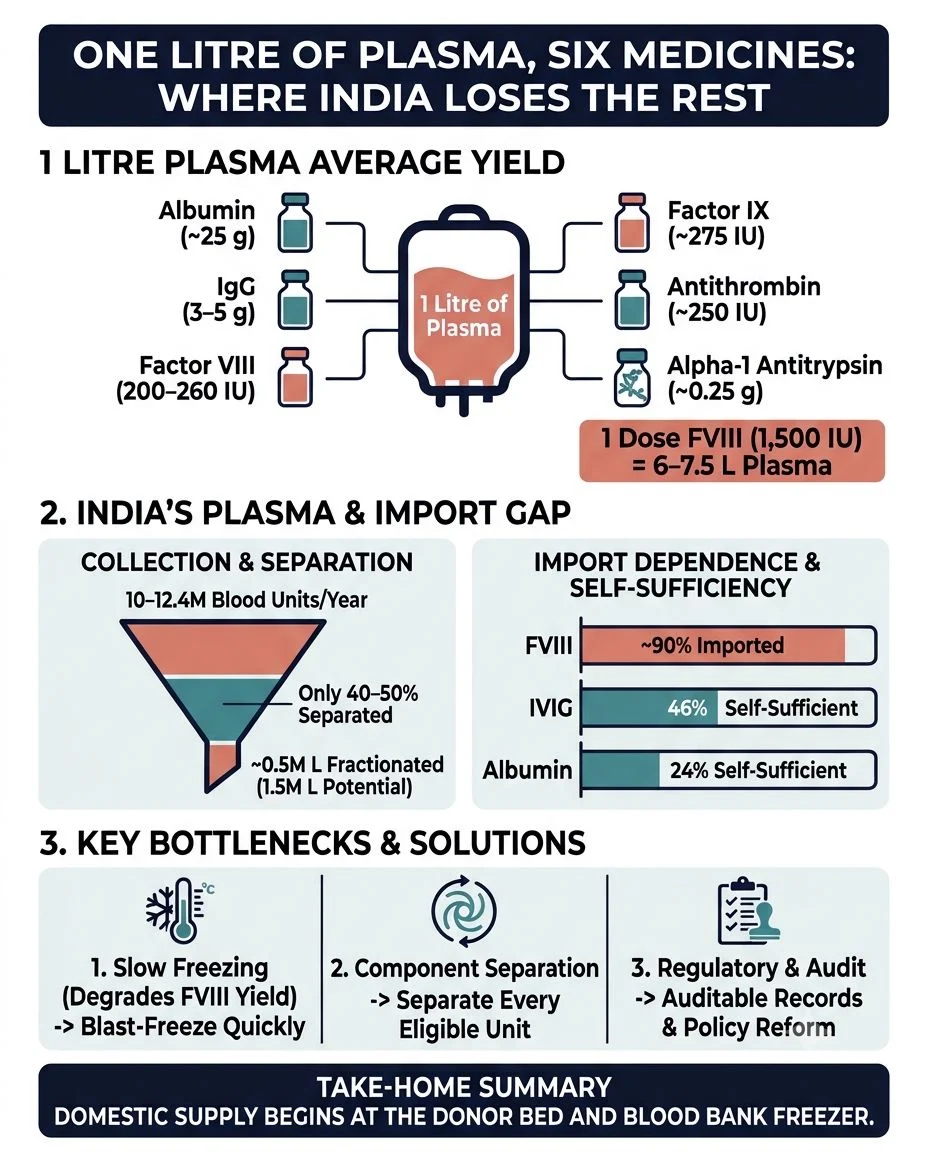
A bag of donated plasma looks like one thing. In a fractionation plant (a facility that separates plasma into purified proteins) it becomes at least six medicines. Yet India imports about 90% of its factor VIII (FVIII). Where does the plasma go?
- What one litre can give: a slide by Jan Bult at an International Society of Blood Transfusion (ISBT) workshop, crediting Burnouf (2015), shows average yields: about 25 g albumin, 3 to 5 g immunoglobulin G (IgG), 200 to 260 international units (IU) of FVIII, about 275 IU of factor IX, about 250 IU of antithrombin and about 0.25 g of alpha-1 antitrypsin.
- Why FVIII is the hard one: the Indian Academy of Pediatrics dose rule is IU = desired rise (%) x body weight (kg) x 0.5. The guideline covers children, so this adult example is only my illustration, before process losses: a 60 kg adult needing a 50% rise needs 1,500 IU, about the FVIII in 6 to 7.5 litres of plasma at the yields above.
- India’s plasma picture: Ajmani (2018) reports 10 to 11 million blood units a year from over 2,700 blood banks, with only about 40% separated into components. About 0.50 to 0.55 million litres of plasma reach fractionation, and about 500,000 litres are fractionated a year. He estimates about 1.5 million litres if all blood were separated.
- Newer data: Mammen et al. report about 12.4 million units in 2018 to 2019, with around 50% separated.
- What it costs: Ajmani reports about 90% import dependence for FVIII, and says hyperimmune products are imported or made from imported bulk. He gives India’s self-sufficiency as 46% for intravenous immunoglobulin (IVIG) and 24% for albumin, with four fractionation units.
- A problem in the collection room: Ajmani says most blood banks do not blast-freeze or snap-freeze plasma, which he calls one of the important reasons for poor FVIII yield from Indian plasma.
- Rule gaps he listed (2018): apheresis source plasma for fractionation was not permitted, payment for it was prohibited, and nucleic acid testing was not mandatory. He recommends mandatory component separation, a legal path for source plasma, and a national body to steer plasma policy.
- Rules are moving: in March 2026 the health ministry issued a draft rule to end duplicate viral testing of finished plasma products. It is a draft; check its status.
- What any blood bank can do now (my reading of Ajmani): separate every eligible unit, freeze plasma quickly, and keep records a fractionator can audit.
Synthesis: the plant is only the middle of the chain. How much FVIII, albumin and IgG a country makes is largely set at the donor bed and in the blood bank freezer.
If every eligible unit were separated and frozen quickly, how much of our FVIII import could we replace?”
Other posts featuring Thirunavukkarasu Angappan on Hemostasis Today.
-
Nov 23, 2026, 15:06Giuseppe Biondi Zoccai: Hemoglobin-to-Creatinine Ratio Linked to Early Markers of Anthracycline-Induced Cardiac Injury
-
Nov 23, 2026, 14:54Mina Mokaram: New Research Examines MDS Progression and Transplant Outcomes in Pediatric CAMT
-
Nov 23, 2026, 14:41Danyel Chermon: Study Reveals Independent Effects of BMI and Genetic Risk on B12 and Folate Status
-
Nov 23, 2026, 14:25Ayomide Juliana: Promoting Informed Reproductive Decisions Through Sickle Cell Genotype Awareness
-
Nov 23, 2026, 14:15Disseminated Intravascular Coagulation: From Diagnostic Scores to Molecular Phenotyping
-
Nov 23, 2026, 14:13Mariam AlEissa: AI and Pharmacogenomics Drive WarfaRisk’s Personalized Warfarin Dosing Initiative
-
Nov 23, 2026, 13:32Reza Shojaei: Can Your Coffee Habit Leave a Trace in Donated Blood?
-
Nov 23, 2026, 12:56Essama Telli: VTE During Nivolumab – Balancing Recurrence and Bleeding Risk
-
Nov 23, 2026, 12:47Rehan Khan: Epoprostenol in PAH – Why Continuous Infusion Matters