


Thirunavukkarasu Angappan: Anti-TFPI Antibodies and an Antithrombin-Lowering Drug
Thirunavukkarasu Angappan, Vice President of Operations and Manufacturing at PopVax, shared a post on LinkedIn:
”Taking the Brake Off Clotting: Anti-TFPI Antibodies and an Antithrombin-Lowering Drug
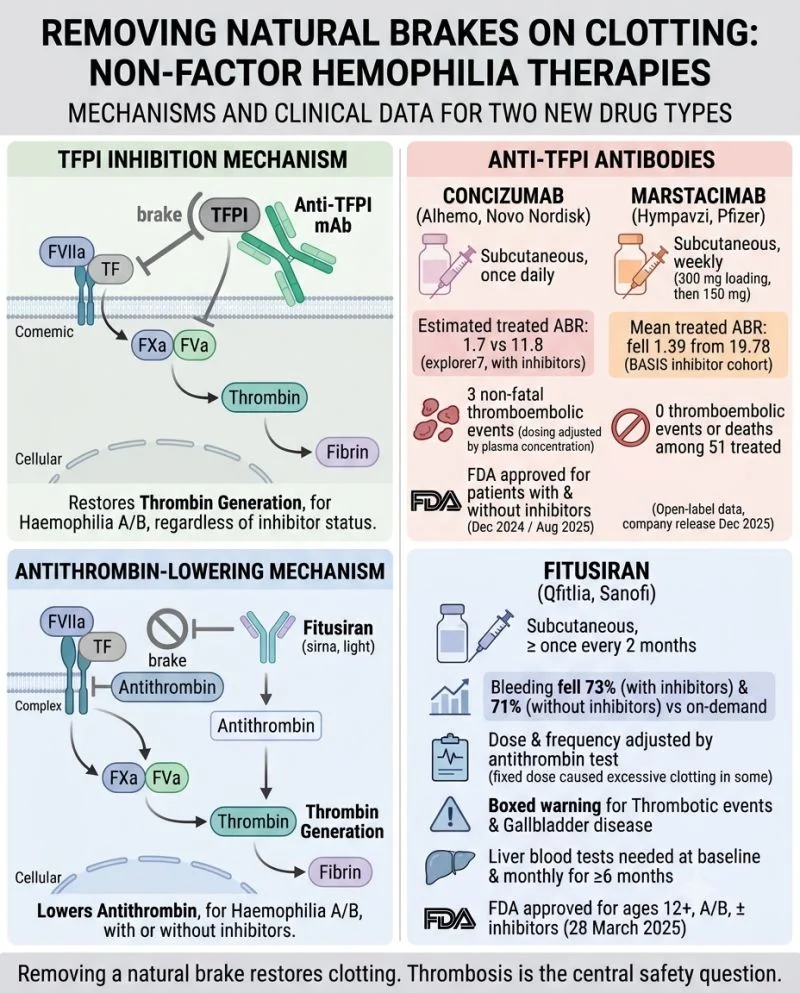
What if, instead of replacing a missing clotting factor, we removed a natural brake on clotting? Three non-factor therapies now do this, in two ways.
Tissue factor pathway inhibitor (TFPI) is one brake. As per Mahlangu (2025), it restrains the extrinsic pathway by inhibiting the factor VIIa-tissue factor complex and the prothrombinase complex (activated factor X with factor Va). Concizumab and marstacimab both bind its Kunitz-2 domain, allowing thrombin generation to proceed despite missing factor VIII or IX, regardless of inhibitor status.
Concizumab (Alhemo, Novo Nordisk) is given once daily under the skin. In explorer7 (133 people with haemophilia A or B and inhibitors), the estimated annualised bleeding rate (ABR) for treated spontaneous and traumatic bleeds was 1.7 versus 11.8 without prophylaxis (ratio 0.14), and about 60 percent of patients had no bleeds. Three non-fatal thromboembolic events led to a treatment pause; dosing was then restarted with adjustment by plasma concentration. The United States Food and Drug Administration (FDA) approved it in December 2024 for patients with inhibitors, and in August 2025 for those without.
Marstacimab (Hympavzi, Pfizer) is given weekly: 300 mg loading dose, then 150 mg. In the BASIS inhibitor cohort (48 people in the efficacy analysis), mean treated ABR fell from 19.78 to 1.39, a 93 percent reduction. No thromboembolic events or deaths occurred among 51 treated people. This was open-label, not randomised, with each person as their own control, from a company release of December 2025 data; the inhibitor indication was not yet approved then.
The third drug works differently.
Fitusiran (Qfitlia, Sanofi) lowers antithrombin, another natural brake on thrombin. As per the FDA, it was approved on 28 March 2025 for people aged 12 and over with haemophilia A or B, with or without inhibitors, given under the skin from once every two months.
Its dose and frequency are adjusted using an antithrombin test, because a fixed monthly dose caused excessive clotting in some patients. Bleeding fell 73 percent in patients with inhibitors and 71 percent in those without, compared with on-demand treatment.
Fitusiran carries a boxed warning for thrombotic events and gallbladder disease, and liver blood tests are needed at baseline, then monthly for at least six months.
The pattern is clear: removing a brake restores clotting, and thrombosis is the central safety question for every drug in this class.
Anti-TFPI antibodies and fitusiran are non-factor routes to prophylaxis, beside factor replacement and the FVIIIa-mimic emicizumab.
For a patient without inhibitors, would you choose factor replacement, emicizumab, an anti-TFPI antibody, fitusiran or gene therapy, and why?”
Other posts featuring Thirunavukkarasu Angappan on Hemostasis Today.
-
Oct 28, 2026, 05:52Reegan Burnell-Clarke: Pegcetacoplan and the Evolving Treatment Landscape of PNH
-
Oct 28, 2026, 03:50ZhiChao (David) Yang: MedicalBench Tests AI in Clinical Reasoning
-
Oct 28, 2026, 03:46Phillip Smith: Strengthening Partnerships and Connections in the Rare Disease and Hemophilia Communities
-
Oct 28, 2026, 03:42Ashley Bradley: Understanding Jalen Hurts’ Diagnosis: DVT and Venous Thromboembolism in Athletes
-
Oct 28, 2026, 03:39Gregory Denomme: Petz and Garratty’s Immune Hemolytic Anemias Third Edition
-
Oct 28, 2026, 03:38Ahmed Alotaibi: Monoclonal Antibodies Challenge Routine Pretransfusion Testing
-
Oct 28, 2026, 03:32Wolfgang Miesbach: Should Prophylaxis in Type 3 VWD Follow the Bleeding Phenotype?
-
Oct 28, 2026, 03:25Owen McCarty: Exploring Platelet Polyphosphates in Coagulation Under Flow
-
Oct 28, 2026, 03:19Arwa Z. Al-Riyami: Key Takeaways from the Blood Conference in Auckland