

Chronic Preoperative Corticosteroid Use and Postoperative Venous Thromboembolism Risk – Thrombosis and Haemostasis Journal
Thrombosis and Haemostasis Journal shared a post on LinkedIn:
“TH: Why did you (and your colleagues) write this paper?
What was its main purpose?
Narat Srivali and Frederica De Giacomi: Many surgical patients take corticosteroids long-term for inflammatory, autoimmune, or other chronic conditions.
Steroids are known to promote a prothrombotic state, but no one had pooled the evidence on whether chronic preoperative use raises the risk of blood clots after surgery.
Postoperative venous thromboembolism (VTE), meaning deep vein thrombosis (DVT) and pulmonary embolism (PE), is a major and largely preventable cause of surgical morbidity and mortality.
We wanted to quantify that risk across surgical specialties and see where it might matter most.
What are the main conclusions?
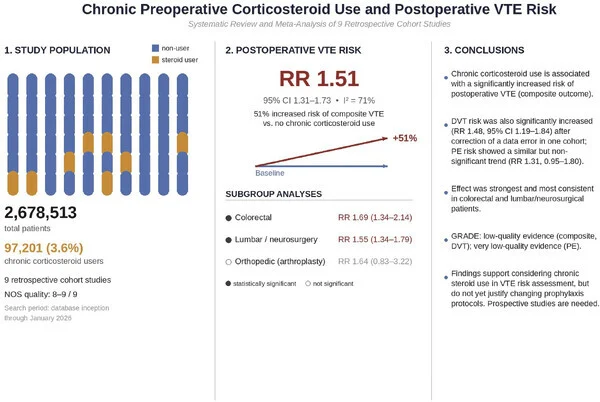
N.S and F.D.G: Across nine retrospective cohort studies and more than 2.6 million surgical patients, chronic preoperative corticosteroid use was associated with a 51% higher risk of postoperative VTE (RR 1.51, 95% CI 1.31–1.73). DVT risk was significantly increased (RR 1.48). PE showed a similar but non-significant trend (RR 1.31), and that should not be read as evidence of no effect.
The association was clearest in colorectal surgery (RR 1.69) and lumbar/neurosurgery (RR 1.55).
It was weaker in arthroplasty, where one very large cohort influenced the results.
The certainty of evidence was low for composite VTE and DVT and very low for PE.
The studies were retrospective and could not account for steroid indication, dose, or duration, so residual confounding is likely.
What are the paper’s implications?- to the public?-to medical professionals?
N.S and F.D.G: For medical professionals: Chronic steroid use is worth documenting as one factor in perioperative VTE risk assessment, alongside established factors such as malignancy, immobility, and prior VTE.
It deserves particular attention in colorectal and spine or neurosurgical settings.
Given the low-quality evidence, our findings do not justify changing prophylaxis protocols.
Prospective studies that capture steroid indication, dose, and duration are needed to define dose–response relationships and to test whether intensified prophylaxis improves outcomes.
For the public: Patients who take steroids long-term should tell their surgical team about it, including the dose and how long they have been taking it, so it can be considered in their overall risk assessment.
They should never stop or change steroid treatment on their own before surgery, because abruptly stopping can be dangerous.
Any decision about clot prevention should be made together with the care team.”
Stay updated with Hemostasis Today.
-
Nov 14, 2026, 09:30Ney Carter Borges: Vulnerable Plaque – Imaging and Clinical Significance
-
Nov 14, 2026, 09:25Carmelo Raffo: How Much Antithrombotic Therapy is Truly Necessary after LAAC?
-
Nov 14, 2026, 09:19Mary Cushman: Excellent to Have Jordan Shavit Visit Us for a Virtual Lab Meeting Today
-
Nov 14, 2026, 09:15Chancellor Donald: Heading to ASH 2026 in New Orleans? Let’s Connect on Faculty Opportunities at Tulane
-
Nov 14, 2026, 09:11Sajja Venkatesh: FDA Approved Asundexian, the First Factor XIa Inhibitor
-
Nov 14, 2026, 09:05Selina Evans: How Can Hospitals Make VTE Risk Assessment and Prevention Truly Routine?
-
Nov 14, 2026, 09:01Abdul Rehman Abid: DAPT vs Aspirin Monotherapy Beyond 12 Months Following Drug-Eluting Stent Implantation
-
Nov 14, 2026, 00:23Saji Kumar: The Role of Agentic AI in Blood Bank Inventory Coordination
-
Nov 14, 2026, 00:04Carlos A. Metidieri Menegozzo: The First Priority in Trauma Transfusion May Be Time to First Blood Product