


William Wallace: A Magnesium Ion Decides Whether Your Brain Learns or Not
William Wallace, Co-Founder and Chief Scientific Officer at Supplement Success Solutions, shared a post on LinkedIn:
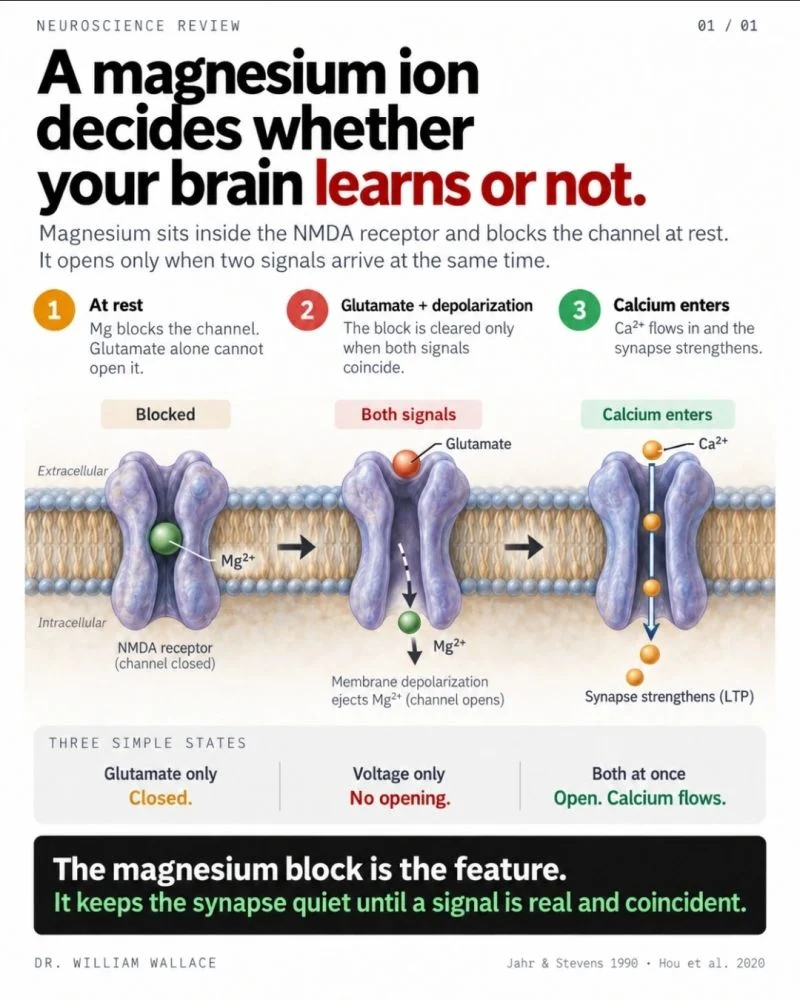
“There is a magnesium ion sitting inside one of the most important channels in your brain, and it spends most of its time blocking it. That is not a malfunction. That block is how your brain decides what to learn.
The channel is the NMDA receptor. It is central to learning and memory, and it has an unusual rule for opening. Glutamate, the brain’s main excitatory signal, has to bind to it. But binding alone does nothing, because a magnesium ion is physically lodged in the pore, plugging it shut.
The only way to clear that plug is for the neuron itself to already be active and electrically depolarized. Glutamate plus voltage, at the same instant, pops the magnesium out.
So the receptor only opens when two things happen together: an incoming signal and a neuron that is already firing. That makes it a coincidence detector. It is the molecular version of ‘these two things are related,’ and that is the cellular basis of learning.
When it opens, calcium floods in, triggers an enzyme called CaMKII, and the synapse gets stronger. Strengthening that connection is, quite literally, the physical act of learning something.
The magnesium block is the gatekeeper for the whole process. It keeps the channel silent until the signal is real and coincident, so the brain strengthens what matters and ignores random noise.
This is where it gets interesting. That same block also acts as a brake on overexcitation. When magnesium is low, the brake loosens and these channels become easier to open with less provocation. At the mechanism level, that means the threshold for excitation drops.
This is a clean, well-established piece of biochemistry. It is also exactly the kind of mechanism that gets oversold, so be careful with the leap from ‘magnesium gates NMDA receptors’ to ‘magnesium fixes anxiety.’ The gating is real and rigorous. The clinical claims downstream of it are a separate, much messier question.
What is not in doubt: a single magnesium ion sitting in a channel is one of the most elegant control switches in human biology, and it is running quietly in your head right now.”
Other posts featuring William Wallace on Hemostasis Today.
-
Nov 15, 2026, 04:31Aakriti Gupta: Anticoagulation for Leaflet Thickening After TAVR
-
Nov 14, 2026, 23:57Jamie S. Y. Ho: Exploring the Mechanisms of Arterial Thrombosis and the Evolution of Antithrombotic Therapy
-
Nov 14, 2026, 23:53Jacopo Imberti: The Past, Present and Future of Arterial Thrombosis Research
-
Nov 14, 2026, 23:48Shrouk Ramadan: Joining the Editorial Review Board of Clinical and Applied Thrombosis and Hemostasis
-
Nov 14, 2026, 23:46Habib Bennaceur: Moving Towards Fewer Limitations for People Living With Haemophilia
-
Nov 14, 2026, 23:44Paul Healy: EU Approves Frehemgo for Haemophilia A
-
Nov 14, 2026, 23:43Mehak Trehan: ASH 2026 Benign Hematology – Ten Abstracts Through an Indian Lens
-
Nov 14, 2026, 23:33Felipe Magalhaes Furtado: Artificial Intelligence Advances PNH Clone Detection Through Machine Learning
-
Nov 14, 2026, 23:33Mona Alfaraj: International Pathology Day Promotes Education in Hemoglobinopathy Diagnostics