


Wolfgang Miesbach: FIX-Padua Assay Variability Complicates Comparisons of Haemophilia B Gene Therapies
Wolfgang Miesbach, Head of Hemostasis/Hemophilia Center at Medical Clinic 2 at University Hospital Frankfurt, shared a post on LinkedIn:
“A 40-fold difference in vector dose, and all three products land in the same mild-to-normal range.
Three gene therapies for haemophilia B have been licensed, all exploiting the hyperactive FIX-Padua variant, but differing in capsid, genome configuration, dose and immunomodulation — from 5 × 10¹¹ to 2 × 10¹³ vg/kg.
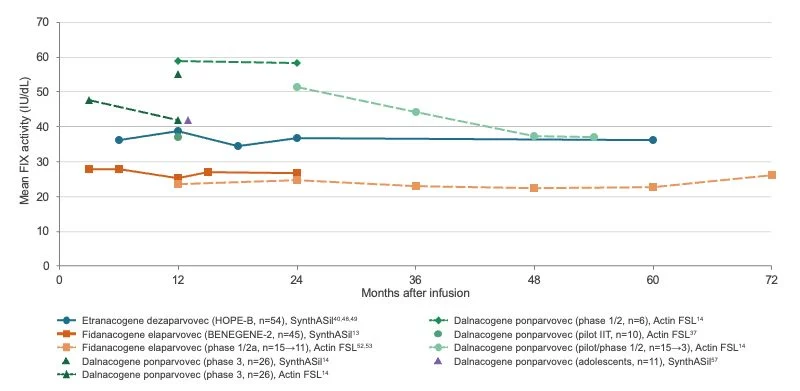
Comparing them has been hampered by one practical obstacle: FIX-Padua activity is reagent dependent, and the same sample can differ by up to 1.9-fold between one-stage assays.
In the dalnacogene ponparvovec phase 3 cohort, identical samples gave 55.1 IU/dL on one reagent and 41.9 IU/dL on another.
In this review Glenn Pierce and I harmonised all activity data to a single one-stage scale.
That establishes analytical comparability, not clinical equivalence: mean activity 27–55 IU/dL, annualised bleeding rates 0.6–1.5 and reductions in FIX consumption above 90 percent for all three products — but measured at year 5, month 15 and week 52 respectively, in different populations.
No assay has been validated against bleeding outcome after gene transfer, so these means do not rank the products by clinical benefit.
The paradox is this: haemophilia B is the clearest efficacy success of AAV gene therapy, and uptake has been minimal.
Of the three licensed products, one was withdrawn worldwide before a single patient received it commercially, leaving etranacogene dezaparvovec the only one available in the West and dalnacogene ponparvovec the only one in China.
Our conclusion: the biology works, and the five- to 13-year data leave little doubt about it.
Further progress depends less on the next capsid than on the economics, logistics and equity of access.
Other posts featuring Wolfgang Miesbach on Hemostasis Today.
-
Nov 25, 2026, 13:00Chaza Alaji: Vitamin B6 and Its Essential Role in Blood Formation and Brain Function
-
Nov 25, 2026, 12:50Edward Lee Carter: Beyond CHA₂DS₂-VASc – Are We Measuring the Patient—or Just Scoring the Risk Factors?
-
Nov 25, 2026, 12:26Anne Trezise: The Blood Sample Pathway in Laboratory Diagnostics
-
Nov 25, 2026, 12:18Research Can’t Move Forward Without Funding – American Society of Hematology
-
Nov 25, 2026, 12:14Nicolaus Kröger: Mapping Bone Marrow Recovery After Allogeneic Transplantation for Myelofibrosis
-
Nov 25, 2026, 12:09Melissa McGue: Strengthening Advocacy for Hematology
-
Nov 25, 2026, 11:53Michael Praktiknjo: Early Portal Decompression Associated with Reduced Cirrhosis Decompensation
-
Nov 25, 2026, 11:29Streptococcus oralis Links Platelet Adhesion to Antibody-Dependent Activation – Platelets Journal
-
Nov 25, 2026, 11:08Limb Fat Distribution Linked to Increased Venous Thromboembolism Risk – JTH