

Modernizing DIC Diagnosis in Cirrhosis: Building an International Registry for Precision Hemostasi
One of the important presentations at the ISTH 2026 Congress addressed a long-standing challenge in clinical hemostasis: how to accurately diagnose disseminated intravascular coagulation (DIC) in patients with cirrhosis.
Presented by Ecaterina Scarlatescu, the session highlighted the rationale, design and early findings of an international prospective registry developed through a collaboration between the ISTH DIC Subcommittee and the ISTH Subcommittee on Hemostatic Management in Patients with Liver Disease.
The initiative aims to generate the evidence needed to develop a cirrhosis-specific DIC scoring system.
Why Is Diagnosing DIC in Cirrhosis So Difficult?
Patients with cirrhosis frequently exhibit laboratory abnormalities that closely resemble those used to diagnose DIC, including:
- Prolonged PT/INR
- Thrombocytopenia
- Reduced fibrinogen levels
- Elevated D-dimer concentrations
However, these abnormalities arise from different biological mechanisms than in DIC.
In DIC, coagulation factors and platelets are consumed because of systemic activation of coagulation. I
n contrast, cirrhosis is characterized by impaired hepatic synthesis of coagulation factors, altered protein distribution, thrombocytopenia related to portal hypertension and splenic sequestration and chronically elevated fibrinolytic markers.
As a result, many patients with cirrhosis may fulfill existing DIC scoring criteria despite not having true disseminated intravascular coagulation.
This overlap creates significant diagnostic uncertainty and may influence clinical management.
The International DIC in Cirrhosis Registry
To address this challenge, investigators launched a prospective, multicenter international registry enrolling adult patients with cirrhosis admitted to hospital wards and intensive care units.
Importantly, the registry is designed to reflect real-world clinical practice.
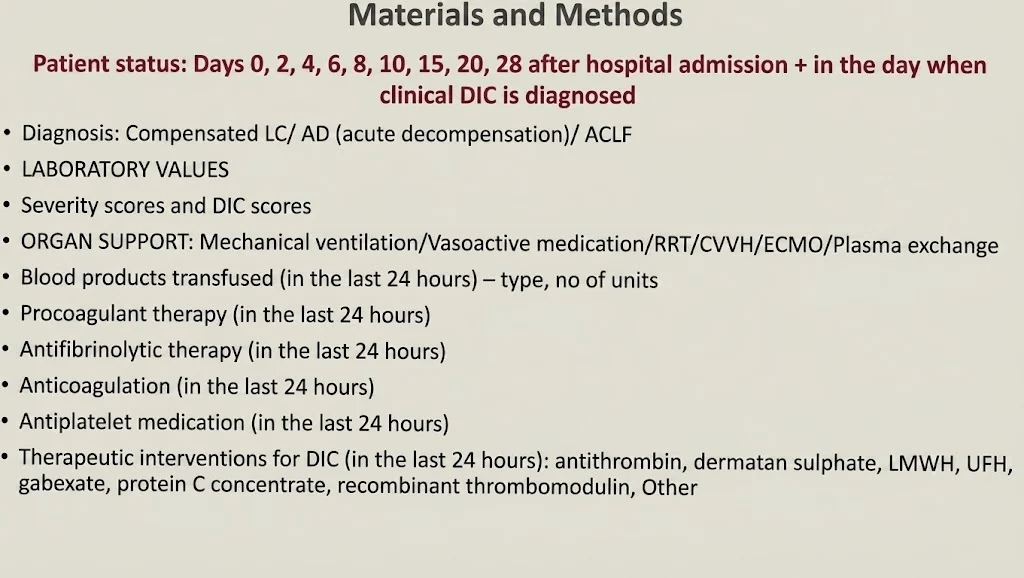
No additional blood tests, imaging studies or interventions are required. Instead, participating centers collect information that is already routinely available during patient care.
Baseline data include patient characteristics, liver disease severity and documentation of any clinical manifestations suggestive of DIC during hospitalization.
Follow-up data are recorded at predefined intervals and include routine laboratory values, organ support requirements, transfusion history, and clinical outcomes.
Because the registry relies entirely on existing clinical data, it provides an efficient and pragmatic approach for evaluating DIC across diverse healthcare settings.
Key Objectives
The registry has four major goals:
- Describe current diagnostic and treatment practices for DIC in patients with cirrhosis.
- Determine how frequently patients with cirrhosis meet existing DIC diagnostic criteria.
- Assess whether positive DIC scores correlate with true clinical manifestations of DIC and short-term outcomes.
- Develop and validate a DIC scoring system specifically adapted for cirrhosis.
Early Findings From the International Registry
At the time of the presentation, 10 international centers had joined the registry, with 8 centers actively enrolling patients.
More than 150 patients had been included; however, the investigators aim to recruit at least 300 patients.
As the registry relies exclusively on routinely collected clinical data from participating hospitals, missing data are expected, making a larger sample size essential for meaningful analyses.
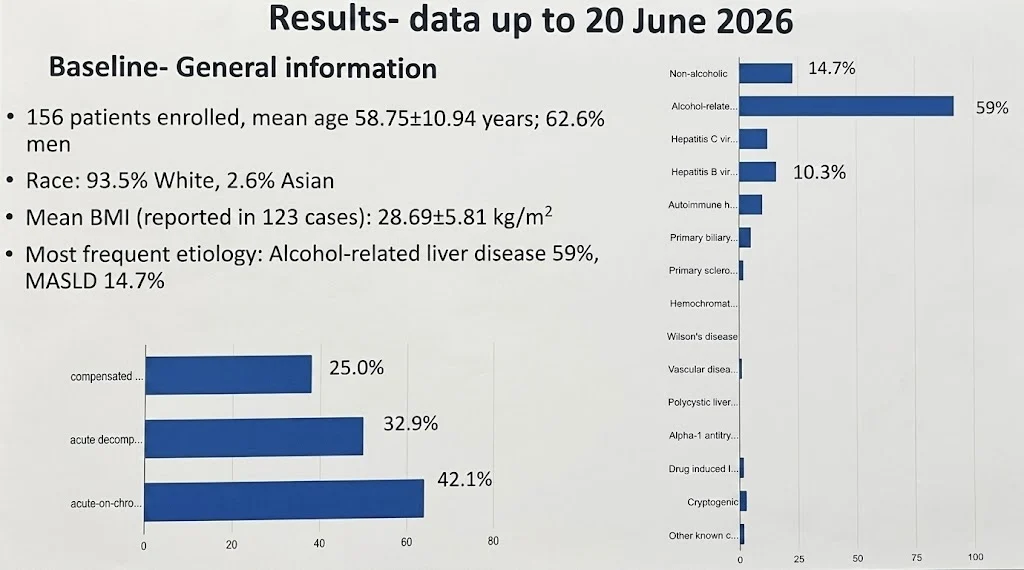
The majority of enrolled patients had alcohol-related liver disease, while approximately one-quarter had compensated cirrhosis.
The predominance of alcohol-related liver disease likely reflects the large proportion of patients recruited from intensive care units.
More than 90% of ICU admissions were due to organ dysfunction, with neurological dysfunction being the most common indication, followed by respiratory and renal dysfunction.
Only 15 patients were receiving anticoagulant therapy at hospital admission.
Low-molecular-weight heparin was the most frequently used anticoagulant, followed by apixaban. Clinical manifestations suggestive of DIC were recorded in 34 of 141 evaluable patients (approximately 24%).
Among thrombotic manifestations, deep vein thrombosis and pulmonary embolism were the most commonly reported events.
Baseline Laboratory Characteristics
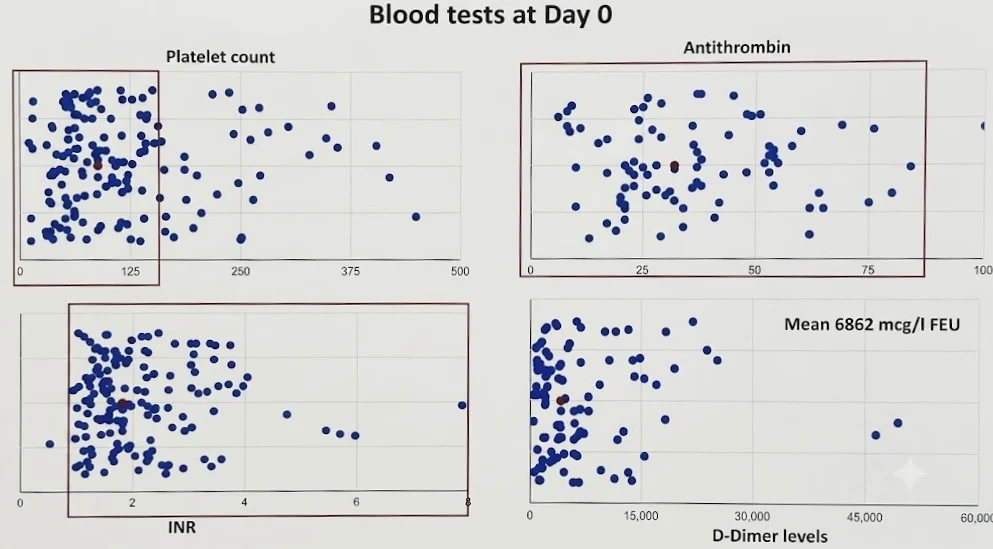
Baseline laboratory data demonstrated abnormalities commonly observed in patients with cirrhosis and frequently incorporated into conventional DIC scoring systems.
Many patients had reduced platelet counts, decreased antithrombin levels, prolonged INR, and markedly elevated D-dimer concentrations.
The mean D-dimer value at baseline was approximately 6,800, highlighting the pronounced activation of coagulation and fibrinolysis frequently observed in this patient population.
tThese findings further illustrate the substantial laboratory overlap between cirrhosis and DIC, emphasizing the diagnostic challenges encountered when applying existing DIC scoring systems to patients with advanced liver disease.
Toward Validation of a Cirrhosis-Specific DIC Score
Ecaterina Scarlatescu also highlighted a recent development in the field: the publication of a new DIC scoring system specifically tailored for patients with cirrhosis.
The ongoing international registry will provide an opportunity to evaluate this proposed score by comparing its performance with existing diagnostic systems and assessing its association with clinical manifestations of DIC and patient outcomes.
Ultimately, the registry is expected to provide the evidence required to validate a diagnostic approach specifically adapted to patients with cirrhosis.
Clinical Implications
Distinguishing true disseminated intravascular coagulation from the hemostatic alterations associated with cirrhosis remains one of the most challenging issues in coagulation medicine.
By combining prospective international data with the evaluation of a newly proposed cirrhosis-specific DIC score, this collaborative ISTH initiative has the potential to improve diagnostic accuracy and provide an evidence-based framework for the assessment of DIC in patients with advanced liver disease.
Stay updated with Hemostasis Today.
-
Oct 26, 2026, 15:13Heghine Khachatryan: Approaching Thrombocytopenia Through Mechanism and Clinical Context
-
Oct 26, 2026, 15:03Quentin Eichbaum։ AABB 2026 Annual Meeting Personal Highlights
-
Oct 26, 2026, 14:57A Father’s Marathon Journey Inspired by His Son – National Bleeding Disorders Foundation
-
Oct 26, 2026, 14:48Fran Huelsmeyer: The Clinical Importance of Blood Donation in Maternal Care
-
Oct 26, 2026, 14:45Maria Elisa Mancuso: Shaping the Future of Hemophilia Care with Patients
-
Oct 26, 2026, 14:35Choosing the Right VTE Risk Assessment Model for Clinical Practice
-
Oct 26, 2026, 14:29Ilenia Calcaterra: HEMOPLATE Explores Biological Factors Behind Bleeding Variability in Haemophilia A
-
Oct 26, 2026, 14:28Giovanni Solimeno: An Advanced Thrombin Injection Technique for Complex Femoral Pseudoaneurysms
-
Oct 26, 2026, 14:20Abdul Mannan: Are We Teaching Doctors to Think or Just Trust AI?