

Factor XII Inhibition and the Future of Contact Pathway Targeting
Beyond Conventional Anticoagulation
The development of anticoagulants has traditionally focused on suppressing thrombin generation through the common coagulation pathway. Direct oral anticoagulants targeting factor Xa or thrombin have transformed the prevention and treatment of venous thromboembolism, stroke prevention in atrial fibrillation, and several other thrombotic conditions. Yet their central limitation remains unchanged: the same pathways that drive pathological thrombosis also contribute to normal hemostasis.
This creates a difficult therapeutic balance. Increasing anticoagulant intensity may reduce thrombosis but expose patients to major bleeding, while reducing treatment intensity may leave them insufficiently protected.
Factor XII inhibition has emerged from a different therapeutic concept. Instead of broadly suppressing coagulation, it aims to interfere with the contact pathway, a system that appears to contribute substantially to thrombosis and thrombo-inflammation but may be less essential for everyday hemostasis.
The goal is ambitious: to separate thrombosis from hemostasis more effectively than current anticoagulants allow.
The Contact Pathway: More Than an In Vitro Cascade
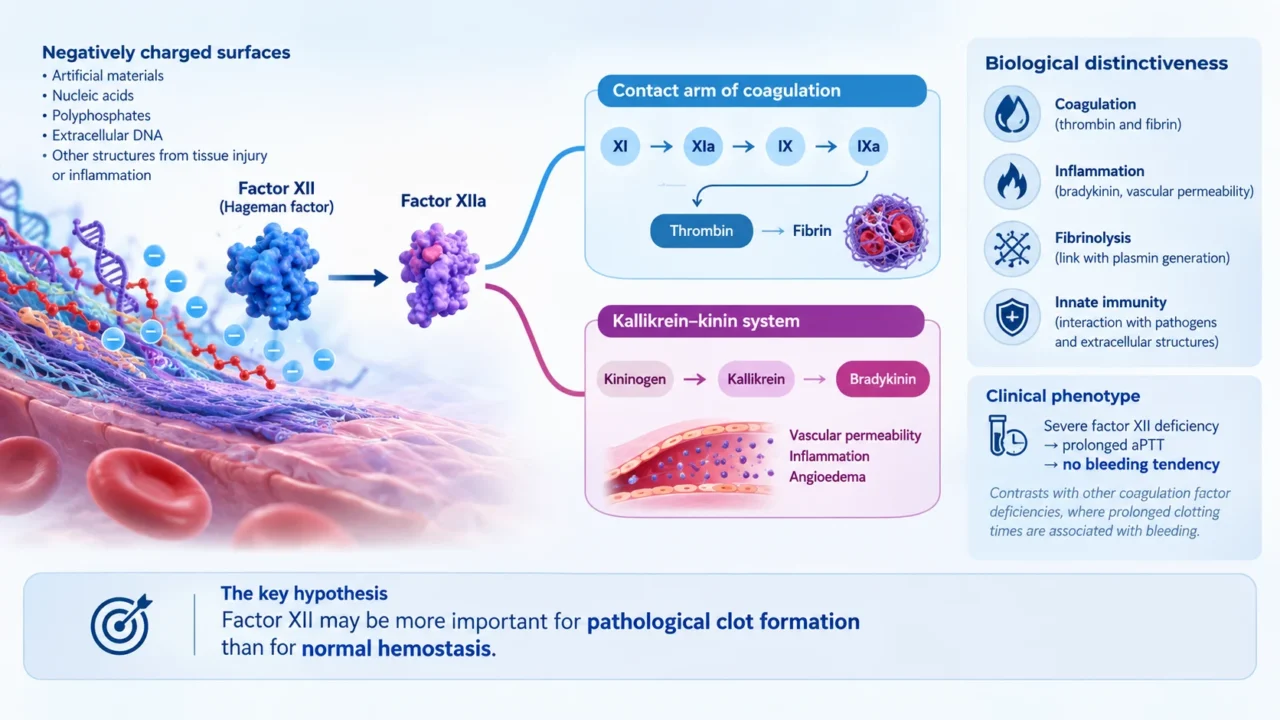
Factor XII, also known as Hageman factor, is a plasma zymogen activated when blood encounters negatively charged surfaces. These surfaces may include artificial materials, nucleic acids, polyphosphates, extracellular DNA and other molecular structures generated during tissue injury or inflammation.
Once activated to factor XIIa, it initiates two interconnected systems. The first is the contact arm of coagulation, in which factor XIIa activates factor XI and ultimately contributes to thrombin and fibrin formation. The second is the kallikrein–kinin system, which promotes bradykinin generation and links contact activation to vascular permeability, inflammation and angioedema.
This dual role makes factor XII biologically distinctive. It is not simply another component of the coagulation cascade; it is positioned at the interface of coagulation, inflammation, fibrinolysis and innate immunity.
The clinical phenotype of factor XII deficiency has contributed substantially to interest in this target. Patients with severe inherited factor XII deficiency may have a markedly prolonged activated partial thromboplastin time, yet they generally do not develop a corresponding bleeding disorder. This contrasts with deficiencies of several other coagulation factors, in which prolonged clotting times are associated with clinically important hemorrhage.
That observation led to a compelling hypothesis: factor XII may be more important for pathological clot formation than for normal hemostasis.
Why Target Factor XII?
The most attractive feature of factor XII inhibition is the possibility of selectively suppressing thrombus propagation while preserving tissue-factor-driven hemostasis at sites of vascular injury.
In preclinical models, genetic deletion or pharmacological inhibition of factor XII has reduced arterial and venous thrombosis without producing the degree of bleeding observed with conventional anticoagulants. The effect appears particularly relevant when coagulation is initiated by artificial surfaces, polyphosphates, extracellular DNA or inflammatory structures rather than by the classical tissue factor pathway.
This distinction may become clinically important in situations where the blood interacts with medical devices. Catheters, dialysis circuits, extracorporeal membrane oxygenation systems and other artificial surfaces can activate the contact system and promote thrombus formation. In such settings, factor XII inhibition could theoretically reduce device-associated thrombosis while limiting systemic anticoagulant exposure.
However, the biological rationale should not be mistaken for clinical proof. Human factor XII deficiency does not reliably protect against thrombosis, and available clinical evidence has not established a simple inverse relationship between factor XII levels and thromboembolic risk. Factor XII is therefore best regarded as a promising therapeutic target rather than a validated biomarker for individual thrombosis risk.
Factor XII Versus Factor XI
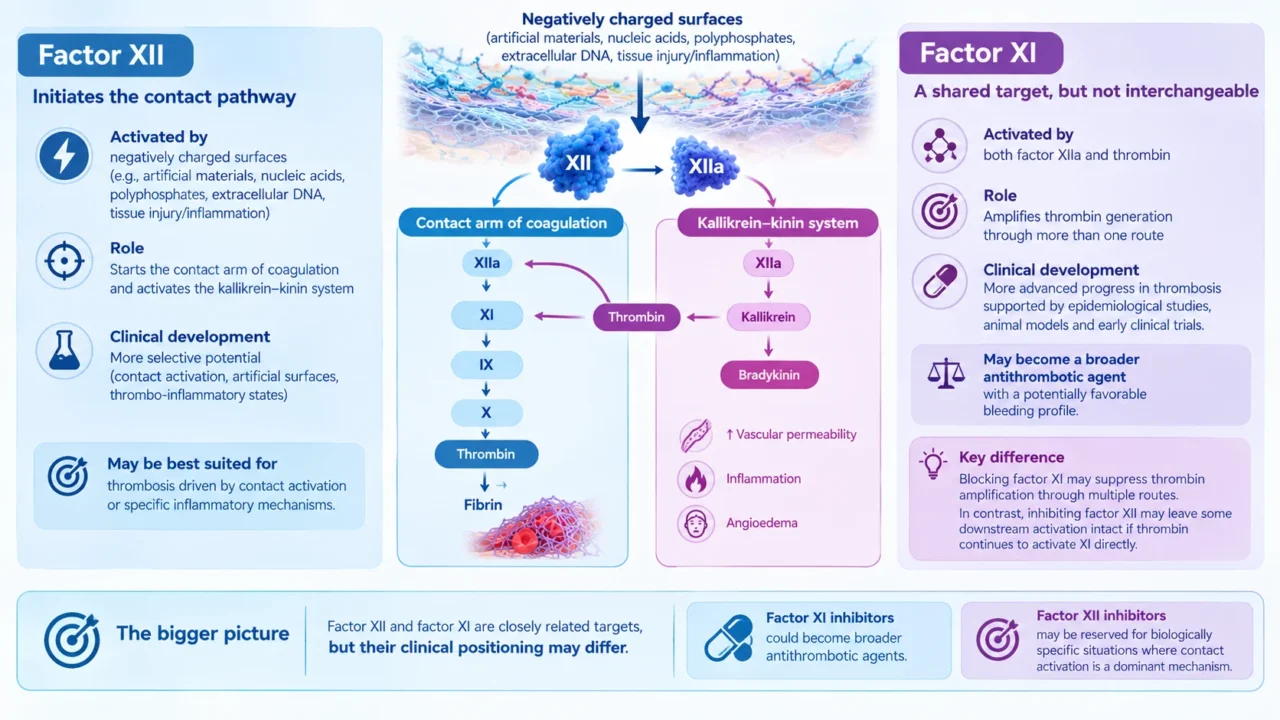
Factor XII and factor XI are closely related targets, but they are not interchangeable.
Factor XII initiates the contact pathway, whereas factor XI can be activated by both factor XIIa and thrombin. This means that factor XI inhibition may suppress thrombin amplification through more than one route. In contrast, blocking factor XII may leave some downstream activation intact if thrombin continues to activate factor XI directly.
For this reason, factor XI inhibitors currently have a more advanced clinical development pathway in thrombosis. Epidemiological studies, animal models and early clinical trials have provided relatively strong support for the concept that factor XI can be inhibited to reduce thrombosis with a potentially favorable bleeding profile.
Factor XII inhibition may prove more selective. Its greatest value could emerge in thrombosis driven by contact activation, artificial surfaces or thrombo-inflammatory mechanisms rather than in every form of venous or arterial thrombosis.
This distinction may eventually shape the clinical positioning of these therapies. Factor XI inhibitors could become broader antithrombotic agents, while factor XII inhibitors may be reserved for biologically specific situations in which contact activation is a dominant mechanism.
Garadacimab: The First Major Clinical Validation
The most advanced example of factor XIIa inhibition is garadacimab, a monoclonal antibody that binds activated factor XII and inhibits its enzymatic activity.
Its first major clinical application has not been anticoagulation. Instead, garadacimab was developed for hereditary angioedema, a disorder in which dysregulated contact-system activation increases bradykinin generation and causes recurrent episodes of tissue swelling.
In June 2025, the U.S. Food and Drug Administration approved garadacimab-gxii, marketed as Andembry, for the prophylaxis of hereditary angioedema attacks in adults and children aged 12 years or older. It became the first FDA-approved prophylactic therapy specifically targeting factor XIIa, with once-monthly subcutaneous administration.
In the pivotal clinical program, factor XIIa inhibition substantially reduced the frequency of hereditary angioedema attacks. The FDA review reported a model-estimated mean monthly attack rate of 0.22 with garadacimab compared with 2.07 with placebo, corresponding to an approximately 89% relative reduction. Importantly, the studies did not identify a signal of clinically significant bleeding or a major increase in thromboembolic events.
These findings do not establish garadacimab as an anticoagulant for venous thromboembolism or arterial thrombosis. Patients with hereditary angioedema are not equivalent to patients receiving treatment for atrial fibrillation, cancer-associated thrombosis or acute pulmonary embolism, and the trials were not designed to assess thrombotic efficacy.
They do, however, provide an important proof of principle. Long-term pharmacological inhibition of factor XIIa is clinically feasible, and sustained suppression of this pathway does not necessarily result in the bleeding phenotype associated with more downstream anticoagulant targets.
Where Could Factor XII Inhibition Matter Most?
Medical devices and extracorporeal circuits
Thrombosis related to artificial surfaces may represent the clearest potential application. Contact activation can contribute to clot formation within dialysis circuits, catheters, extracorporeal support systems and other blood-contacting devices.
A factor XII-directed strategy could reduce clotting within these systems without producing the same degree of systemic anticoagulation. This would be particularly valuable for patients in whom conventional heparin or direct anticoagulants are limited by bleeding risk.
The challenge is to demonstrate more than laboratory or circuit-based efficacy. Future trials will need to show that factor XII inhibition improves clinically meaningful outcomes, such as circuit survival, reduction in transfusion requirements, fewer interruptions of therapy and lower rates of patient-associated thrombosis.
Thrombo-inflammatory disease
The contact pathway is activated by neutrophil extracellular traps, extracellular DNA, polyphosphates and other inflammatory structures. These mechanisms are relevant to cancer-associated thrombosis, severe infection, autoimmune disease and inflammatory vascular injury.
Factor XIIa inhibition could therefore have effects extending beyond fibrin formation. By suppressing both contact-system coagulation and kallikrein–kinin activation, it may influence the interaction between thrombosis and inflammation.
This remains an attractive but largely investigational concept. It is not yet clear whether inhibiting factor XIIa will produce clinically meaningful anti-inflammatory effects in patients, or whether the pathway is sufficiently dominant across different diseases to justify treatment.
High-risk anticoagulation settings
A safer antithrombotic profile could be particularly valuable in patients with a high risk of intracranial or gastrointestinal bleeding. Potential future populations may include patients requiring thrombosis prevention after intracranial hemorrhage, individuals with cancer and competing bleeding risks, or patients who need prolonged anticoagulation but cannot tolerate current agents.
This possibility should be approached cautiously. A lower bleeding risk does not automatically guarantee adequate protection against thrombosis. The central question will be whether factor XII inhibition provides enough antithrombotic efficacy in the specific disease mechanism being treated.
The Main Scientific and Clinical Challenges
The first challenge is biological heterogeneity. Contact activation may be central in one thrombotic setting but relatively unimportant in another. A factor XII inhibitor that performs well in artificial-surface thrombosis may not provide sufficient protection against thrombin generation driven primarily by tissue factor.
The second challenge is pathway redundancy. Thrombin can activate factor XI independently of factor XIIa, potentially bypassing the blocked pathway. This may limit the efficacy of factor XII inhibition in established thrombi or in diseases with intense tissue factor activity.
The third challenge concerns laboratory monitoring. Factor XII inhibition can prolong the activated partial thromboplastin time without necessarily causing clinical bleeding. Conventional coagulation assays may therefore overestimate the functional anticoagulant effect or incorrectly suggest a bleeding tendency. New pharmacodynamic assays will be needed to evaluate thrombin generation, contact-system activity and the relationship between drug exposure and clinical outcomes.
Reversal is another important consideration. Monoclonal antibodies have prolonged biological activity, which may complicate urgent surgery or management of unexpected adverse events. The development of neutralizing agents or other rapid reversal strategies could become essential if these therapies are used in vulnerable patients.
Finally, clinical trial design will be decisive. Trials must move beyond surrogate outcomes such as clotting time or device patency and evaluate recurrent thrombosis, major bleeding, mortality, functional recovery and quality of life.
From One-Size-Fits-All Anticoagulation to Mechanism-Based Therapy
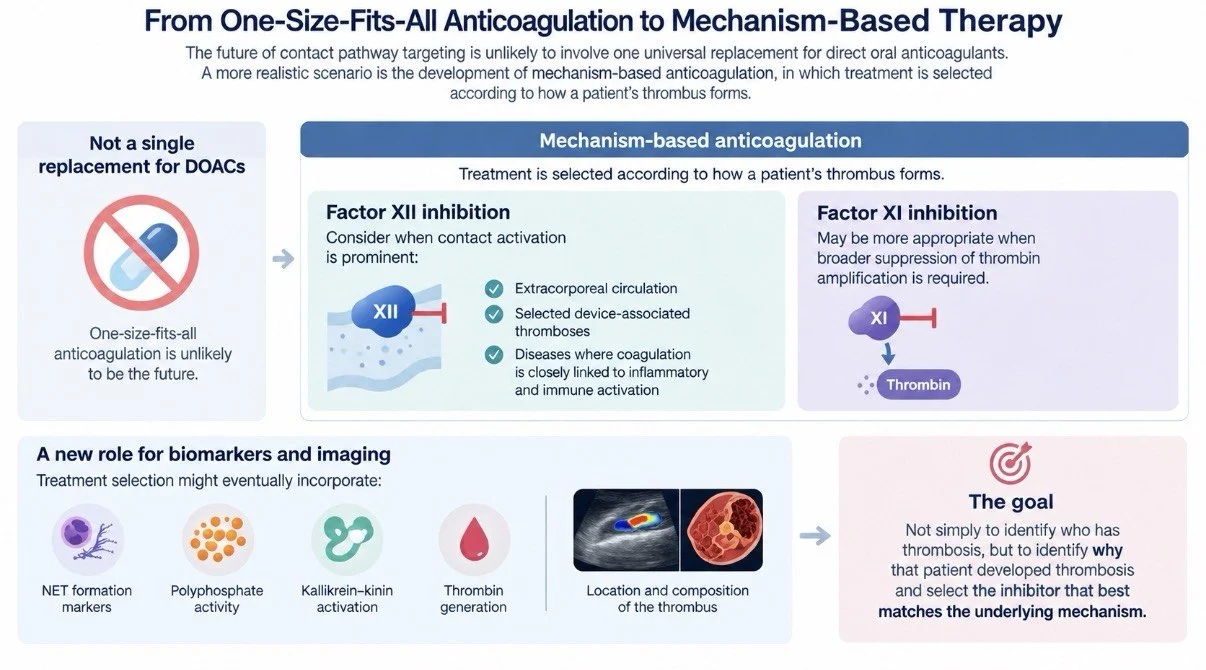
The future of contact pathway targeting is unlikely to involve one universal replacement for direct oral anticoagulants. A more realistic scenario is the development of mechanism-based anticoagulation, in which treatment is selected according to how a patient’s thrombus forms.
In this model, factor XII inhibition could be considered when contact activation is prominent: during extracorporeal circulation, in selected device-associated thromboses, or in diseases where coagulation is closely linked to inflammatory and immune activation. Factor XI inhibition may be more appropriate when broader suppression of thrombin amplification is required.
This approach would also change the role of biomarkers and imaging. Treatment selection might eventually incorporate markers of NET formation, polyphosphate activity, kallikrein–kinin activation or thrombin generation, together with the location and composition of the thrombus.
The objective would not simply be to identify who has thrombosis. It would be to identify why that patient developed thrombosis and select the inhibitor that best matches the underlying mechanism.
What the Next Trials Must Show
The next generation of factor XII studies will need to answer several practical questions. Can inhibition reduce clinically important thrombosis rather than only laboratory activation? Does it provide a meaningful safety advantage over factor XI, factor Xa or thrombin inhibition? Which patients benefit most? Can the therapy be used safely during procedures, extracorporeal support or prolonged outpatient treatment?
The field will also need to establish whether factor XII inhibition is most effective as monotherapy or as part of a layered strategy. Combination treatment with antiplatelet agents, low-intensity anticoagulation or device-based interventions may be useful, but each combination could alter the bleeding profile.
Garadacimab has demonstrated that factor XIIa can be safely and effectively targeted in hereditary angioedema. The next step is more demanding: proving that the same biological pathway can be exploited to prevent or treat thrombosis in carefully selected clinical settings.
The Future of Contact Pathway Targeting
Factor XII inhibition represents one of the most conceptually interesting developments in anticoagulant research. It challenges the traditional assumption that effective thrombosis prevention must inevitably compromise normal hemostasis.
The evidence available today supports a measured conclusion. Factor XII is a credible and biologically distinctive target, particularly in contact activation, device-related thrombosis and thrombo-inflammatory disease. Its clinical role in thrombosis, however, remains unestablished, and the success of factor XIIa inhibition in hereditary angioedema should not be extrapolated directly to venous or arterial thromboembolic disease.
The future will probably not belong to a single new anticoagulant. It will belong to more precise treatment strategies that distinguish thrombosis driven by tissue factor, platelets, inflammation, artificial surfaces or contact activation.
Factor XII inhibition may become an important part of that future—not because it suppresses coagulation indiscriminately, but because it may allow clinicians to target a pathological component of coagulation while preserving more of the hemostatic system patients need.
Frequently Asked Questions
1. What is factor XII?
Factor XII is a blood protein that initiates the contact pathway of coagulation.
2. What is the contact pathway?
It is a coagulation pathway activated by negatively charged surfaces, inflammation and artificial materials.
3. Why target factor XII?
Factor XII may promote thrombosis while contributing relatively little to normal hemostasis.
4. Does factor XII deficiency cause bleeding?
Usually not. Despite prolonged aPTT, most patients do not have clinically significant bleeding.
5. Does factor XII deficiency prevent thrombosis?
No. Current evidence does not show reliable protection against thrombosis.pubmed.ncbi.nlm.nih
6. How does factor XII inhibition differ from factor Xa inhibition?
Factor XII inhibitors act earlier and more selectively in the coagulation cascade.
7. What is garadacimab?
Garadacimab is a monoclonal antibody that inhibits activated factor XII.
8. Is garadacimab approved as an anticoagulant?
No. It is approved for hereditary angioedema prevention, not thrombosis treatment.accessdata.fda+1
9. Where could factor XII inhibitors be useful?
Potential applications include dialysis circuits, catheters and other artificial blood-contacting surfaces.
10. Will factor XII inhibitors replace current anticoagulants?
Probably not. They are more likely to become targeted therapies for selected patients.
Written by Anna Stepanyan, MD
Stay updated with Hemostasis Today.
-
Sep 24, 2026, 08:55Andres Gudino: Clot Characterization Through Hounsfield Units in Ischemic Stroke
-
Sep 24, 2026, 06:52Gina Sado: Screening-Detected Atrial Fibrillation Carries High Risk of Heart Failure
-
Sep 24, 2026, 06:33Benjamin Vipler: Optimal Oral Anticoagulation Choice in Atrial Fibrillation and Advanced CKD
-
Sep 24, 2026, 06:08Christopher Salerno: AI-Powered At-Home Anemia Screening Advances Telehealth Access
-
Sep 24, 2026, 05:38Aya Qattan: When a Normal CBC Does Not Mean Normal Iron Status
-
Sep 24, 2026, 05:11Mastering Warm Autoimmune Hemolytic Anemia Diagnosis and Practice – ASH Education
-
Sep 23, 2026, 16:04Monia Ezzalfani: Advancing Patient-Centered Care in Hemophilia A and B
-
Sep 23, 2026, 15:49Bilge Başak: How Activated PRP Modulates Osteoarthritic Chondrocyte Function
-
Sep 23, 2026, 14:50Mbonjo Bitsie Dora: Strengthening Sickle Cell Care Through Education, Awareness and Innovation