

Fostamatinib in Immune Thrombocytopenia: Targeting Spleen Tyrosine Kinase to Reduce Platelet Destruction
Immune thrombocytopenia (ITP) is an autoimmune disorder in which the immune system mistakenly attacks the body’s own platelets. The resulting low platelet count can cause easy bruising, pinpoint skin hemorrhages, gum or nose bleeding, and, in more severe cases, serious internal bleeding. Although ITP is often described as a disease of excessive platelet destruction, impaired platelet production may also contribute to the low platelet count.
Fostamatinib is an oral small-molecule inhibitor of spleen tyrosine kinase, commonly known as SYK. It represents a targeted approach to ITP because it does not primarily aim to increase platelet production. Instead, it interferes with the immune signaling pathways that allow antibody-coated platelets to be recognized and destroyed.
The Immune Mechanism of ITP
In ITP, the immune system produces autoantibodies that bind to platelets. These antibody-coated platelets are then recognized by macrophages, particularly in the spleen, through Fc gamma receptors. Once recognized, the platelets are engulfed and destroyed by phagocytosis.
SYK is an intracellular signaling enzyme that plays a central role in this process. When an antibody-coated platelet binds to an activating Fc receptor on a macrophage, SYK-dependent signaling helps initiate the cellular response that leads to platelet uptake and destruction. By inhibiting SYK, fostamatinib interrupts this pathway and reduces antibody-mediated platelet clearance.
How Fostamatinib Works
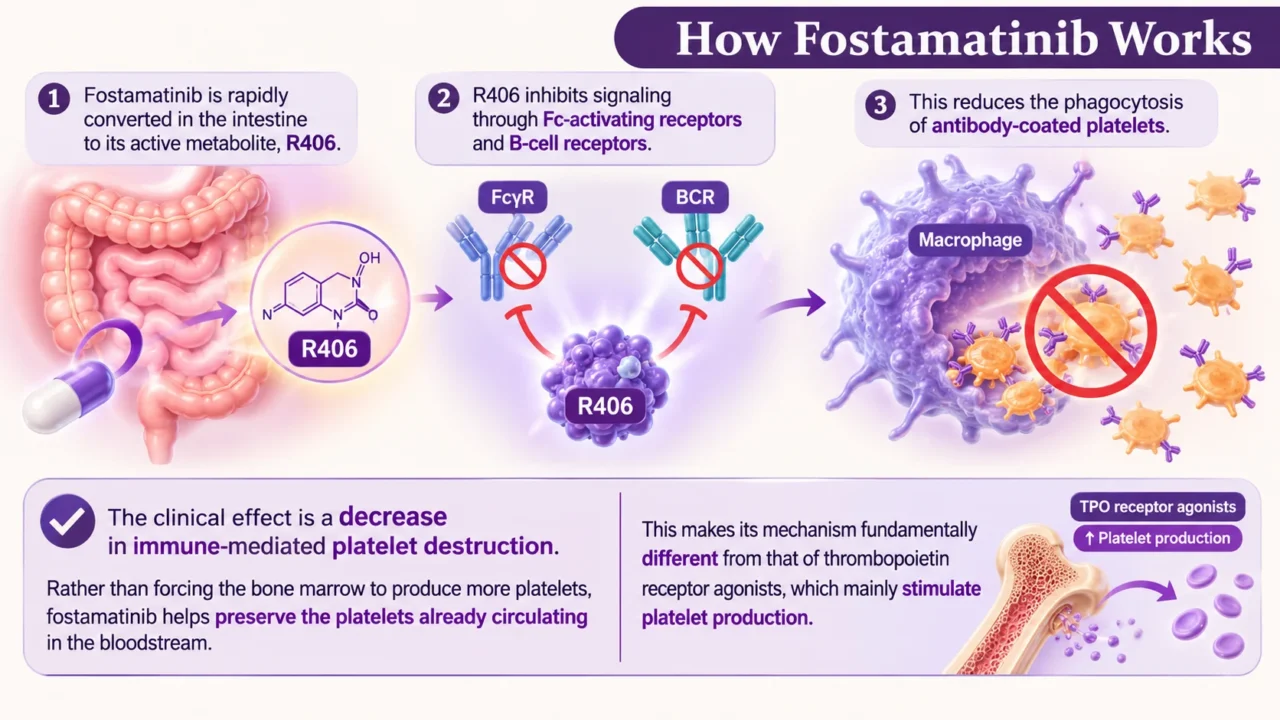
Fostamatinib is rapidly converted in the intestine to its active metabolite, R406. This metabolite inhibits signaling through Fc-activating receptors and B-cell receptors, thereby reducing the phagocytosis of antibody-coated platelets.
The clinical effect is a decrease in immune-mediated platelet destruction. Rather than forcing the bone marrow to produce more platelets, fostamatinib helps preserve the platelets already circulating in the bloodstream. This makes its mechanism fundamentally different from that of thrombopoietin receptor agonists, which mainly stimulate platelet production.
Clinical Effectiveness
Fostamatinib has been studied in adults with persistent or chronic ITP who had previously received multiple treatments, including corticosteroids, thrombopoietin receptor agonists, rituximab, and sometimes splenectomy. In the pivotal phase 3 trials, significantly more patients treated with fostamatinib achieved platelet counts of at least 50 \times 10^9/L than patients receiving placebo.
In the pooled analysis of two randomized trials, 43 of 101 patients treated with fostamatinib achieved at least one platelet count of 50 \times 10^9/L or higher, compared with 7 of 49 patients who received placebo. A stable response, defined as maintaining platelet counts above 50 \times 10^9/L in at least four of six scheduled assessments, was achieved by 18 patients in the fostamatinib group and only one patient in the placebo group.
For many patients who respond, the increase in platelet count occurs within the first few weeks of treatment. Long-term follow-up has shown that many responders maintain clinically meaningful platelet counts for at least 12 months, and some continue to respond beyond 24 months.
Place in Treatment
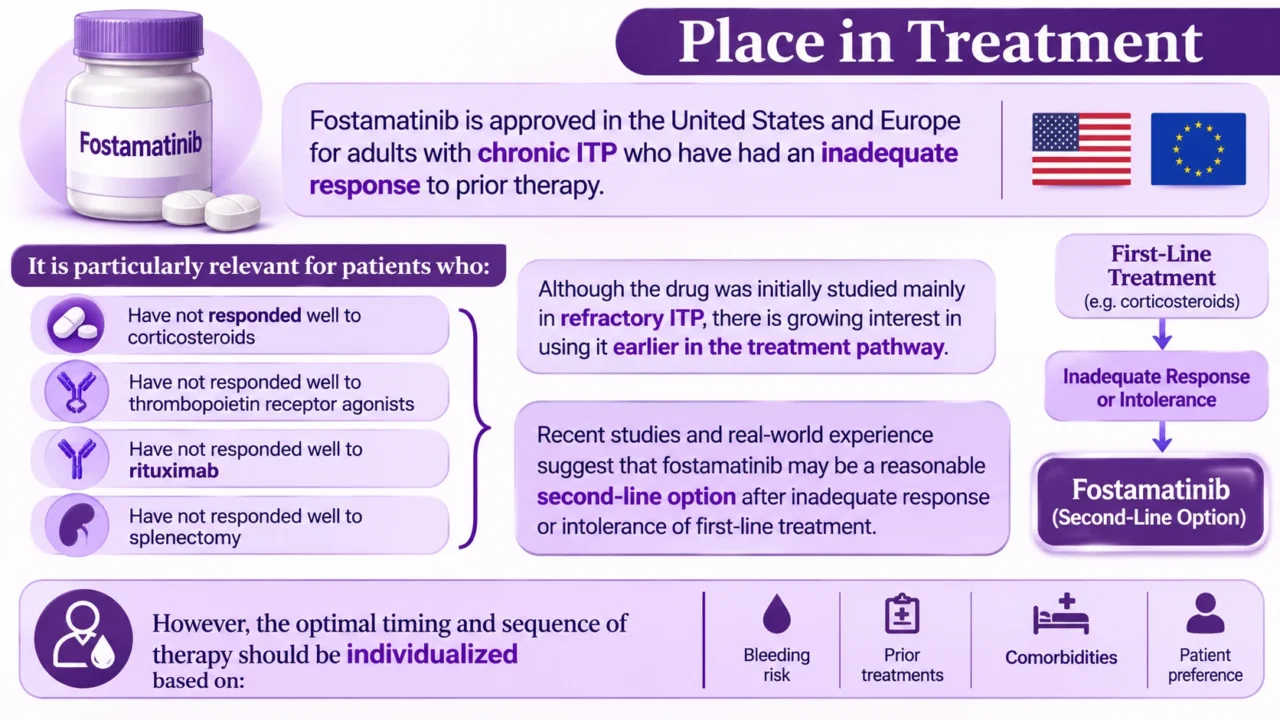
Fostamatinib is approved in the United States and Europe for adults with chronic ITP who have had an inadequate response to prior therapy. It is particularly relevant for patients who have not responded well to corticosteroids, thrombopoietin receptor agonists, rituximab, or splenectomy.
Although the drug was initially studied mainly in refractory ITP, there is growing interest in using it earlier in the treatment pathway. Recent studies and real-world experience suggest that fostamatinib may be a reasonable second-line option after inadequate response or intolerance of first-line treatment. However, the optimal timing and sequence of therapy should be individualized based on bleeding risk, prior treatments, comorbidities, and patient preference.
Early Use in Second- or Third-Line Therapy
A 2026 multicenter Spanish study, Early Use of Fostamatinib in Immune Thrombocytopenia, examined whether fostamatinib could be effective when introduced earlier in the treatment pathway rather than being reserved for heavily pretreated patients. The study included 72 adults treated at 22 Spanish centers, with 25 patients receiving the drug as second-line therapy and 47 as third-line therapy.
The patients had a median age of 67 years, and most were women. Their median baseline platelet count was 28 \times 10^9/L, while the median time from ITP diagnosis to the start of fostamatinib was 17 months. Bleeding symptoms were present in 26.4 percent of patients during the month before treatment.
The results were strongly supportive of earlier use. Overall, 83.3 percent of patients achieved a response, defined as a platelet count of at least 30 \times 10^9/L with at least a twofold increase from baseline and control of bleeding. A complete response, meaning a platelet count of at least 100 \times 10^9/L, was achieved by 65.3 percent of patients.
Response rates were high in both treatment settings: 76.0 percent among patients receiving fostamatinib as second-line therapy and 87.2 percent among those receiving it as third-line therapy. Complete responses were observed in 56.0 percent and 70.2 percent of these groups, respectively. The median time to platelet response was only 10.5 days, while the median time to the highest platelet count was 62 days.
What the Study Suggests
These findings suggest that fostamatinib may provide meaningful benefit not only in refractory ITP but also when used relatively early after inadequate response to first-line corticosteroids or one additional systemic treatment. The authors argue that earlier introduction of the drug may optimize clinical benefit, particularly because second-line use was associated with faster platelet recovery than third-line use.
The study also found that most patients continued fostamatinib as monotherapy. Among those who needed additional treatment, corticosteroids and intravenous immunoglobulin were the most common concomitant therapies. The possibility of reducing or stopping other ITP medications is clinically important, especially for patients who experience steroid-related adverse effects or require repeated rescue treatment.
Safety in Routine Practice
Fostamatinib was generally well tolerated in this real-world cohort. Adverse events occurred in 44.4 percent of patients, but most were mild or moderate in severity. The most frequent effects were diarrhea, hypertension, and headache; liver enzyme abnormalities and neutropenia were also reported.
Treatment discontinuation because of adverse effects occurred in 15.3 percent of patients. Three patients experienced thromboembolic events, including deep vein thrombosis and pulmonary embolism, but all had additional established thrombotic risk factors unrelated to fostamatinib. The authors therefore emphasized that these events should be interpreted in the context of each patient’s underlying risk rather than attributed solely to the drug.
Importance for Clinical Practice
This study strengthens the argument that fostamatinib should not be viewed exclusively as a last-resort treatment. Its high response rates, rapid onset of action, and acceptable tolerability support its consideration as a second- or third-line option in adults with ITP.
At the same time, the study was observational and lacked a control group, so its findings cannot prove that fostamatinib is superior to other second-line therapies. Nevertheless, the consistency of the results with prior phase 3 trials and other real-world studies makes a strong case for including SYK inhibition earlier in individualized ITP treatment strategies.
Real-World Evidence From a Japanese Study
A recent single-center retrospective study from Japan, published in International Journal of Hematology, evaluated the real-world effectiveness and safety of fostamatinib in patients with immune thrombocytopenia. The study included 11 patients and assessed treatment outcomes both with fostamatinib alone and in combination with thrombopoietin receptor agonists.
The results showed a rapid platelet response after treatment initiation. Among the three patients evaluable at week 1, all achieved a platelet count of at least 30,000/μL and at least a twofold increase from baseline. By week 2, 10 of 11 patients, or 90.9 percent, met the response criteria. Overall, 10 of 11 patients achieved the response threshold at least once within 24 weeks.
This study is important because it provides evidence outside the controlled setting of randomized clinical trials. It suggests that the platelet-count improvement seen with fostamatinib in phase 3 studies can also be observed in routine clinical practice, often within one to two weeks of starting treatment.
The authors concluded that fostamatinib demonstrated real-world effectiveness and acceptable safety in patients with ITP. Although the sample size was small and the design was retrospective, the findings support the practical value of SYK inhibition as a treatment strategy, particularly in patients who need a rapid response or have limited options after prior therapies.
The study also reinforces the central message of fostamatinib’s mechanism: by targeting SYK-dependent immune signaling, the drug reduces the destruction of antibody-coated platelets and can produce clinically meaningful increases in platelet count. This real-world evidence complements the earlier phase 3 FIT1 and FIT2 trials, which established fostamatinib’s efficacy in previously treated adults with persistent or chronic ITP.
Safety and Monitoring
The most common adverse effects of fostamatinib include diarrhea, nausea, hypertension, and elevated liver enzymes. These effects are usually manageable with dose adjustment, supportive treatment, or antihypertensive therapy, but they require regular monitoring.
Patients receiving fostamatinib should have their blood pressure checked regularly, because the drug can increase both systolic and diastolic blood pressure. Liver function tests should also be monitored, as hepatotoxicity and transaminase elevations have been reported. A complete blood count is important to detect neutropenia, and clinicians should review potential drug interactions, particularly with strong inhibitors or inducers of CYP3A4.
Unlike some thrombopoietin receptor agonists, fostamatinib has not shown a major signal for thromboembolic events. Nevertheless, each patient’s cardiovascular and thrombotic risk should still be assessed individually, especially when other risk factors are present.
Conclusion
Fostamatinib offers a targeted treatment strategy for immune thrombocytopenia by inhibiting SYK-dependent signaling and reducing antibody-mediated platelet destruction. Its mechanism addresses one of the central problems in ITP: the immune system’s removal of antibody-coated platelets by macrophages.
For adults with persistent or chronic ITP who have not achieved an adequate response to previous therapies, fostamatinib provides an important alternative. By protecting circulating platelets from immune-mediated destruction, it can help increase platelet counts, reduce bleeding risk, and improve the management of a disease that can be difficult to control with conventional treatments.
FAQs
1. What is fostamatinib?
Fostamatinib is an oral medication that inhibits spleen tyrosine kinase, or SYK. It is used to treat adults with persistent or chronic immune thrombocytopenia (ITP) who have not had an adequate response to previous treatments.
2. How does fostamatinib affect platelets?
It does not mainly stimulate platelet production. Instead, it reduces immune-mediated platelet destruction by inhibiting SYK-dependent signaling, which prevents macrophages from engulfing antibody-coated platelets.
3. Why is SYK important in ITP?
SYK is involved in signaling through Fc receptors, which allow immune cells to recognize and destroy platelets coated with autoantibodies. This process is particularly active in the spleen.
4. Who is fostamatinib intended for?
It is intended for adults with ITP whose platelet count has not increased adequately after prior therapy. Previous treatments may include corticosteroids, thrombopoietin receptor agonists, rituximab, or splenectomy.
5. Can fostamatinib be used earlier in treatment?
Yes. Recent studies suggest that it may be effective not only in difficult-to-treat cases but also as second- or third-line therapy. In a Spanish multicenter study, the overall response rate was 83.3 percent, while 65.3 percent achieved a complete response.
6. How quickly does it work?
In clinical studies, platelet counts often begin to rise within the first two weeks in patients who respond. In the Spanish study, the median time to platelet response was approximately 10.5 days.
7. What side effects can it cause?
The most common side effects are diarrhea, nausea, headache, high blood pressure, and elevated liver enzymes. Neutropenia can also occur.
8. What monitoring is needed during treatment?
Blood pressure, liver function, complete blood counts, and neutrophil levels should be monitored regularly. Patients should also inform their clinician about all medications they take, because some drugs may interact with fostamatinib.
9. Does fostamatinib increase the risk of blood clots?
Fostamatinib has not shown the same concerning thromboembolic signal associated with some thrombopoietin receptor agonists. However, thromboembolic events have been reported in some patients, so individual thrombotic risk should still be assessed by a clinician.
10. What does “response” to fostamatinib mean?
A response is often defined as a platelet count of at least 30 \times 10^9/L, at least a twofold increase from baseline, and control of bleeding. A complete response is generally defined as a platelet count of at least 100 \times 10^9/L.
Written by Anna Stepanyan, MD
Stay updated with Hemostasis Today.
-
Nov 20, 2026, 14:37Giuseppe Leone: The Evolving Treatment Landscape of Adult ITP
-
Nov 20, 2026, 14:25Sameer A.: When Heparin Triggers Thrombosis – A Case of HIT
-
Nov 20, 2026, 14:21Chris Oung: Postoperative VTE Risk and Timing Across Surgical Specialties
-
Nov 20, 2026, 14:17Melissa Pickett: HIT Detection Can Miss a Critical Platelet Decline
-
Nov 20, 2026, 14:02Hasan Burak İşleyen։ Thrombocytopenia and Mortality in Critically Ill Cancer Patients
-
Nov 20, 2026, 13:50Louise Maes: CONVINCE Trial Imaging Studies Reveal New Insights Into Carotid Plaque and Vascular Risk
-
Nov 20, 2026, 13:50Lara Kurdi: A Presentation of Triple-Positive Antiphospholipid Syndrome
-
Nov 20, 2026, 13:46Rahul Bohra: Beyond Platelet Counts – The Lived Experience of ITP
-
Nov 20, 2026, 13:34Yohei Hisada: How Well Do Mouse Leukemia Models Reflect Human Disease?