

Nipocalimab for Warm Autoimmune Hemolytic Anemia: What the FDA Approval Means
The U.S. Food and Drug Administration (FDA) approved nipocalimab-aahu (Imaavy) for the treatment of warm autoimmune hemolytic anemia (wAIHA) in adults and children aged 12 years and older who are currently or previously treated with corticosteroids.
It is the first FDA-approved drug specifically indicated for wAIHA.
The approval introduces a targeted approach to a disease traditionally managed with corticosteroids, rituximab and other immunosuppressive therapies.
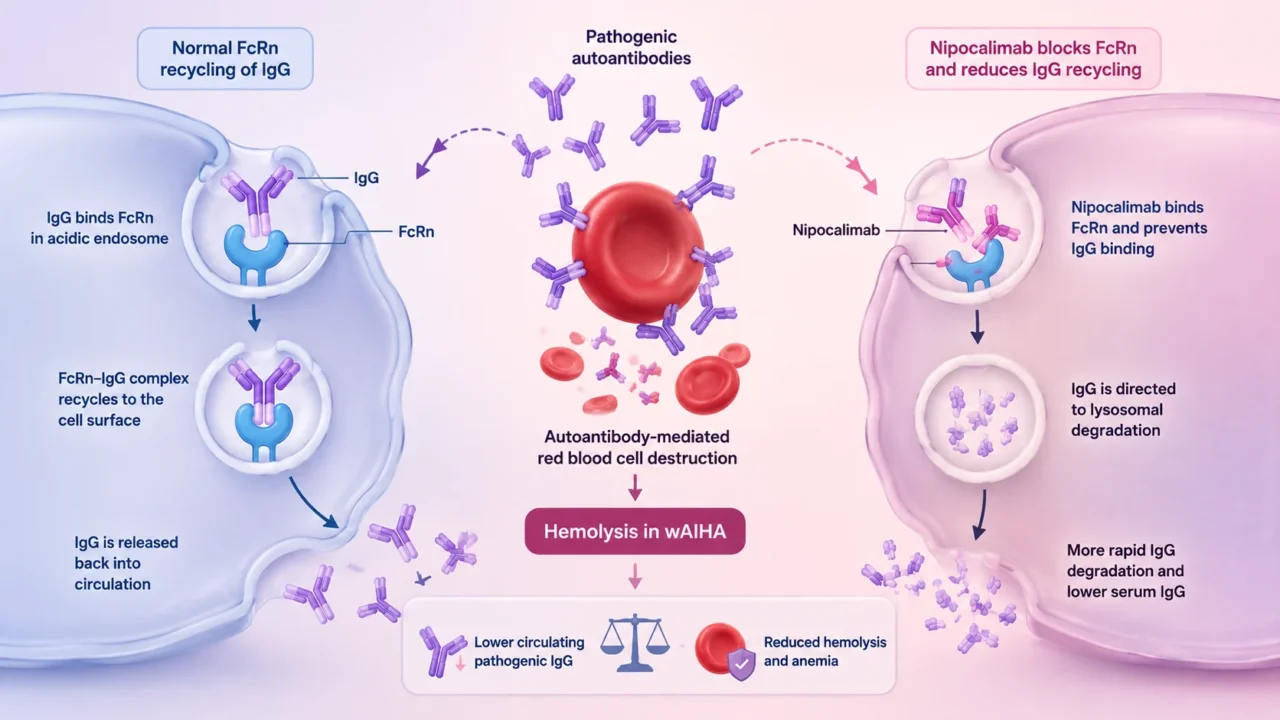
Nipocalimab targets the neonatal Fc receptor (FcRn), an important regulator of IgG levels in the circulation. By blocking this receptor, the drug increases IgG breakdown and reduces circulating IgG, including pathogenic autoantibodies.
Why Is wAIHA Difficult to Treat?
Warm autoimmune hemolytic anemia is primarily driven by IgG autoantibodies against red blood cells. These antibodies usually cause extravascular hemolysis, mainly in the spleen and liver.
Patients may develop anemia, fatigue, jaundice and laboratory evidence of hemolysis. A positive direct antiglobulin test is also typical.
Corticosteroids remain the traditional first-line treatment. However, relapses are common, and prolonged steroid exposure can cause significant toxicity.
Rituximab and other immunosuppressive therapies are used in relapsed or refractory disease. Until now, however, wAIHA had no FDA-approved treatment specifically indicated for the condition.
The FcRn–IgG Pathway
The neonatal Fc receptor (FcRn) helps maintain IgG levels by protecting antibodies from intracellular degradation. It binds IgG inside cells and allows it to return to the circulation.
This recycling process extends the half-life of IgG. In wAIHA, however, the circulating IgG pool also contains pathogenic autoantibodies.
Nipocalimab blocks FcRn and reduces IgG recycling. As a result, IgG is broken down more rapidly and circulating pathogenic antibodies can decrease.
From Mechanism to Clinical Evidence
The clinical development of nipocalimab in wAIHA has focused on the ENERGY trial (NCT04119050), a randomized, double-blind, placebo-controlled Phase 2/3 study. The trial enrolled adults with established wAIHA who were currently receiving or had previously received treatment.
In the pivotal analysis, 115 adults were randomized to nipocalimab 30 mg/kg every four weeks, nipocalimab 15 mg/kg every two weeks, or placebo. The primary endpoint was a durable hemoglobin response, designed to assess sustained improvement rather than a temporary rise in hemoglobin.
What Did the ENERGY Trial Show?
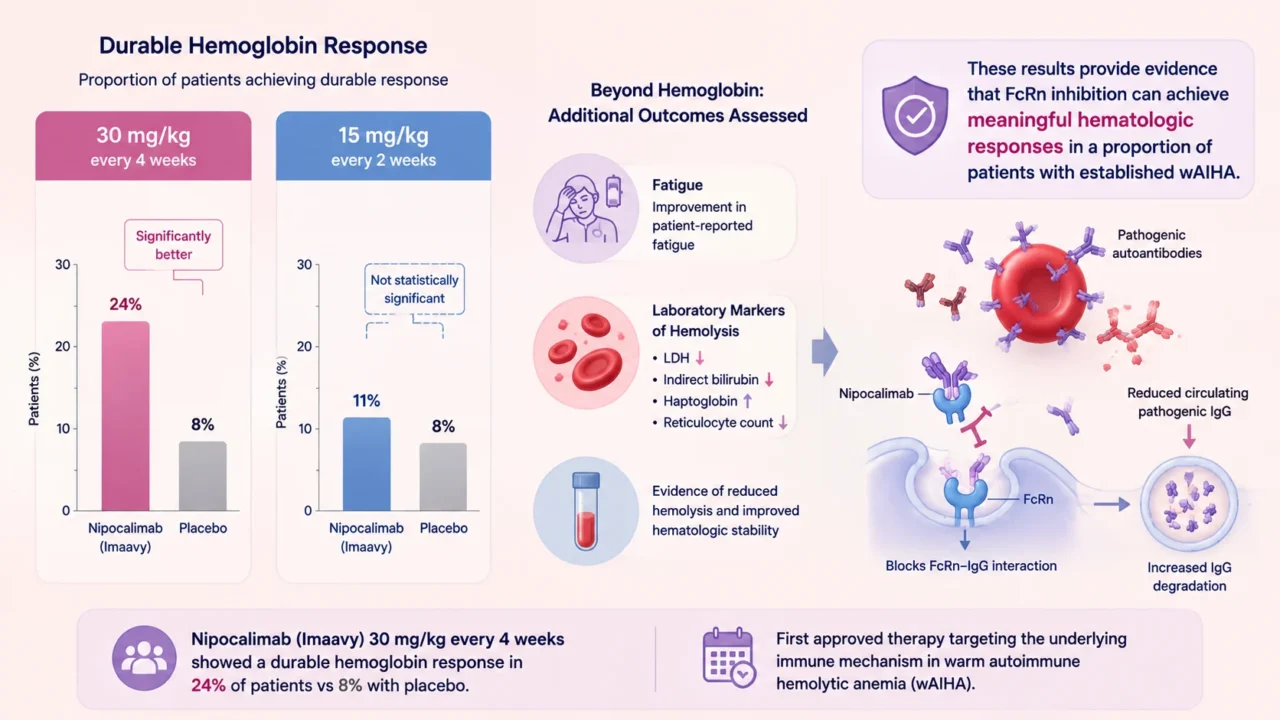
The 30 mg/kg every-four-weeks regimen produced a durable hemoglobin response in 24% of patients, compared with 8% with placebo. The 15 mg/kg every-two-weeks regimen did not demonstrate a statistically significant advantage over placebo.
The study also assessed fatigue and laboratory markers of hemolysis. These outcomes are relevant because the clinical impact of wAIHA extends beyond the hemoglobin concentration itself.
The results provide evidence that FcRn inhibition can achieve meaningful hematologic responses in a proportion of patients with established wAIHA.
A Different Approach to Autoantibody Reduction
Traditional treatment generally works by suppressing immune activity and reducing autoantibody production.
Nipocalimab takes a different approach. It targets FcRn, reducing IgG recycling and increasing IgG breakdown.
This does not eliminate the underlying autoimmune clone. Instead, it changes the lifespan and circulating concentration of IgG.
Safety: The Other Side of Lowering IgG
The same mechanism that makes FcRn blockade effective also creates important safety considerations.
Because FcRn protects IgG from degradation, its inhibition reduces total circulating IgG, not only pathogenic autoantibodies. This makes infection risk and immunoglobulin levels important considerations during treatment.
Vaccination status should also be considered before treatment. The FDA prescribing information recommends avoiding live vaccines during therapy because of the effects of FcRn blockade on IgG.
wAIHA itself is associated with an increased risk of thromboembolic complications. Therefore, the overall safety profile of any new therapy should be considered alongside the underlying thrombotic risk of the disease.
Where Could Nipocalimab Fit?
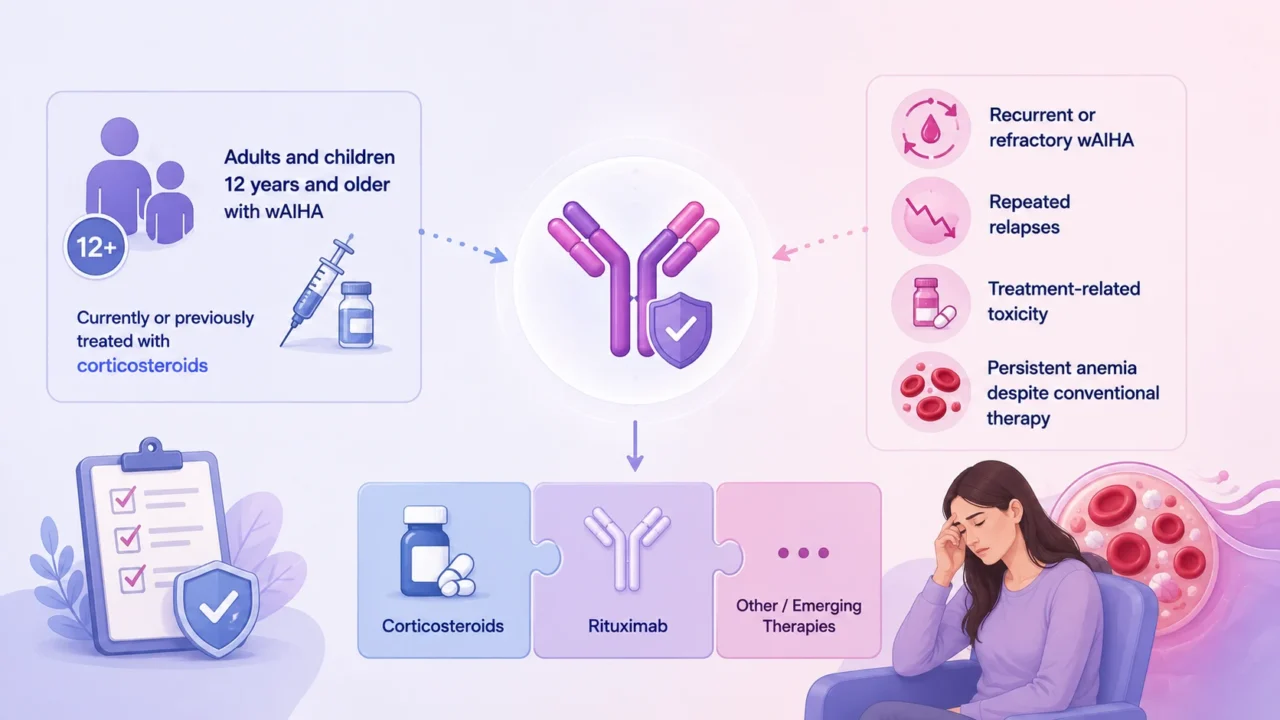
The new FDA indication applies to adults and children aged 12 years and older with wAIHA who are currently or previously treated with corticosteroids.
This does not mean that nipocalimab will immediately replace corticosteroids or rituximab. Its role will need to be defined within the evolving treatment landscape.
The need for additional options is clear. Patients with recurrent or refractory wAIHA may experience repeated relapses, treatment-related toxicity and persistent anemia despite conventional therapy.
FcRn Blockade and the Future of wAIHA
Nipocalimab is part of a broader shift toward targeted treatment of autoimmune diseases.
Instead of broadly suppressing immune activity, FcRn inhibition targets the circulating IgG pool. This provides a different way to intervene in diseases driven by pathogenic antibodies.
Other targeted approaches are also being investigated in wAIHA, including complement inhibition and therapies directed at B-cell function.
Nipocalimab therefore represents not only a new treatment option for wAIHA, but also a broader proof of concept for FcRn-directed therapy in antibody-mediated disease.
What Does the 2026 Approval Mean?
The FDA approval of nipocalimab marks an important development in wAIHA treatment. For the first time, patients with wAIHA have an FDA-approved therapy specifically targeting a key mechanism involved in IgG-mediated disease.
The ENERGY trial showed that a proportion of previously treated patients achieved durable hemoglobin responses. However, the majority did not meet the primary endpoint, highlighting the need for continued research and longer-term follow-up.
The significance of nipocalimab lies in its mechanism. Rather than replacing a missing component or broadly suppressing the immune system, it changes the way IgG is maintained in the circulation.
For wAIHA, this marks a move toward mechanism-based, antibody-directed therapy.
Written by Hermine Sayiyan, MD
-
Oct 16, 2026, 13:59Aya Akmal Amin: Antiphospholipid Syndrome Management and Risk Stratification
-
Oct 16, 2026, 13:10Emanuel Sueldo: CAHT 2026 Celebrates Scientific Progress and Team Achievements
-
Oct 16, 2026, 13:05Maha Othman: Queen’s Health Sciences Advances CAT Risk Models and Pediatric ISTH-BAT Cut-Offs
-
Oct 16, 2026, 13:03Thrombosis Awareness Must Lead to Timely Action – Roche
-
Oct 16, 2026, 12:49Wolfgang Miesbach: 5-Year CBDR Data Confirms Emicizumab Safety and Efficacy in Hemophilia A
-
Oct 16, 2026, 12:40Edward Lee Carter: How Factor XI Inhibition Could Transform Anticoagulation Therapy
-
Oct 16, 2026, 12:40Marc Carrier: Looking Ahead to ISTH 2027 in Vancouver
-
Oct 16, 2026, 12:30Bob Lempke: How One Blood Donation Can Save Up to Three Lives
-
Oct 16, 2026, 12:30Why VWF Therapies Belong on the EU Critical Medicines List – EHC