

Obstetric APS: From Standardized Anticoagulation to Biology-Driven Precision Care
A New Era Begins in Obstetric APS
Obstetric antiphospholipid syndrome (OAPS) remains one of the most challenging autoimmune conditions in maternal-fetal medicine.
Although major advances in diagnosis and treatment have improved pregnancy outcomes, a significant proportion of women continue to experience complications despite receiving guideline-based therapy.
The traditional approach has focused on preventing thrombosis with low-dose aspirin and low molecular weight heparin (LMWH). However, discussions at the ISTH 2026 Congress highlighted a fundamental shift in thinking: pregnancy complications in APS cannot be explained by coagulation abnormalities alone.
The future of OAPS management is moving beyond anticoagulation toward a deeper understanding of immune activation, placental dysfunction, vascular biology, and individualized risk assessment.
Why Does Standard Therapy Still Fail?
Despite appropriate treatment, approximately 20–30% of pregnancies affected by APS remain complicated by recurrent pregnancy loss, fetal growth restriction, preeclampsia, placental insufficiency, or premature delivery.
The reason is increasingly clear: APS-related pregnancy complications are driven by multiple biological pathways.
Antiphospholipid antibodies can trigger complement activation, endothelial injury, trophoblast dysfunction, inflammatory responses and abnormal angiogenesis, ultimately impairing placental development.
This explains why simply increasing anticoagulation intensity does not always improve outcomes.
The challenge is no longer only preventing clot formation – it is understanding and treating the complex biology of placental injury.
Moving Beyond “More Heparin”
One of the important messages from ISTH 2026 was a reconsideration of a common clinical approach: escalating LMWH doses after recurrent pregnancy complications.
Although increasing LMWH from prophylactic to higher doses is sometimes considered in refractory cases, current evidence does not demonstrate a clear improvement in live birth rates.
At the same time, higher doses may increase maternal bleeding risk and complicate obstetric management.
The key message is that treatment failure should not automatically lead to stronger anticoagulation.
Instead, it should prompt a deeper question:
What biological mechanism is driving disease in this individual patient?
This concept represents the foundation of precision medicine in APS.
From Anticoagulation to Immune-Targeted Therapies
The most exciting developments discussed at ISTH focused on therapies that address mechanisms beyond coagulation.
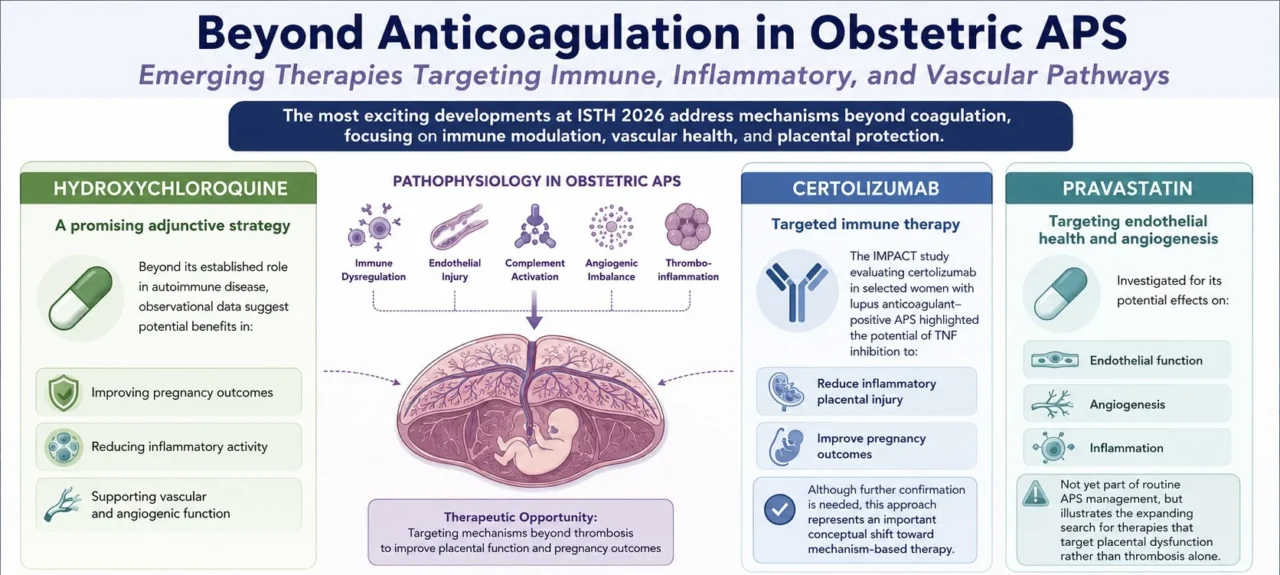
Hydroxychloroquine has emerged as one of the most promising adjunctive strategies.
Beyond its established role in autoimmune disease, observational data suggest potential benefits in improving pregnancy outcomes, reducing inflammatory activity, and supporting vascular and angiogenic function.
Another area generating significant interest is targeted immune therapy.
The IMPACT study evaluating certolizumab in selected women with lupus anticoagulant-positive APS highlighted the potential of TNF inhibition to reduce inflammatory placental injury and improve pregnancy outcomes. Although further confirmation is needed, this approach represents an important conceptual shift toward mechanism-based therapy.
Pravastatin is also being investigated because of its potential effects on endothelial function, angiogenesis, and inflammation. While it is not yet part of routine APS management, it illustrates the expanding search for therapies that target placental dysfunction rather than thrombosis alone.
The Future May Be Predicted by Biomarkers
Perhaps the most transformative message from the ISTH session was the growing importance of biomarkers.
Currently, clinicians often recognize treatment failure only after complications have already developed. Future management may allow earlier identification of women who are unlikely to respond to standard therapy.
Angiogenic biomarkers, particularly Placental Growth Factor (PlGF) and soluble fms-like tyrosine kinase-1 (sFlt-1), are becoming increasingly important in understanding placental health.
The sFlt-1/PlGF ratio provides insight into angiogenic imbalance and may help identify pregnancies at increased risk.
PROMISE study findings demonstrated that abnormal biomarker trajectories early in pregnancy were associated with severe complications, suggesting that biological monitoring could become a cornerstone of future APS care.
The goal is not simply to react to complications – but to predict them before they occur.
Redefining APS: Beyond Classification Criteria
Another important discussion at ISTH focused on the limitations of current APS classification criteria.
The Sydney and ACR/EULAR criteria were designed primarily for research purposes and may not capture the full clinical spectrum of APS. Some women experience severe pregnancy complications despite not fulfilling traditional laboratory definitions.
This has increased interest in the concept of non-criteria APS and the role of additional biomarkers, including antiphosphatidylserine/prothrombin antibodies and anti-β2 glycoprotein I Domain 1 antibodies.
The future may require a broader understanding of APS – not as a single disease entity, but as a biologically diverse syndrome. 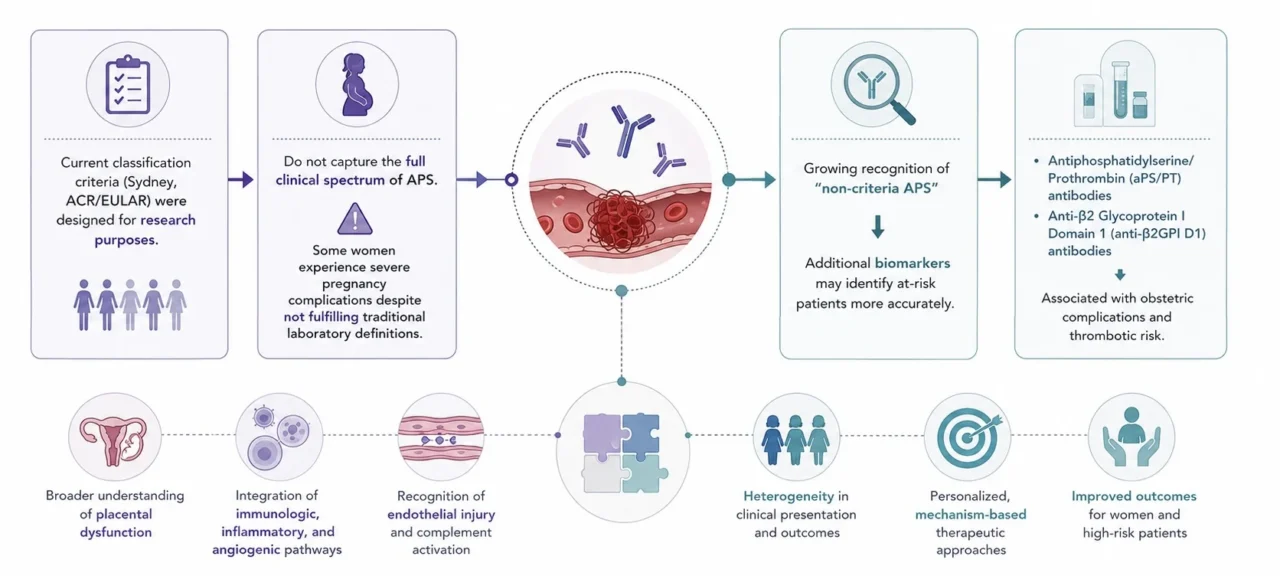
OAPS Is a Lifelong Condition
A crucial reminder from the session was that obstetric APS does not end after delivery.
Women with OAPS remain at increased risk of future thrombotic events, particularly those with lupus anticoagulant positivity, triple-positive antibody profiles, or associated systemic lupus erythematosus.
This highlights the importance of long-term cardiovascular risk assessment and follow-up. Pregnancy may be the first clinical manifestation of a lifelong vascular and immune disorder.
Toward AI-Driven Personalized APS Care
The next generation of APS management may integrate clinical characteristics, antibody profiles, molecular signatures, angiogenic biomarkers, and longitudinal pregnancy data into predictive models.
Artificial intelligence has the potential to identify which patients require standard therapy, who may benefit from additional immune-directed approaches, and who requires closer monitoring.
This represents a major transition – from treating all patients according to the same pathway toward individualized, biology-driven care.
The Future of Obstetric APS: Precision Instead of Protocols
The most important message from ISTH 2026 was not the introduction of a single new treatment. It was a change in perspective.
For decades, the central question was:
How can we prevent thrombosis in APS pregnancy?
The next era asks a different question:
Which biological pathway is responsible for disease in this patient, and how can we target it?
The future of obstetric APS will likely be shaped by the integration of immunology, hematology, vascular biology, placental science, biomarkers, and artificial intelligence.
After decades dominated by anticoagulation, OAPS is entering a new chapter:
from standardized therapy to precision medicine.
Written by Heghine Khachatryan, MD, PhD, Editor-in-Chief at Hemostasis Today.
Stay updated with Hemostasis Today.
-
Sep 16, 2026, 09:20Mengistu Abate Belay: Bridging the Gap in Anemia Prevention During Pregnancy
-
Sep 16, 2026, 09:09Younes Kalakhy: When Normal Coagulation Tests Miss von Willebrand Disease
-
Sep 16, 2026, 09:00Test Your Knowledge of Warm Autoimmune Hemolytic Anemia – ASH Education
-
Sep 16, 2026, 08:28Jean Nakhle: Uncovering How Excess Cysteine Drives Cell Death
-
Sep 16, 2026, 08:20Heghine Khachatryan: Arterial and Venous Thrombosis May Require Different Approaches in Neonates
-
Sep 16, 2026, 07:57Tammuella Chrisentery-Singleton: Standing on the Shoulders of Giants in Hemophilia Care
-
Sep 16, 2026, 07:33Jakob Werner Hansen: Nordic VEX AZA Trial Reaches an Important Milestone
-
Sep 16, 2026, 06:54Jonathan Furniss: The Platelet Response That Helps Drive Tissue Repair
-
Sep 16, 2026, 05:25Paul Armstrong: Honoured to Take the Lead at The Platelet Society