


Gerard J. Myers: Why Do Clinicians Ignore The Potential Morbidity Associated With IV Air and The Effects of VAE?
Gerard J. Myers, Healthcare Consultant and Legal Perfusion Expert at Eastern Perfusion International, shared a post on LinkedIn:
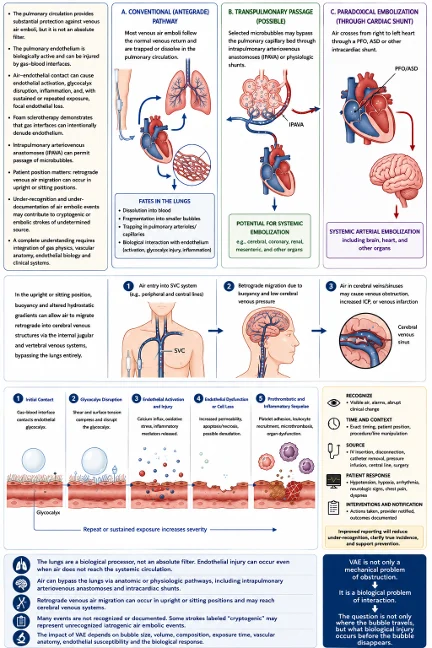
“In clinical care, the traditional teaching surrounding venous air embolism (VAE) is that any intravenously introduced air bubbles will travel to the right heart and subsequently be ‘filtered’ by the lung’s pulmonary circulation, thereby preventing any danger to systemic embolization.
This is due to a failure of the didactic education and clinical leadership around the pathophysiology of air in blood and the potential morbidity associated intravenous air from any source. To those who use the excuse that this is a rare event, please read my article stated below (The Cumulative Impact of ‘Rare Events’ in Healthcare – July 21, 2025).
The pulmonary circulation will provide some protection from venous air morbidity, but this concept simply represents an oversimplification of a very complex interaction between air, blood/gas physiology, vascular anatomy, and endothelial biology.
First of all, we should point out the distinction between large volumes of air associated with cardiac dysfunction and death, and smaller volumes of air associated with strokes, cerebral dysfunction and endothelial damage and vascular permeability. The cute posts or comments about ‘a little air will never kill you’ always focus on how much intravenous air it would take to kill a person.
Thereafter, emphasizing that those smaller air bubbles in intravenous lines are harmless and should be ignored. Nothing could be further from the truth, and nothing could be so misleading to the general public.
Hopefully, after many presentations, publications and articles on this topic over the years (see list below), maybe this one will finally hit home with some people. Let me be clear, this article is not about massive air causing death.
Microbubbles entering the venous blood system are immediately coated by proteins, platelets and leukocytes (as would any foreign material), making the surface composition and thickness of a in blood completely different that a microbubble in water.
These intravascular attachments make the microbubble walls thicker and more difficult to break or adsorb as they pass through the circulatory system. Neutrophils tend to aggregate around intravascular microbubbles in an attempt to destroy them, and platelets adhering to a bubble surface also induce aggregation that plays a role in platelet activation and thrombus generation.
The pulmonary vasculature has a very large surface area to provide gas exchange, but it is not an anatomical or mechanical filter for air or solid emboli.
It is a highly active endothelial coated organ with the same fundamental vascular protections as the systemic circulation, including an endothelial glycocalyx, nitric oxide signaling pathways, inflammatory responses, and mechanisms for vascular permeability regulation.
Exposure of any endothelial surface to gaseous embolic interfaces has been demonstrated to produce endothelial activation, glycocalyx disruption, oxidative stress, inflammatory signaling, and alterations in vascular function.
Therefore, even if intravascular pulmonary emboli do not progress to the systemic circulation, the pulmonary endothelium itself can represent a site of biologically significant injury.
Researchers have been using air bubbles to damage and denude endovascular surfaces in arterial and venous conduits for many years. These vascular researchers have demonstrated that air interfaces can produce endothelial disruption. In fact, air-bubble denudation techniques have historically been used to selectively remove endothelial cells from these isolated vessels for research during physiological studies.
This raises also an important mechanistic question regarding cardiac surgery: whether repeated exposure to gaseous microemboli during cardiopulmonary bypass (CPB) or even other clinical situations may produce not only endothelial activation and glycocalyx injury but also focal endothelial loss under certain conditions.
Even the clinical use of a therapy to destroy varicose and spider veins, called foam sclerotherapy, further demonstrates the biological potential of gaseous emboli endothelial interactions. In this procedure, foam containing sclerosant and gas is intentionally injected into a patient to damage the localized venous endothelium, producing thrombosis and fibrosis of these targeted veins.
While the clinical context differs substantially from inadvertent intravascular air bubble exposure, it confirms that gas bubble interfaces can contribute to significant endothelial injury.
The assumption that venous air is always eliminated by the lungs also requires further refinement. Intrapulmonary arteriovenous anastomoses (IPAVA) shunts in the lungs are known, recognized pathways that can permit passage of selected microbubbles or particulate material past the lung’s alveoli, through the pulmonary circulation, and into the left side of the heart.
Overall, bubble behavior depends on the size, composition, surface characteristics, and exposure to the endothelial surfaces over time. Smaller bubbles may dissolve rapidly, but gaseous microemboli also possess a high surface-area-to-volume ratio, increasing their interaction with endothelial surfaces.
Even patient positioning represents another frequently overlooked variable. In upright or sitting positions, retrograde venous air emboli migration has been described, particularly involving cerebral venous pathways such as the Inferior Veno-Cava and the Jugular blood flows.
Hydrostatic gradients, venous pressure relationships, and buoyancy in venous vessels may allow air to move contrary to normal venous flow. This mechanism challenges the assumption that all venous air must traverse the pulmonary circulation and enter the arterial circulation before affecting cerebral structures.
One of the biggest problems with VAE in clinical situations is the under-recognition and under-reporting of iatrogenic air embolic events. Air entry associated with peripheral or central intravenous access may be transient, witnessed or unwitnessed, but it is always inadequately documented. This is a major problem in trying to recognize the harm associated with VAE.
Neurological events occurring after venous air emboli events may therefore be subsequently classified as cryptogenic in nature or an embolic stroke of undetermined source when the initiating event was not recognized or recorded.
Improved documentation of suspected air exposure, timing, patient position, vascular access events, and clinical response is essential for accurate epidemiological understanding.
Even though air emboli vascular obstruction is a concern, the clinical significance of VAE should therefore extend beyond that traditional concept of mechanical vascular obstruction and death only (as previously stated).
The interaction between gas emboli and the vascular system involves the potential for strokes, endothelial damage, inflammation, coagulation activation and prolonged hospital stays and costs.
A more comprehensive model of VAE recognizes that the question is not only where the bubble travels, but also what biological response occurs before that bubble disappears.
Further research using advanced imaging, endothelial biomarkers, glycocalyx assessment, and controlled experimental models is needed to define the true impact of gaseous microemboli in modern medicine.
This involves all professions (in and out of a hospital setting) involved in the delivery of blood or fluids into the patient’s vascular system.
Here are some papers, articles and posts that I have presented that may help with the understanding of vascular air embolism.
LinkedIn …
- The Cumulative Impact of ‘Rare Events’ in Healthcare – July 21, 2025
- Air Bubble Size and Volume in Intravenous Lines – January 8, 2025
- Gaseous Microemboli When Using VAVD during Cardiopulmonary Bypass – Feb 26, 2024
- Why Are Air Bubbles prevented in Heart Surgery … But tolerated in Intravenous Therapy? June 29, 2022
- Pathophysiology of microbubbles – Dec 30, 2021
- What is the cost of air bubbles in a peripheral Intravenous Line? – Sept 14, 2020
- The Reality of Intravenous Air Bubbles: A need to correct Misinformation and Myth – Nov 26, 2019
- A Free Webinar on the Hazards Associated with Intravenous Line Air – Oct 15, 2018
- How Lucky Do You Feel When Air Bubbles Are In Your Intravenous Line? – Nov 26, 2014
Publications …
- Arterial and Venous Air Emboli in Health Care – J Extra Corpor Technol. 2021;53:220–4
- Preventing Gaseous Microemboli During Blood Sampling and Drug Administration: An In Vitro Investigation – JECT. 2007;39:192–198
- Air in intravenous lines: a need to review old opinions – Perfusion 2017, 1-4
- Endothelial Glycocalyx and Cardiopulmonary Bypass – J Extra Corpor Technol. 2017; 49:174-81
Stay updated with Hemostasis Today.
-
Oct 19, 2026, 03:54Jennifer Trowbridge: How Mutant Blood Stem Cells Use Inflammation to Drive Their Own Expansion
-
Oct 19, 2026, 03:39Wyenona Hicks: Catching Up With Old Friends and New Colleagues at AABB 2026
-
Oct 19, 2026, 03:33Developing a Non-Invasive Treatment for Life-Threatening PE – University of Michigan College of Engineering
-
Oct 19, 2026, 03:28Jim Hoffman: How NETs Contribute to Gallstone Formation and Growth
-
Oct 19, 2026, 03:28Nicolas Hubacz: The Organized Chaos of Mitochondria
-
Oct 19, 2026, 03:02Neda Horvacki: Using ROTEM to Refine Transfusion Decisions in Acute Trauma
-
Oct 19, 2026, 02:45Diego Escarraman Martinez: MATTERs Study – When a Cohort Gave Us Major Clues about TXA in Trauma
-
Oct 19, 2026, 02:35Brian O Mahony: Promoting Physical Activity and Sport in Haemophilia Care
-
Oct 19, 2026, 02:35Malusi Mtetwa: Tranexamic Acid – What Does the Evidence Tell Us?