


Jeannie Devereaux Links PRP and Physical Therapy
Jeannie Devereaux, PhD Supervisor at Victoria University, shared on LinkedIn:
”Over the holidays, I had several conversations with people who had received PRP and/or cortisone injections.
What surprised me, however, was not the choice of treatment itself, but the fact that these interventions were often administered without any recommendation for physical therapy.
In many cases, the injection was presented as a standalone solution, rather than as part of a broader biological and mechanical rehabilitation strategy.
This raised an important concern, because both PRP and cortisone fundamentally alter tissue biology, yet neither can translate into optimal or durable outcomes without the appropriate mechanical input that only structured physical therapy can provide.
Physical therapy is not merely compatible with high dose PRP treatments; biologically and anatomically, it is synergistic.
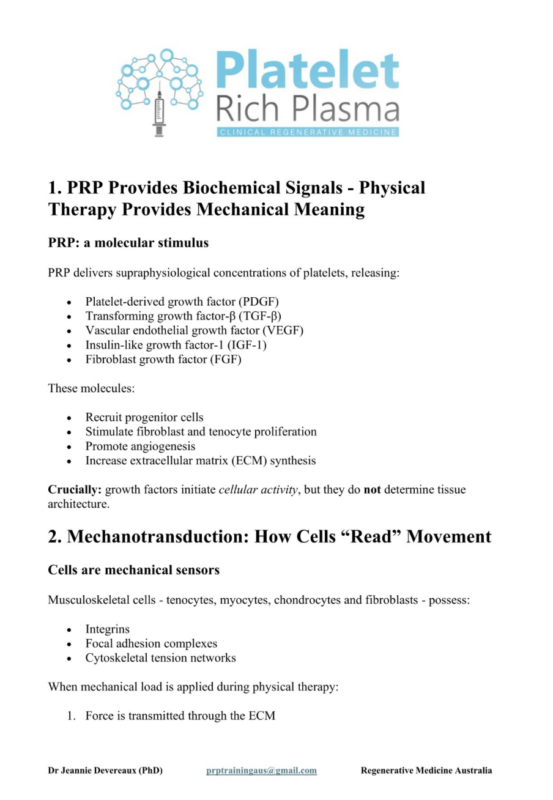
PRP supplies the molecular signals for regeneration, while physical therapy provides the mechanical instructions that tell tissues how to heal, remodel, and function.
Without this mechanical input, PRP’s regenerative potential is significantly under-utilised.
Below is a deep dive into the biology and anatomy underpinning this synergy.
Follow the link to the free Patreon page for uploaded studies.”
Read the full post here.
Stay updated with Hemostasis Today.
-
Oct 19, 2026, 19:08IPAW 2026 Comes to a Close, but the Work Continues – PPTA
-
Oct 19, 2026, 17:44Paul Riley: Moderating a Webinar on Anticoagulation Monitoring
-
Oct 19, 2026, 16:36Christopher Pittman: Blood Clot Prevention Cannot End at Hospital Discharge
-
Oct 19, 2026, 16:13Javier M. Floren: When Immune Cells Move With Their Environment
-
Oct 19, 2026, 16:04Hussnain Javaid: New EHA Guidelines for HbSC Disease Management
-
Oct 19, 2026, 15:50Deep Madkaiker: A New Academic Opportunity in Transfusion Medicine at ACTREC
-
Oct 19, 2026, 15:19Why Hematologists Should Care About Diminished Ovarian Reserve in SCD – ASH Education
-
Oct 19, 2026, 14:16Hyperfibrinolysis as an Underrecognized Cause of Bleeding
-
Oct 19, 2026, 13:36Shobhna Ladva: Aspen Pharma EME Raises Awareness of Blood Clot Risks During Hormonal Transitions