

W David Freeman։ The Mechanical Penumbra in Intracerebral Hemorrhage and Its Potential for Tissue Recovery
W David Freeman, Physician at Mayo Clinic, shared a post on X about a recent article by Sebastian Koch et al., published in Neurology, adding:
”Beyond ischemia: Could a ‘mechanical penumbra’ hold the key to saving brain tissue after intracerebral hemorrhage (ICH)?
While penumbral imaging revolutionized ischemic stroke care, acute ICH treatment has lacked a similar imaging-guided target for intervention.
A paper in Neurology introduces a compelling framework for perihematomal tissue recovery.
Here is what you need to know:
- Rethinking the Penumbra in ICH
Previous models focused on ischemic or metabolic penumbrae, but evidence demonstrates that perihematomal blood flow is often oligemic due to reduced metabolic demand rather than primary ischemia. Instead, physical compression by the hematoma exerts mass effect directly on surrounding tissue.
- What Is the Mechanical Penumbra?
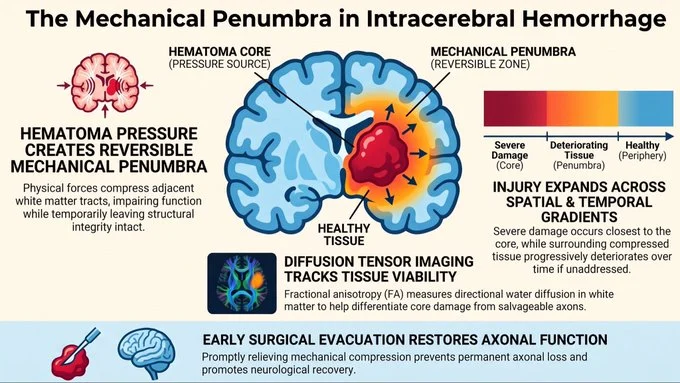
It refers to perilesional white matter compressed by physical hematoma forces. These axons remain structurally intact but functionally impaired. If decompression occurs in a timely manner, tissue can recover, analogous to relieving a compressed peripheral nerve.
- Spatial and Temporal Gradients
Core Axons: Irreversibly damaged axons closest to the hematoma.
Penumbral Axons: Compressed, nonfunctioning, but salvageable white matter tracts.
Time Window: Persistent compression leads to permanent axonal loss, whereas timely evacuation may restore tissue integrity.
- Imaging the Target via DTI
Diffusion Tensor Imaging (DTI) and Fractional Anisotropy (FA) offer promising biomarkers for mapping axonal integrity. By evaluating spatial and temporal FA gradients around subcortical hemorrhages, clinicians could identify patients who stand to benefit most from surgical evacuation.
Key Takeaway
Developing validated imaging biomarkers of the mechanical penumbra could transform ICH trials, such as REACH and MINUTE, and shift treatment toward precision surgical selection.”
Title: The Mechanical Penumbra in Intracerebral Hemorrhage
Authors: Sebastian Koch, Jose G. Romano, Weizhao Zhao, Ayham Alkhachroum

Proceed to the video attached to the post.
Stay updated on all scientific advances with Hemostasis Today.
-
Oct 9, 2026, 13:48Maxime Dely: Raising Awareness for Blood Donation
-
Oct 9, 2026, 13:48Vera Ghali: Anemia in Myelofibrosis and Its Impact on Treatment Outcomes and Overall Survival
-
Oct 9, 2026, 13:11Ayshathul Noora։ Carbetocin vs Oxytocin in Preventing Postpartum Hemorrhage
-
Oct 9, 2026, 13:07The Rebalanced Patient: New Therapies and New Thrombotic Risks in Hemophilia
-
Oct 9, 2026, 12:48Santiago Cepeda Chafla: CereBleed Simplifies Brain Hemorrhage Assessment
-
Oct 9, 2026, 12:34Abdul Muqtadir Abbasi: Pancytopenia Is a Finding, Not a Diagnosis
-
Oct 9, 2026, 12:24Mercy Lung’aho: When Diet Quality and Nutritional Biomarkers Tell Different Stories
-
Oct 9, 2026, 12:22Eugene Fan: Bridging Therapeutic Breakthroughs and Equitable Thalassaemia Care
-
Oct 9, 2026, 12:14Brittany Busse: A New Focus on Iron Deficiency Before Anemia