


Maurizio Bertaina: Does Hemoglobin at Admission Matter in Cardiogenic Shock?
Maurizio Bertaina, Cardiologist at ASL Città di Torino – Giovanni Bosco Hospital, shared a post on LinkedIn about a recent article he and his colleagues co-authored, published in Journal of Cardiovascular Medicine, adding:
“Does hemoglobin at admission matter in cardiogenic shock?
Pleased to share our latest publication from the ALT-Shock-2 Registry, now published in the Journal of Cardiovascular Medicine:
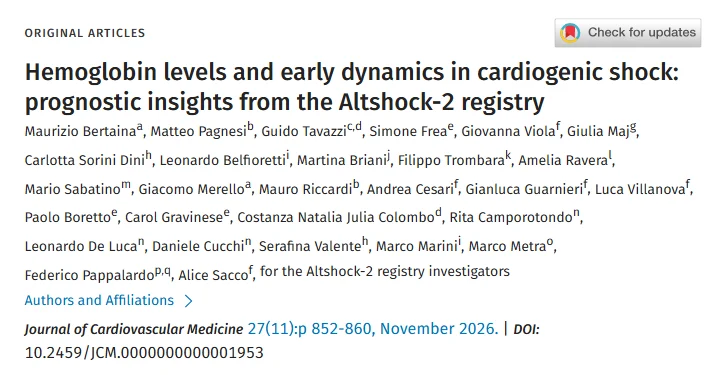
‘Hemoglobin Levels and Early Dynamics in Cardiogenic Shock: Prognostic Insights from the ALT-Shock-2 Registry’
In this multicenter study involving 796 patients with cardiogenic shock from 12 Italian centers, we investigated the prognostic relevance of admission hemoglobin levels and their changes during the first 24 hours.
Key findings:
- Anemia was highly prevalent: 50.5% at admission, increasing to 67% after 24 hours.
- Patients with lower admission hemoglobin had a worse clinical profile, including greater comorbidity burden, impaired renal function, and lower blood pressure.
- In-hospital mortality increased substantially with decreasing admission hemoglobin: 43.6% vs. 28.0% vs. 21.6%across hemoglobin tertiles.
- After adjustment for established clinical and hemodynamic predictors of outcome in cardiogenic shock, including blood pressure,lactate, renal function, cardiac arrest, and SCAI shock stage, each 1 g/dl higher admission Hb was associated with lower mortality (adjOR 0.87; 95% CI 0.80–0.93), independent of shock etiology (AMICS vs HF-CS). In contrast, 24h Hb did not improve risk prediction.
The take-home message?
Admission hemoglobin is a simple, readily available marker that may contribute to early risk stratification in cardiogenic shock, regardless of its underlying etiology.
Whether anemia represents a modifiable contributor to impaired oxygen delivery or primarily reflects underlying frailty and disease severity remains an important question for future research.
A sincere thank you to all the investigators and participating centers of the ALT-SHOCK-2 collaborative group.”
Title: Hemoglobin levels and early dynamics in cardiogenic shock: prognostic insights from the Altshock-2 registry
Authors: Maurizio Bertaina, Matteo Pagnesi, Guido Tavazzi, Simone Frea, Giovanna Viola, Giulia Maj, Carlotta Sorini Dini, Leonardo Belfioretti, Martina Briani, Filippo Trombara, Amelia Ravera, Mario Sabatino, Giacomo Merello, Mauro Riccardi, Andrea Cesari, Gianluca Guarnieri, Luca Villanova, Paolo Boretto, Carol Gravinese, Costanza Natalia Julia Colombo, Rita Camporotondo, Leonardo De Luca, Daniele Cucchi, Serafina Valente, Marco Marini, Marco Metra, Federico Pappalardo, Alice Sacco
Stay updated on all scientific advances with Hemostasis Today.
-
Nov 22, 2026, 23:55Renjith Vijayakumar Selvarani: One CAR-T Infusion Resets the Immune System in 3 Severe Autoimmune Diseases
-
Nov 22, 2026, 23:54Lukasz Kuzma: Beyond Composite Outcomes in the Comparison of LAAC and Oral Anticoagulation
-
Nov 22, 2026, 21:32Maxime Dely: SAGM and PAGGSM – What Do Red Blood Cell Storage Solutions Contain?
-
Nov 22, 2026, 21:28Phil Cranch: 817mL of Plasma and an Hour Well Spent at Lifeblood
-
Nov 22, 2026, 21:24Ella Hinson: Turning Type B Blood into Type O – How Omni Tackles the National Blood Shortage
-
Nov 22, 2026, 21:19Fikreab Tesfaye Tefera: 10 KeyTakeaways from 2026 ASH Guideline On Diagnosis and Management of Aplastic Anemia
-
Nov 22, 2026, 21:13Hannah Shalom: How PEMT and CBS Actually Shape Homocysteine and Choline Needs?
-
Nov 22, 2026, 21:07Godfred Oduro: Novo Nordisk Haemophilia and Hemoglobinopathies Foundation Workshop in Ghana
-
Nov 22, 2026, 21:04The EHA-TiF Preceptorship on Hemoglobinopathies has Concluded in Athens, Greece