


Aadil Sheikh: Menopausal Hormone Therapy and Thrombosis Rethinking Route Dose and Risk
Aadil Sheikh, Hormone Health Specialist | Men’s Health Service Development at London Hormone Clinic, shared a post on LinkedIn about a recent article by he, published in BMJ, adding:
“A rapid response I wrote has been published in the BMJ, responding to the Danish nationwide study on menopausal hormone therapy and thrombosis that made headlines this September.
The study is a genuine contribution. It is the first large registry to isolate modern oestradiol from the older, horse-derived oestrogens most of the historical fear was built on, and it reports absolute risk alongside relative risk, a number needed to harm of 1,055 for a year of oral treatment. Useful, honest numbers.
My response raises three considerations for translating a population-level finding into an individual prescribing decision.
Route and dose are hard to fully separate. Sixty per cent of oral users were on more than 1mg a day, while 56 per cent of transdermal users were on 50 micrograms or less, and the transdermal group was far smaller, 53 clotting events against 661 on oral. Some of what reads as a route effect is partly a dose effect in disguise.
Venous and arterial risk are not the same story. The clotting risk extended across oral doses. The stroke and heart attack risk did not. Oral oestradiol at 1mg or below showed no increase in either. The clinical picture is more precise than a simple oral-versus-transdermal framing allows.
And the progestogens studied are not the one most relevant to a lot of current practice. Eighty per cent of combined regimens used norethisterone. Micronised progesterone was not captured, so the study has little to say about that specific combination directly, though it does not undo the oestrogen-only signal.
The honest conclusion, and the one I end the response on, is that this strengthens the case for transdermal oestradiol in women with real venous risk factors, and for discussing the small excess risk with women on oral treatment. It does not establish that a woman already well on low-dose oral oestradiol, with no relevant risk factors, needs to change route for this reason alone.”
Title: Contemporary menopausal hormone therapy and thrombotic disease: nationwide nested case-control study
Author: Aadil Sheikh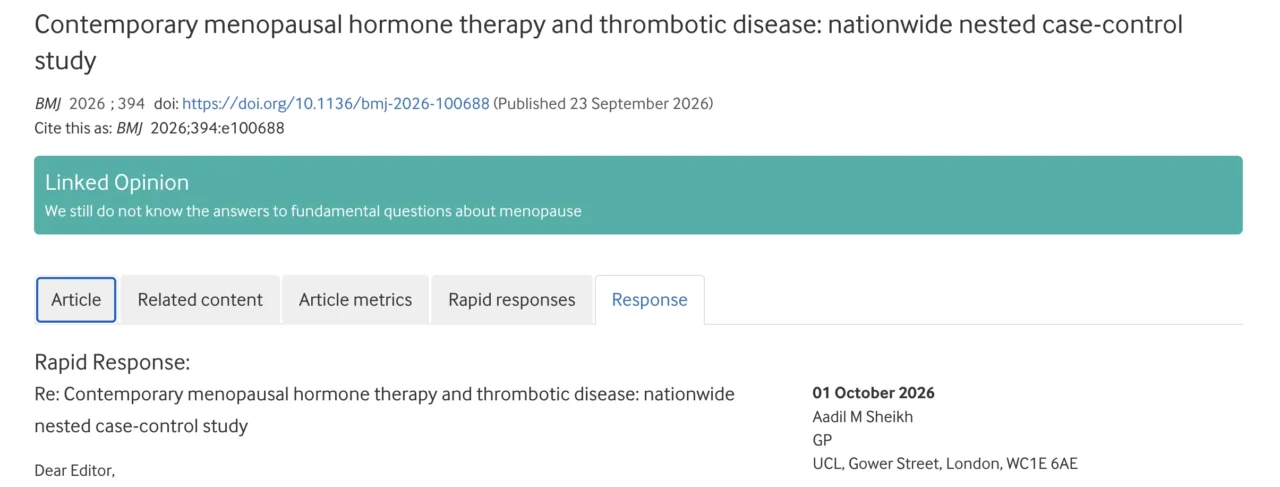
Stay updated on all scientific advances with Hemostasis Today.
-
Oct 4, 2026, 05:39Alicja Urbaniak: Targeting CD148 for Novel Antithrombotic Therapy
-
Oct 4, 2026, 05:27Nirali Thakkar: Influenza and Myocardial Infarction An Unexpected Cardiovascular Connection
-
Oct 4, 2026, 05:03Hisham Fahmi: Thromboprophylaxis in Children With ALL A Risk Adapted Approach
-
Oct 4, 2026, 05:00Mary Cushman: Erin Michos Highlights Rising Heart Disease Mortality Among Younger Women in the US
-
Oct 4, 2026, 04:48Liv Tybjærg Nordestgaard: Is Fasting Necessary Before Blood Sampling?
-
Oct 4, 2026, 04:31Sonal Sonu: Gen Z doesn’t just set trends – Gen Z saves lives
-
Oct 4, 2026, 04:22Registration Opens for 2027 Highlights of ASH – American Society of Hematology
-
Oct 4, 2026, 04:06Konstantinos Stavroulakis: Vessel Preparation in Lower Limb Revascularization
-
Oct 4, 2026, 03:34Liselotte Hyveled: Exploring Opportunities to Improve Hemophilia and Sickle Cell Care in Ghana