


Adam Urato: The Platelet Paradox of SSRIs
Adam Urato, Maternal-Fetal Medicine Physician at MetroWest Medical Center, shared a post on X about a recent article by Amir Mahdi Ghafarian et al., published in AJS, adding:
“New study: Patients on SSRI/SNRIs undergoing colon surgery had increased bleeding and blood transfusion rates.
These drugs have chemical effects on platelets – lowering platelet serotonin.
Increased rates of postpartum hemorrhage, GI bleeding, & other postsurgical bleeding have previously been demonstrated.
The authors write: ‘By inhibiting platelet serotonin reuptake, these agents deplete the platelet serotonin that supports aggregation and hemostasis, providing a biological basis for increased bleeding.'”
Sanil Rege, Consultant Psychiatrist and Director of Mental Health at Beleura Private Hospital, shared this post on X, adding:
“But what’s the other side of the equation.
The same effect on platelets is protective in other scenarios.
SSRIs and myocardial infarction (MI) risk
Long-term SSRI use reduces MI risk.
‘The use of SSRIs may confer a protective effect against MI.
This could be attributable to the inhibitory effect SSRIs have on serotonin-mediated platelet activation or possibly amelioration of other factors associated with increased risk for MI in depression.’
Why?
- Serotonin promotes platelet aggregation and vasoconstriction of diseased coronary arteries.
- Less platelet serotonin is equal to lower clot formation risk which is equal to lower coronary artery occlusion risk.
Prescribing a medication is a risk benefit analysis.
If you look at only one side of the equation without understanding the person for whom you are prescribing for, you aren’t really performing a risk benefit analysis.
Thus – Bleeding risk increases due to impaired platelet aggregation – MI risk decreases due to reduced clot formation Hence nuance is needed in cardiovascular medicine where other anticoagulants and NSAIDs may be prescribed.”
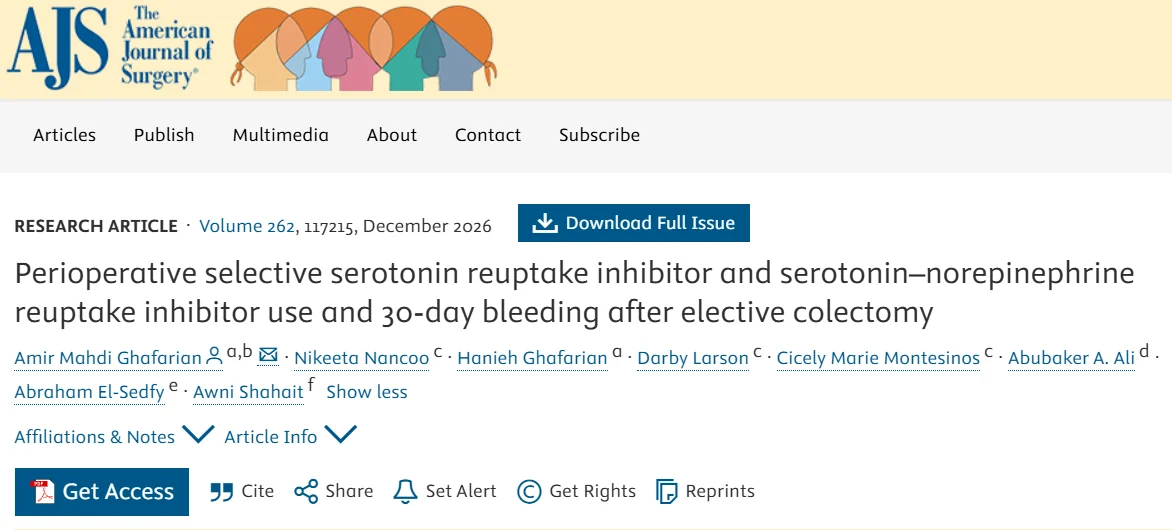
Title: Perioperative selective serotonin reuptake inhibitor and serotonin–norepinephrine reuptake inhibitor use and 30-day bleeding after elective colectomy
Authors: Amir Mahdi Ghafariana, Nikeeta Nancooc, Hanieh Ghafariana, Darby Larsonc, Cicely Marie Montesinosc, Abubaker A. Alid, Abraham El-Sedfye, Awni Shahait
Stay updated with Hemostasis Today.
-
Oct 19, 2026, 11:37Beth Faiman: APSHO Fellows Celebrated for Advancing Hematology and Oncology Practice
-
Oct 19, 2026, 11:26Emanuele Pacini: Myelodysplastic Syndromes Research Featured at JSH Annual Meeting in Kyoto
-
Oct 19, 2026, 10:57Jesmond Dalli: How Erythroblasts Shape Neutrophil Development and Function
-
Oct 19, 2026, 10:41Hisham Fahmi: SCD – Should Gene Editing Begin Before Organ Damage?
-
Oct 19, 2026, 10:33Pallavi Madhiraju: YARTEMLEA Faces Another European Rejection Despite FDA Approval
-
Oct 19, 2026, 10:28Brig Tathagata Chatterjee: Acute Leukemias in AYAs at the Japanese Society of Hematology Conference
-
Oct 19, 2026, 10:27Heather M. Johnson: Join the Discussion on Optimizing the CTEPH Diagnostic Pathway
-
Oct 19, 2026, 10:18Flora Peyvandi: Unravelling the Complexity of VWF Through Genetics
-
Oct 19, 2026, 09:55High DOAC Adherence in Patients With Ischemic Stroke and AF – International Journal of Stroke