


Alan Nurden: Pregnancy Challenges and Bleeding Risks in Inherited Platelet Disorders
Alan Nurden, Emeritus Research Director at CNRS, Co-Founder of the French National Reference Centre for Inherited Platelet Disorders (CRPP), shared a post on LinkedIn about a recent article by Victor Zibara et al., published in Hematology Reports, adding:
“Victor Zibara and Nicoletta Machin highlight with skill an important topic; pregnancy and delivery for women suffering from an inherited platelet bleeding disorder (IPD).
Women with an IPD are already at a disadvantage as heavy menstrual bleeding is an added handicap to the mucocutaneous bleeding episodes that largely characterize these syndromes.
The authors deal with the challenges posed by pregnancy, labor and postpartum bleeding while not forgetting the neonatal bleeding risk.
In doing so they review the literature for each of the major disorders, one by one.
The rareness of the disorders and the large variability in bleeding between affected individuals means that making general conclusions about treatment is difficult although recombinant FVIIa comes out positively from this review.
The urgent need for international registries disorder by disorder is highlighted by this review.
With regard to my particular interest in Glanzmann thrombasthenia (GT) I would urge that all families with this disorder be genotyped prior to becoming pregnant and not only to identify the gene (ITGA2B or ITGB3) responsible for GT but also for the common alloantigen systems found on the alphaIIbbeta3 integrin.
Immunization for HPA-1a when the mother (but not the father) is homozygous for HPA-1b may have clinical consequences when the antigen remains on the alphavbeta3 integrin as is the case when the disease-causing mutation occurs on ITGA2B (in upwards of 50% of patients).
Total loss of the alphaIIbbeta3 integrin can also result in the formation of polyclonal isoantibodies reacting with multiple sites on the integrin again rendering platelet transfusion ineffective.
So, as the authors underline, much care must be taken by GT families and expert advice, available in specialized national or regional centers, sought by families considering pregnancy as is the case also for the Bernard-Soulier syndrome where patients lack the GPIb-V-IX complex.”
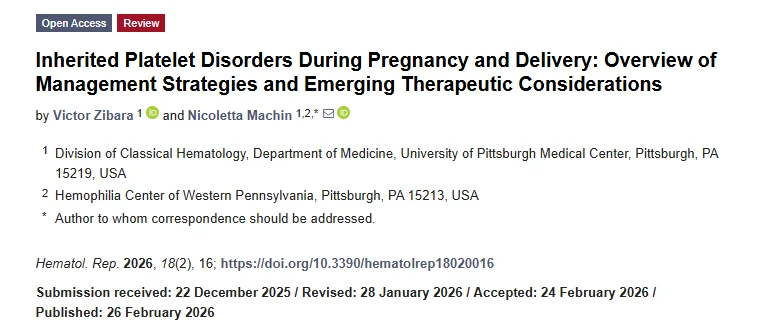
Title: Inherited Platelet Disorders During Pregnancy and Delivery: Overview of Management Strategies and Emerging Therapeutic Considerations
Authors: Victor Zibara, Nicoletta Machin
Other posts featuring Alan Nurden on Hemostasis Today.
-
Jul 23, 2026, 05:48Paschalis Evangelidis: Rethinking Pulmonary Embolism Through the Lens of Thromboinflammation
-
Jul 23, 2026, 05:35Neil Morgan: Honoured to Lead the Platelet and Megakaryocyte Theme at ISTH 2026
-
Jul 23, 2026, 04:42Camilla Oriani: A Memorable First ISTH 2026 in Paris
-
Jul 23, 2026, 03:32Nazlı Pelin Kirkayak: A 9-Year Real-World Analysis of Adult Thrombotic Microangiopathies
-
Jul 23, 2026, 03:24Christelle Orlando: Driving Progress Through Science and Collaboration at ISTH 2026
-
Jul 23, 2026, 03:12Frederik Denorme: How von Willebrand Factor Drives the No-Reflow Phenomenon in Stroke
-
Jul 23, 2026, 03:06Mahsa Mayeli: A Comprehensive Review of Imaging in Posterior Circulation Stroke
-
Jul 23, 2026, 03:00Our Cornerstone Initiative Strengthens Hemophilia Care in Gabon – WFH
-
Jul 22, 2026, 22:34Korawit Juprasertporn: JCM Special Issue Launches with Its 1st Article on Advances in Bleeding Disorders