


Alex John London: AI in Healthcare Must Show Safety and Efficacy Before Use
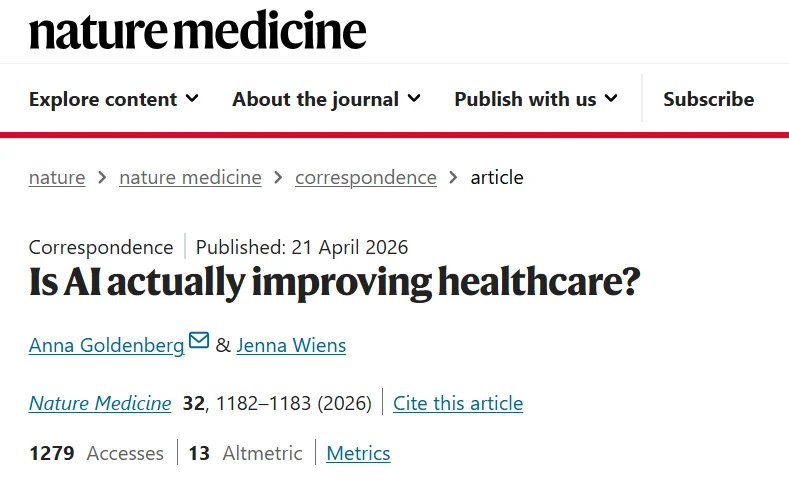
Alex John London, K and L Gates Professor of Ethics and Computational Technologies at Carnegie Mellon University, shared a post on LinkedIn about a recent article by Anna Goldenberg and Jenna Wiens, published in Nature Medicine։
”I’m so old I remember when the safety and efficacy of medical interventions had to be demonstrated convincingly before clinical deployment.
‘To maximize the impact and answer whether AI is improving health-care, we must hold it to the same evidentiary standards as other clinical interventions.
It is not enough to demonstrate accuracy or feasibility and show potential.
The promise of AI in healthcare will be fulfilled when we provide evidence that AI meaningfully changes clinical decisions – and that those changed decisions improve outcomes.’ ”
Title: Is AI actually improving healthcare?
Authors: Anna Goldenberg, Jenna Wiens
Stay updated on all scientific advances Hemostasis Today.
-
Sep 18, 2026, 15:54Swapnil Pawar: Why Aren’t We Using Cryopreserved Platelets Everywhere Yet?
-
Sep 18, 2026, 15:37Abdul Mannan: Evaluating Longitudinal Platelet Trends Beyond Standard Reference Intervals
-
Sep 18, 2026, 15:30Peter A. Everts։ Platelet Phenotype May Hold the Key to More Consistent PRP Therapy
-
Sep 18, 2026, 15:25Brandon Temple: Turning Personal Experience Into Advocacy for wAIHA Research
-
Sep 18, 2026, 15:01A. M. Thirugnanam: Antiplatelet Discontinuation and the Risk of Stent Thrombosis
-
Sep 18, 2026, 14:52Abdul Muqtadir Abbasi: How Do Hematologists Know Which Coagulation Factor Is the Problem?
-
Sep 18, 2026, 14:48Kato Ramaekers: Redefining Integrin αIIbβ3 in Platelet Formation
-
Sep 18, 2026, 14:33Heghine Khachatryan: The discussion of Thrombophilia, APS and Coagulation Testing
-
Sep 18, 2026, 14:27Maria Cherska: Are We Overlooking the Spleen in Cardiometabolic Research?