

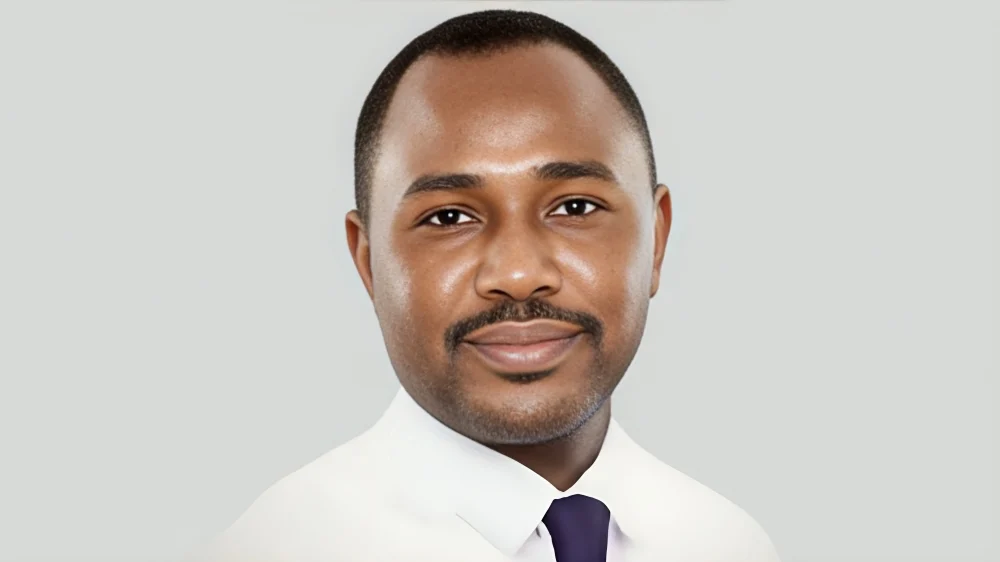
Alfadil Haroon: Bleeding Outcomes in Congenital Versus Acquired FXIII Deficiency
Alfadil Haroon, Assistant Consultant of Hematology at King Faisal Specialist Hospital and Research Centre, Assistant Professor at Alfaisal University, shared a post on LinkedIn about a recent article he and his colleagues co-authored, published in HemaSphere, adding:
“Factor XIII Deficiency: Congenital versus Acquired
Study overview
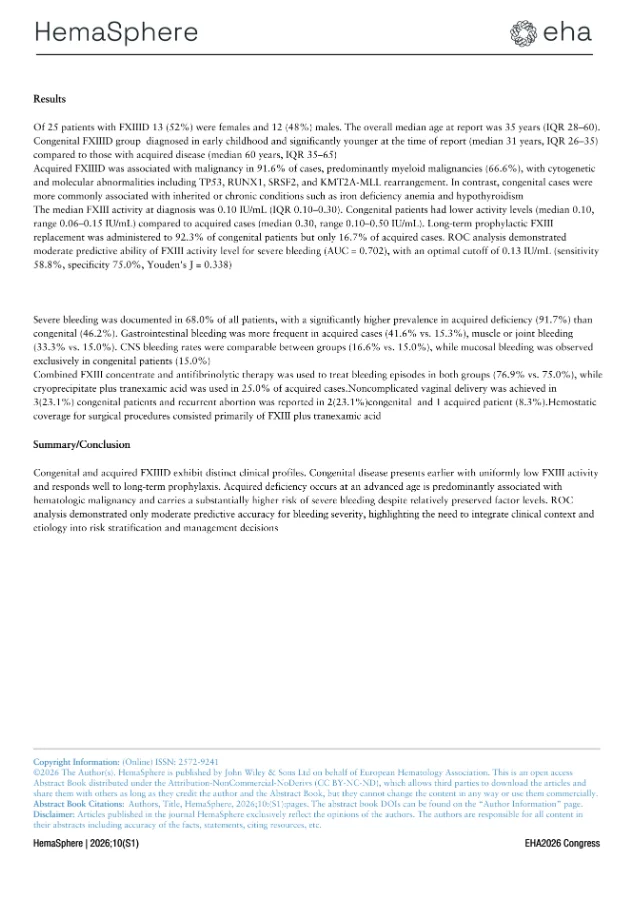
- 25 patients (52 percent congenital, 48 percent acquired)
- Median age: 35 years
Congenital FXIII deficiency:
- Diagnosed early (younger patients)
- Very low FXIII levels
- Managed with long-term prophylaxis
- Lower bleeding risk (46 percent)
Acquired FXIII deficiency:
- Occurs later (median approximately 60 years)
- Strongly linked to malignancy (92 percent)
- Higher FXIII levels than congenital
- Severe bleeding in 92 percent
Bleeding Patterns:
- Acquired FXIIID – more severe bleeding
- GI bleeding: 41.6 percent
- Muscle/joint: 33.3 percent
Congenital FXIIID
- Mucosal bleeding only in this group
- CNS bleeding similar in both groups (approximately 15–16 percent)
Key Biomarker Insight
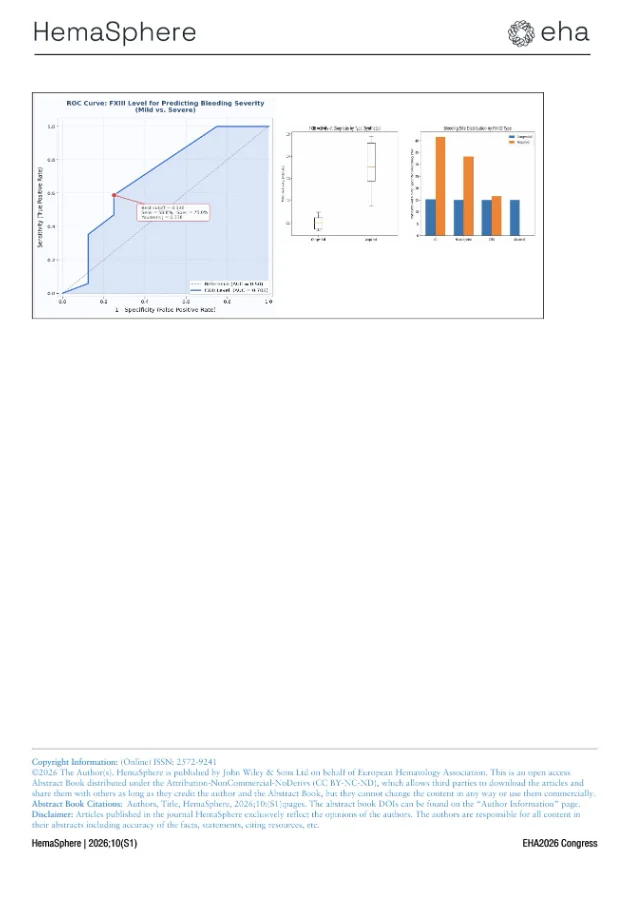
- FXIII level predicts bleeding only moderately
- AUC equals 0.70
- Best cutoff: 0.13 IU/mL
Management Highlights
Congenital: Long-term FXIII replacement (92 percent)
Acquired: Treat underlying disease (especially malignancy), FXIII plus antifibrinolytics for bleeding
Take-Home Messages
- Congenital is not Acquired – completely different diseases
- Acquired FXIIID equals high-risk bleeding disorder
- FXIII level alone is not enough for risk stratification
Clinical Pearl
Patients with acquired FXIII deficiency bleed more despite higher factor levels – highlighting the importance of etiology over numbers.”
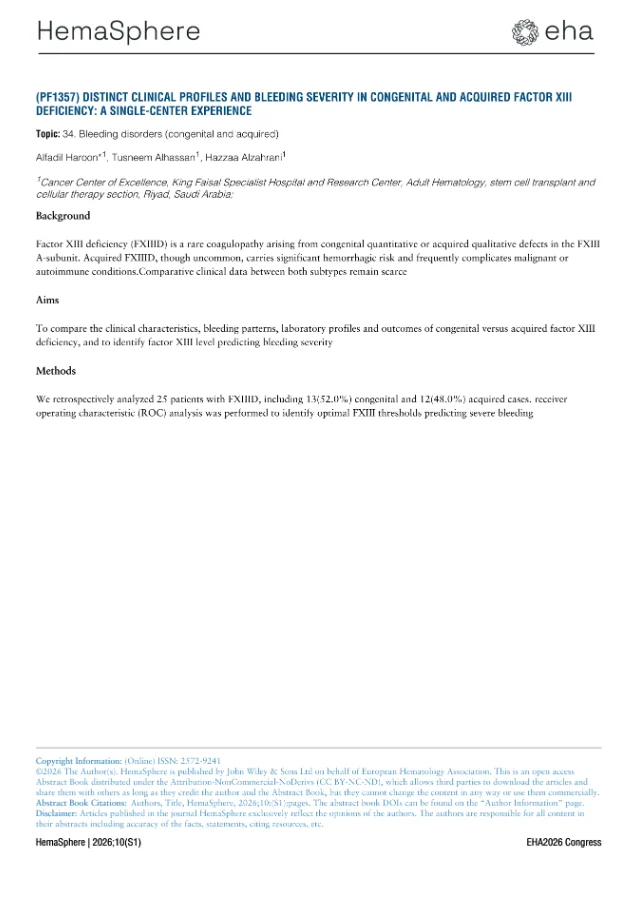
Title: Distinct Clinical Profiles and Bleeding Severity in Congenital and Acquired Factor XIII Deficiency: A Single-Center Experience
Authors: Alfadil Haroon, Tusneem Alhassan, Hazzaa Alzahrani

Stay updated on all scientific advances with Hemostasis Today.
-
Nov 15, 2026, 04:31Aakriti Gupta: Anticoagulation for Leaflet Thickening After TAVR
-
Nov 14, 2026, 23:57Jamie S. Y. Ho: Exploring the Mechanisms of Arterial Thrombosis and the Evolution of Antithrombotic Therapy
-
Nov 14, 2026, 23:53Jacopo Imberti: The Past, Present and Future of Arterial Thrombosis Research
-
Nov 14, 2026, 23:48Shrouk Ramadan: Joining the Editorial Review Board of Clinical and Applied Thrombosis and Hemostasis
-
Nov 14, 2026, 23:46Habib Bennaceur: Moving Towards Fewer Limitations for People Living With Haemophilia
-
Nov 14, 2026, 23:44Paul Healy: EU Approves Frehemgo for Haemophilia A
-
Nov 14, 2026, 23:43Mehak Trehan: ASH 2026 Benign Hematology – Ten Abstracts Through an Indian Lens
-
Nov 14, 2026, 23:33Felipe Magalhaes Furtado: Artificial Intelligence Advances PNH Clone Detection Through Machine Learning
-
Nov 14, 2026, 23:33Mona Alfaraj: International Pathology Day Promotes Education in Hemoglobinopathy Diagnostics