


Amit Mohan: Microfluidic Technology Advances the Assessment of Biomaterial-Induced Thrombosis
Amit Mohan, Assistant Professor of Biomedical Engineering at Ajeenkya D Y Patil University, shared a post on LinkedIn about a recent article by Lingzi Gao et al, published in Biomaterials, adding:
“Can a laboratory chip help predict how blood clots form on medical-device surfaces?
Blood-contacting medical devices such as catheters, vascular grafts and implants face an important challenge: thrombosis.
Understanding how blood interacts with biomaterials is essential for improving device safety.
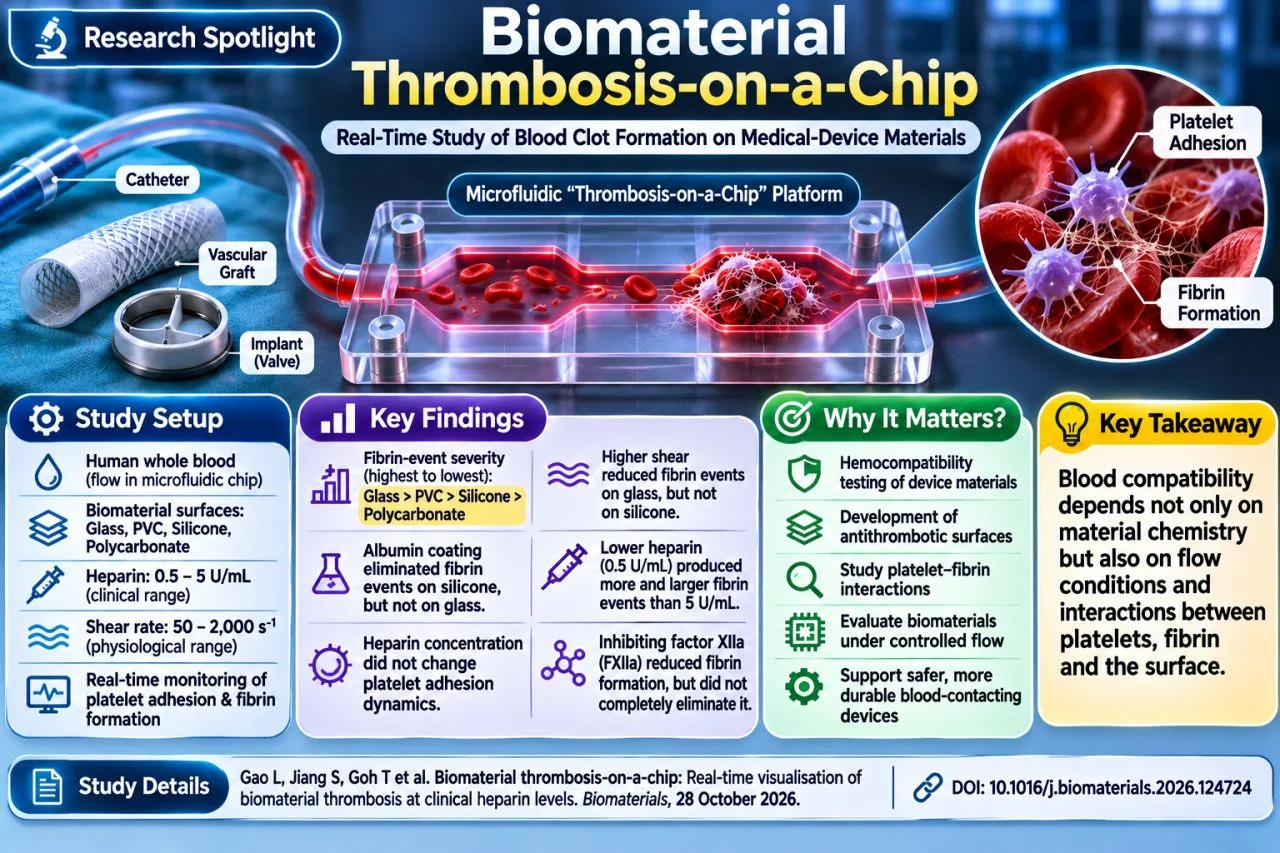
Research Spotlight: Biomaterial Thrombosis-on-a-Chip.
A study published in Biomaterials on 28 October 2026 introduced a microfluidic platform to visualize thrombosis on biomaterial surfaces in real time.
How does it work?
- Uses human whole blood in a microfluidic chip.
- Tests different biomaterial surfaces under controlled flow conditions.
- Investigates heparin concentrations of 0.5–5 U/mL.
- Simulates shear rates from 50 to 2,000 s⁻¹.
- Monitors platelet adhesion and fibrin formation in real time.
What did researchers find?
- Fibrin-event severity followed this order: glass, PVC, silicone and polycarbonate.
- Increasing shear reduced fibrin events on glass, but not on silicone.
- Albumin coating eliminated fibrin events on silicone, but not on glass.
- Lower heparin concentration (0.5 U/mL) produced more and larger fibrin events than 5 U/mL.
- Heparin concentration did not change platelet adhesion dynamics.
- Inhibiting factor XIIa reduced fibrin formation but did not completely eliminate it on glass or silicone.
Why does this matter for biomedical engineering?
This technology could support:
- Hemocompatibility testing of medical-device materials.
- Development of improved blood-contacting surfaces.
- Investigation of platelet and fibrin interactions.
- Evaluation of antithrombotic biomaterials.
- Microfluidic testing under controlled flow conditions.
Key takeaway: Blood compatibility depends not only on material chemistry but also on flow conditions and interactions between platelets, fibrin and the surface.
Limitation: This is an in-vitro experimental platform using human blood. It does not establish clinical thrombosis prevention or predict patient outcomes.
Discussion question: Could thrombosis-on-a-chip become an important tool for preclinical testing of blood-contacting medical devices?”
Title: Biomaterial thrombosis-on-a-chip: Real-time visualisation of biomaterial thrombosis at clinical heparin levels
Authors: Lingzi Gao, Shouyuan Jiang, Tiffany Goh, Jun Ki Hong, Vera M. Ripoll, Vivien M. Chen, Lining Arnold, Anna Waterhouse

Stay updated on all scientific advances with Hemostasis Today.
-
Nov 7, 2026, 02:06Chaza Alaji: The Prothrombotic and Hemorrhagic Spectrum of Tuberculosis
-
Nov 6, 2026, 22:54Vincenzo De Angelis: Presenting Trends and Challenges in Blood and Plasma Collection and Use in Europe
-
Nov 6, 2026, 22:50Alexis Caulier: Leveraging Epigenetic Silencing in HSCs to Modulate Platelet Aggregation
-
Nov 6, 2026, 22:40Panama Achieves Self-Sufficiency in Haemophilia Care – Novo Nordisk Haemophilia and Haemoglobinopathies Foundation
-
Nov 6, 2026, 22:31Luisa Weiss: Exploring the Role of Platelets and Extracellular Vesicles in Calcific Aortic Valve Disease
-
Nov 6, 2026, 22:29Nour Al-Mozain: The Role of Therapeutic Apheresis and Cell Therapy in Advancing Regional Practice
-
Nov 6, 2026, 22:28Moazzam Shahzad: Celebrating Mentees Receiving the 2026 ASH Abstract Achievement Award
-
Nov 6, 2026, 22:25Habib Bennaceur: Self-Sufficiency in Haemophilia Care – A Major Achievement for Panama
-
Nov 6, 2026, 22:25Alessandro Lucchesi: Engineering Disease Trajectories in Myeloproliferative Neoplasms at RiseMPN 2026