


Andreas Calatzis: The Limitations of Monitoring Unfractionated Heparin During ECMO
Andreas Calatzis, Managing Director of Eonis GmbH and Dynabyte GmbH, shared a post on LinkedIn about a recent article he and his colleagues co-authored, published in Frontiers, adding:
”I am happy to announce that our Perspective article has been published in Frontiers in Medicine.
Together with Prof. Christian Weber, Prof. Kai Zacharowski, and Dr. Marie-Louise Lindner, we discuss the limitations of currently available methods for monitoring unfractionated heparin during ECMO and for detecting residual heparin after heparin reversal in cardiac surgery.
This concerns especially the limitations of the anti-Xa assay, which have been reported in the literature (1-4) but have not yet been fully acknowledged by many research groups.
We conclude that due to insufficient validation in the context of ECMO and cardiac surgery the anti-Xa assay cannot be regarded as a generally accepted reference assay for these uses.
Second, pending appropriately designed comparative studies using samples derived specifically from CPB and / or ECMO patients, different anti-Xa assays cannot be considered interchangeable in these settings.
Third, the impact of dextran sulphate on anti-Xa measurements in cardiac surgery and ECMO requires systematic investigation, particularly in the context of protamine reversal and low residual heparin concentrations.
- Gouin-Thibault I, Mansour A, Hardy M, Guéret P, de Maistre E, Siguret V, Cuker A, Mullier F, Lecompte T. Management of Therapeutic-intensity Unfractionated Heparin: A Narrative Review on Critical Points. TH Open. 2024 Oct 17;8(3):e297-e307. doi: 10.1055/a-2359-0987.
- Smahi M, De Pooter N, Hollestelle M et al. Monitoring unfractionated heparin therapy: Lack of standardization of anti‐Xa activity reagents. Journal of Thrombosis and Haemostasis, 18, 2613-2621
- Hardy M, Cabo J, Deliège A et al. Reassessment of dextran sulfate in anti-Xa assay for unfractionated heparin laboratory monitoring. Research and Practice in Thrombosis and Haemostasis, 2023; 7
- Lasne D, Toussaint-Hacquard M, Delassasseigne C et al. Factors Influencing Anti-Xa Assays: A Multicenter Prospective Study in Critically Ill and Noncritically Ill Patients Receiving Unfractionated Heparin. Thromb Haemost. 2023 Dec;123(12):1105-1115. doi: 10.1055/s-0043-1770096.
I highly recommend this excellent review by Isabelle Gouin-Thibault, Adam Cuker, Francois Mullier, Thierry Lecompte et al.”
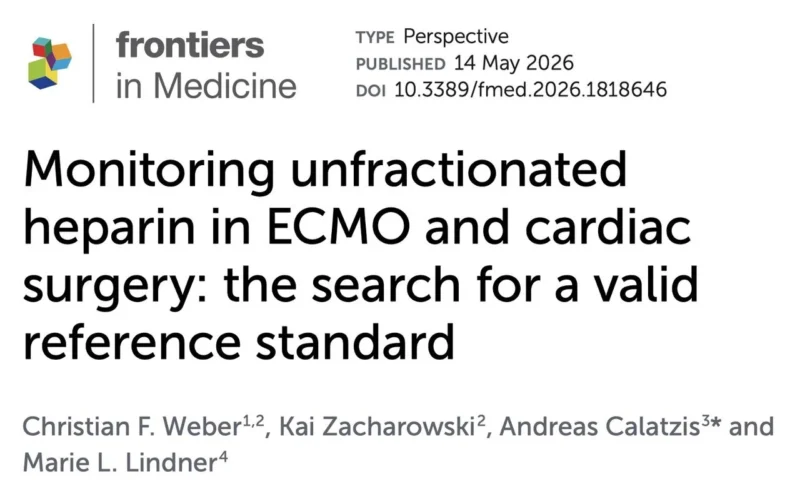
Title: Monitoring unfractionated heparin in ECMO and cardiac surgery: the search for a valid reference standard
Authors: Christian F. Weber, Kai Zacharowski, Andreas Calatzis, Marie L. Lindner
Stay updated on all scientific advances with Hemostasis Today.
-
Oct 9, 2026, 23:46Samuel Misiani Mbunya: Advancing Sickle Cell Care Through Collaboration at the 21st ASCAT Conference
-
Oct 9, 2026, 23:42Hadeel Swed: My First First-Author Publication in Thrombosis Research
-
Oct 9, 2026, 23:38Micheal Avoseh: Exploring Nanoparticle-Based Therapies for Thrombosis and Vascular Inflammation
-
Oct 9, 2026, 16:23David Boone: Distinguishing Stroke Prevention from Rhythm Control in Atrial Fibrillation
-
Oct 9, 2026, 15:27Mohamed Hegazi: Geostatistical Modelling Maps Global β-Thalassaemia Carrier Prevalence
-
Oct 9, 2026, 15:15Maha Othman: Uncovering the Consensus on TXA in TBI – Call for Collaboration on a Landmark Umbrella Review
-
Oct 9, 2026, 15:07Daniel D. Han: How Inhalation Product Exposure Impairs Cardiac and Platelet Recovery After MI
-
Oct 9, 2026, 14:58William Toole: How Ultrasound-Guided PRP Therapy Relieves Joint and Tendon Pain
-
Oct 9, 2026, 14:50Shayan Mohammadmoradi: In Corpus Christi for the 20th Midwest Platelet Conference