

Strategies to Prevent Bleeding in VWD Patients Supported with Left Ventricular Assist Devices
Inserm UMR 1011 – Hemostasis and Cardiovascular Flow shared a post on LinkedIn about a recent article by Antoine Rauch et al, published in JTH:
”A new study from our team, led by Prof. Antoine Rauch and Prof. Sophie Susen, explores strategies to prevent bleeding complications in patients supported with left ventricular assist devices (LVADs).
LVADs improve survival in advanced heart failure but are frequently associated with bleeding complications, partly due to the degradation of von Willebrand factor (VWF) under high shear stress.
In this multicenter randomized clinical trial, we investigated whether prophylactic administration of a purified VWF concentrate could reduce bleeding events in LVAD patients.
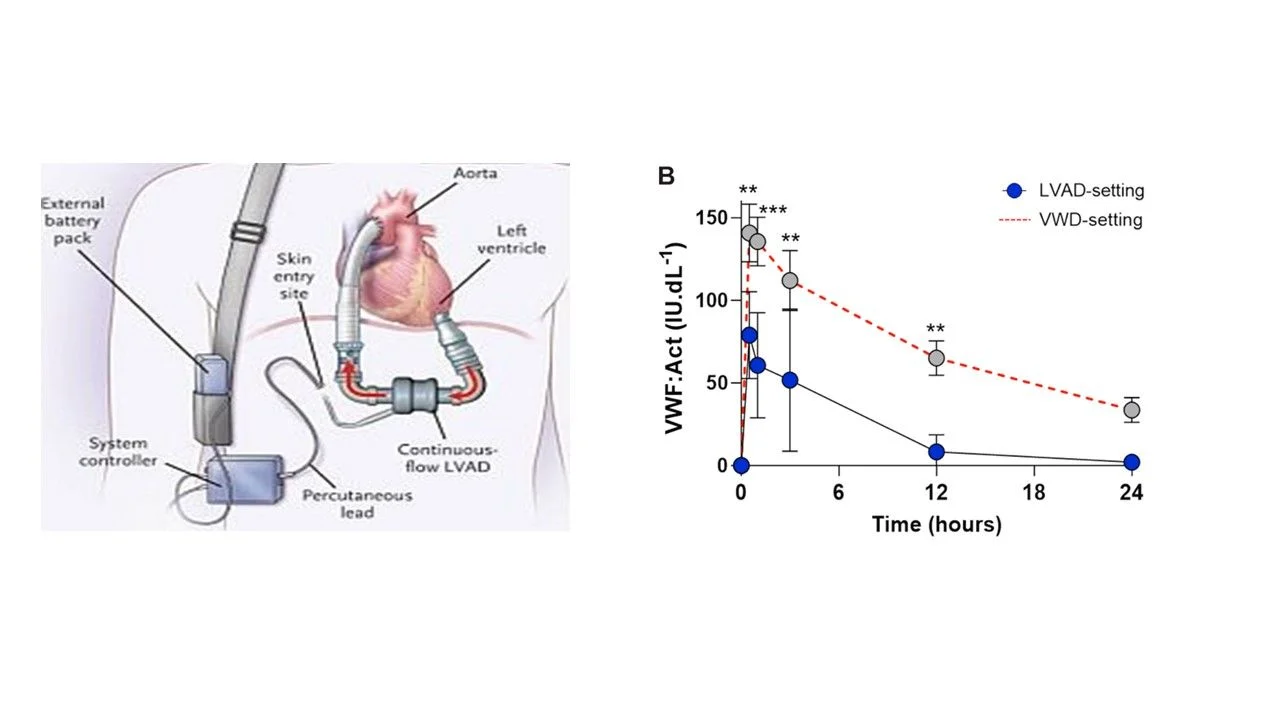
While VWF prophylaxis showed a trend toward reduced bleeding, pharmacokinetic analyses revealed rapid degradation of VWF in the LVAD setting, limiting the duration of its hemostatic effect.
These findings highlight the challenges of managing bleeding in mechanical circulatory support and the need for new therapeutic strategies.”
Melanie Daniel, Physician at Lille Regional University Hospital Center, shared the Inserm UMR 1011 – Hemostasis and Cardiovascular Flow‘s post on LinkedIn, adding:
”Interesting work in Journal of Thrombosis and Haemostasis (JTH) from our team exploring bleeding complications in patients with left ventricular assist devices (LVADs).
The study highlights the rapid degradation of von Willebrand factor activity in the LVAD setting, illustrating the challenges of restoring hemostasis in these patients.
Congratulations to the authors and collaborators.”
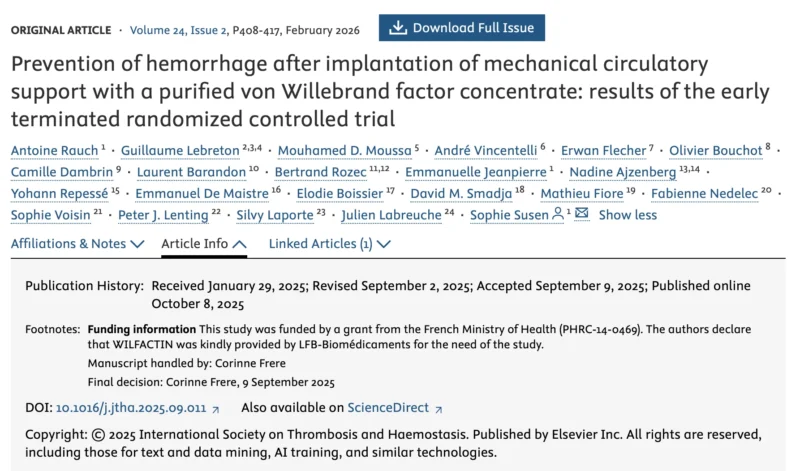
Title: Prevention of hemorrhage after implantation of mechanical circulatory support with a purified von Willebrand factor concentrate: results of the early terminated randomized controlled trial
Authors: Antoine Rauch, Guillaume Lebreton, Mouhamed D. Moussa, André Vincentelli, Erwan Flecher, Olivier Bouchot, Camille Dambrin, Laurent Barandon, Bertrand Rozec, Emmanuelle Jeanpierre, Nadine Ajzenberg, Yohann Repessé, Emmanuel De Maistre, Elodie Boissier, David M. Smadja, Mathieu Fiore, Fabienne Nedelec, Sophie Voisin, Peter J. Lenting, Silvy Laporte, Julien Labreuche, Sophie Susen
Read the Full Article on JTH
Stay updated on all scientific advances with Hemostasis Today.
-
Oct 18, 2026, 17:11Owen McCarty: Understanding Prekallikrein and Its Role in Inflammation and Thrombosis
-
Oct 18, 2026, 17:04Emna Gouider Belhadjali: Don’t Miss GPAS 2026 on Bleeding Disorders
-
Oct 18, 2026, 16:53Mehran Ghasemzadeh: Microparticle-Associated Mitochondrial DNA in Stored Platelet Products
-
Oct 18, 2026, 16:38Edward Lee Carter: A 15-Minute Blood Test for Brain Hemorrhage?
-
Oct 18, 2026, 16:29Patrick Taylor: Oral vs Transdermal Estrogen and Cardiovascular Risk in Menopausal Women
-
Oct 18, 2026, 16:19Artangela Henry: A Meaningful Week at the SCDAA National Convention
-
Oct 18, 2026, 16:04Emília Araújo։ New Insights Into the Genetics of Hemophilia B Leyden
-
Oct 18, 2026, 15:43André Marcel Harris: Award-Winning Research on Texas Sickle Cell Data Collection
-
Oct 18, 2026, 15:21Eleonora Gambineri: First Results of the IEI-Haem Consortium at ESID 2026