


Caitlin Raymond: Could the Apheresis Circuit Itself Modulate Immunity?
Caitlin Raymond, Assistant Professor of Pathology and Transfusion Medicine at University of Wisconsin-Madison, shared a post on LinkedIn about her recent article, published in Frontiers in Medicine, adding:
”Most of us learn apheresis as a story about subtraction.
Remove the autoantibody, the immune complex, the cytokine.
The circuit is just the pipe.
But what if the pipe isn’t neutral?
My new hypothesis paper in Frontiers in Medicine asks whether the extracorporeal circuit itself, independent of anything it removes, could be immunomodulatory.
The idea isn’t new.
Dialysis leukopenia was traced to complement activation by the membrane in the 1970s, and in the 1980s bioengineers described ‘procedurally induced immunomodulation.’
It just never made it into mainstream apheresis thinking.
What I pulled together:
- Biocompatibility data showing blood-surface contact alone can modulate immune activity
- A candidate mechanism: soluble HLA class I adsorbing to circuit surfaces, reported in a small study of modern centrifugal apheresis procedures
- Immunologic changes in the sham arms of apheresis clinical trials, where patients had circuit exposure without net removal
The caveats matter: apheresis runs at far lower flow and duration than ECMO or bypass, anticoagulant (citrate vs heparin) is a real modifier, and sham response rates alone can’t prove a circuit effect.
This is a hypothesis, not a conclusion.
What I like most is that it’s falsifiable.
Collect immune biomarkers in both arms of future sham-controlled apheresis trials. If the sham arms show nothing, the hypothesis is in trouble.
If they do, we may need to stop treating sham as a biologically neutral control.”
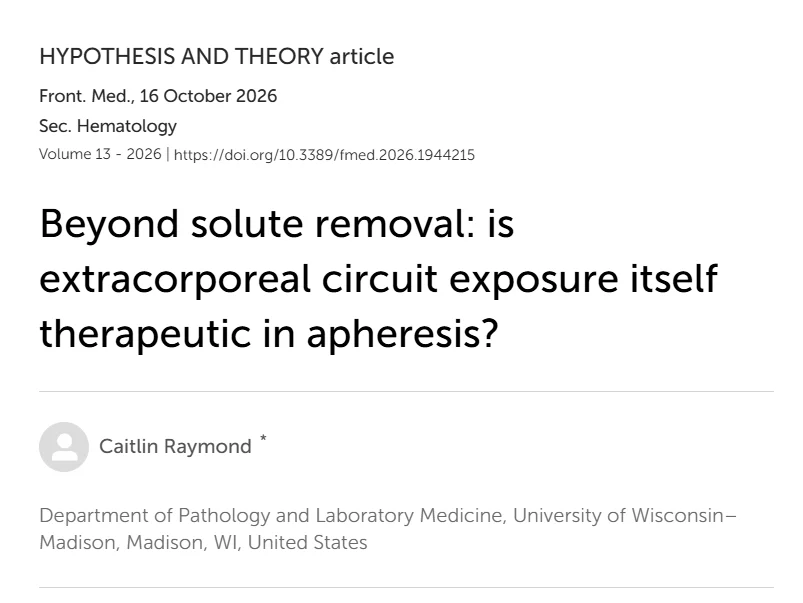
Title: Beyond solute removal: is extracorporeal circuit exposure itself therapeutic in apheresis?
Author: Caitlin Raymond
Stay updated on all scientific advances with Hemostasis Today.
-
Oct 18, 2026, 13:0810 Posts Not to Miss This Week
-
Oct 18, 2026, 12:58Pierpaolo Di Micco: DOACs vs Vitamin K Antagonists in Long-Term Anticoagulation
-
Oct 18, 2026, 12:51Arianne Missimer: Understanding Ferritin Levels Beyond the Normal Range
-
Oct 18, 2026, 12:37Roberto C. Iglesias: Colon Cancer Prevention Beyond Supplements and Vitamins
-
Oct 18, 2026, 12:27Rafael Alejandro Camero Del Vecchio: Paroxysmal Nocturnal Hemoglobinuria Advancing Complement Inhibition with Ravulizumab
-
Oct 18, 2026, 12:26Abdul Mannan: When INR Misleads – Rethinking Bleeding Risk in Cirrhosis
-
Oct 18, 2026, 12:14Stéphane Laurent: The People and Technology Behind Safe Blood Transfusion
-
Oct 18, 2026, 12:14Abhi Kapuria: When VTE Prophylaxis Breaks Down in the ICU
-
Oct 18, 2026, 11:37Lee Anne Sorto: Beyond Compliance – Making Audits Count in Transfusion Safety