


Abdul Mannan: When INR Misleads – Rethinking Bleeding Risk in Cirrhosis
Abdul Mannan,Consultant Haematologist at Betsi Cadwaladr University Health Board, shared a post on LinkedIn:
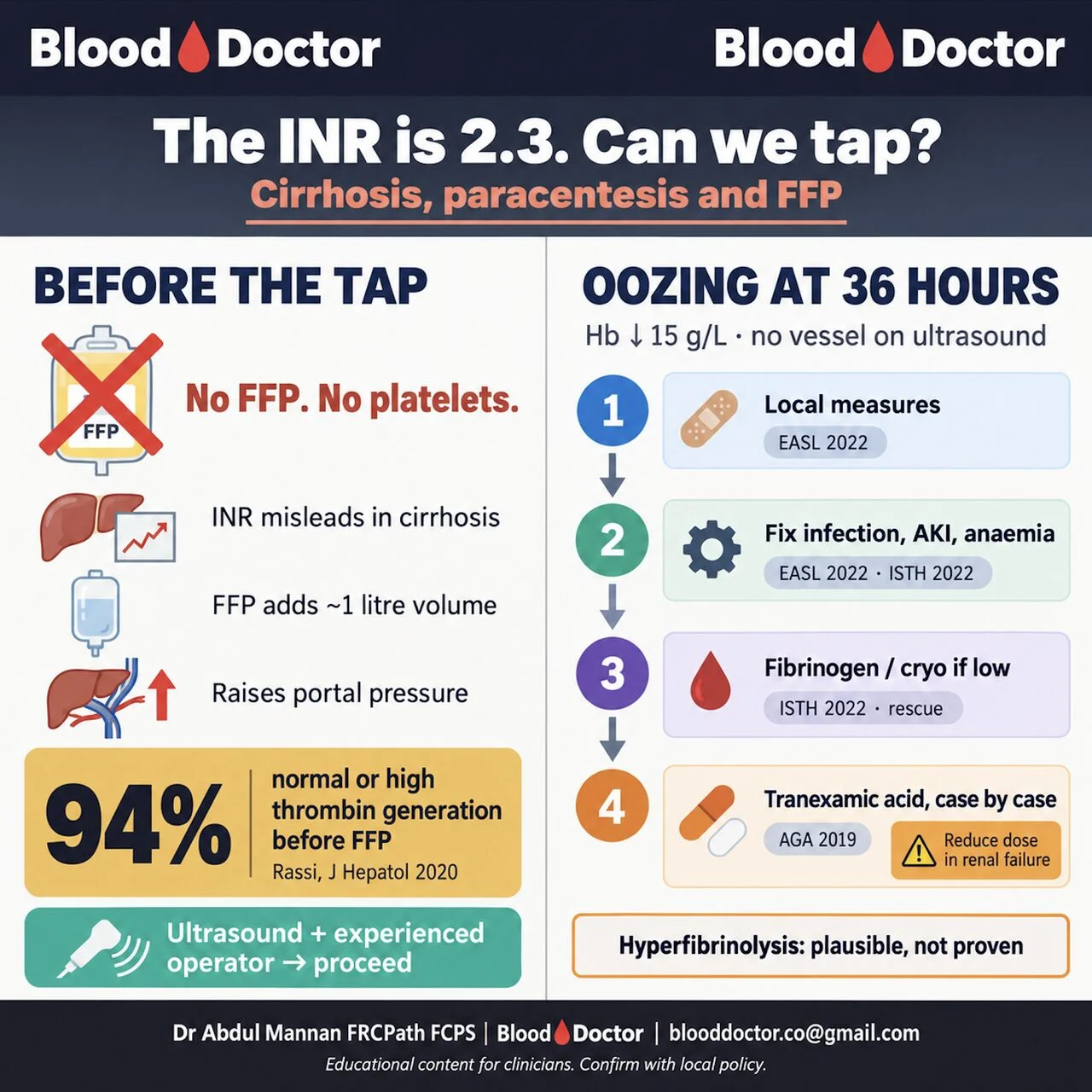
“4 units of FFP before a paracentesis. Here’s why I’d send them back to the blood bank.
The INR is 2.3. The F2 has ordered 4 units of FFP ‘before the paracentesis’.
I’d cancel it.
In cirrhosis, the INR sees only half of the picture.
It picks up the fall in clotting factors and misses the matching fall in natural anticoagulants. A high INR is a poor guide to who will bleed.
Rassi and colleagues (J Hepatol 2020) gave FFP to 53 patients with cirrhosis.
Before transfusion, 94% already had normal or high thrombin generation. Afterwards, the INR fell below 1.5 in only a minority, and thrombin generation went down in a third.
So FFP fixes very little, adds about a litre of volume, and pushes portal pressure up. Paracentesis is a low-risk procedure. Use ultrasound and an experienced operator, and go ahead.
Thirty-six hours later, the puncture site is oozing.
Hb has fallen 15 g/L.
Ultrasound shows no vessel.
That points to haemostatic failure, not a puncture injury.
Work up the ladder:
• Local measures first (EASL 2022).
• Treat infection, AKI and anaemia (EASL 2022; ISTH SSC 2022).
• Fibrinogen or cryo as rescue if fibrinogen is low (ISTH SSC 2022).
• Tranexamic acid case by case, at a reduced dose in renal failure (AGA 2019; EASL 2022).
Late oozing is often blamed on hyperfibrinolysis. None of these three guidelines says so, and EASL lists it as an open research question.
Treat it as a plausible mechanism, not a rule.
What does your unit do when the INR is above 2 before a tap?”
More posts featuring Abdul Mannan on Hemostasis Today.
-
Oct 18, 2026, 12:27Rafael Alejandro Camero Del Vecchio: Paroxysmal Nocturnal Hemoglobinuria Advancing Complement Inhibition with Ravulizumab
-
Oct 18, 2026, 12:14Stéphane Laurent: The People and Technology Behind Safe Blood Transfusion
-
Oct 18, 2026, 12:14Abhi Kapuria: When VTE Prophylaxis Breaks Down in the ICU
-
Oct 18, 2026, 11:37Lee Anne Sorto: Beyond Compliance – Making Audits Count in Transfusion Safety
-
Oct 18, 2026, 11:26Valentina Ajello: Does ANH Benefit Women in Cardiac Surgery?
-
Oct 18, 2026, 11:06Alex Ballout: Novel FUT1 Variant Linked to a Rare H-Deficient Blood Phenotype
-
Oct 18, 2026, 10:51Lethukwenama Letsoalo: Why Women’s Iron Status Matters Before Childbirth
-
Oct 18, 2026, 10:31Working Together for Better Outcomes in Hemophilia Care – Hemophilia Federation (India)
-
Oct 18, 2026, 08:02Neda Ashayeri: Global Perspectives on Hemophilia and Rare Bleeding Disorders in Abu Dhabi