

AF Density Improves Stroke Risk Prediction Beyond AF Burden – Cardiology Insights and Heart Health
Cardiology Insights and Heart Health shared a post on LinkedIn about a recent article by Lindsey Rosman, published in European Heart Journal։
”Background
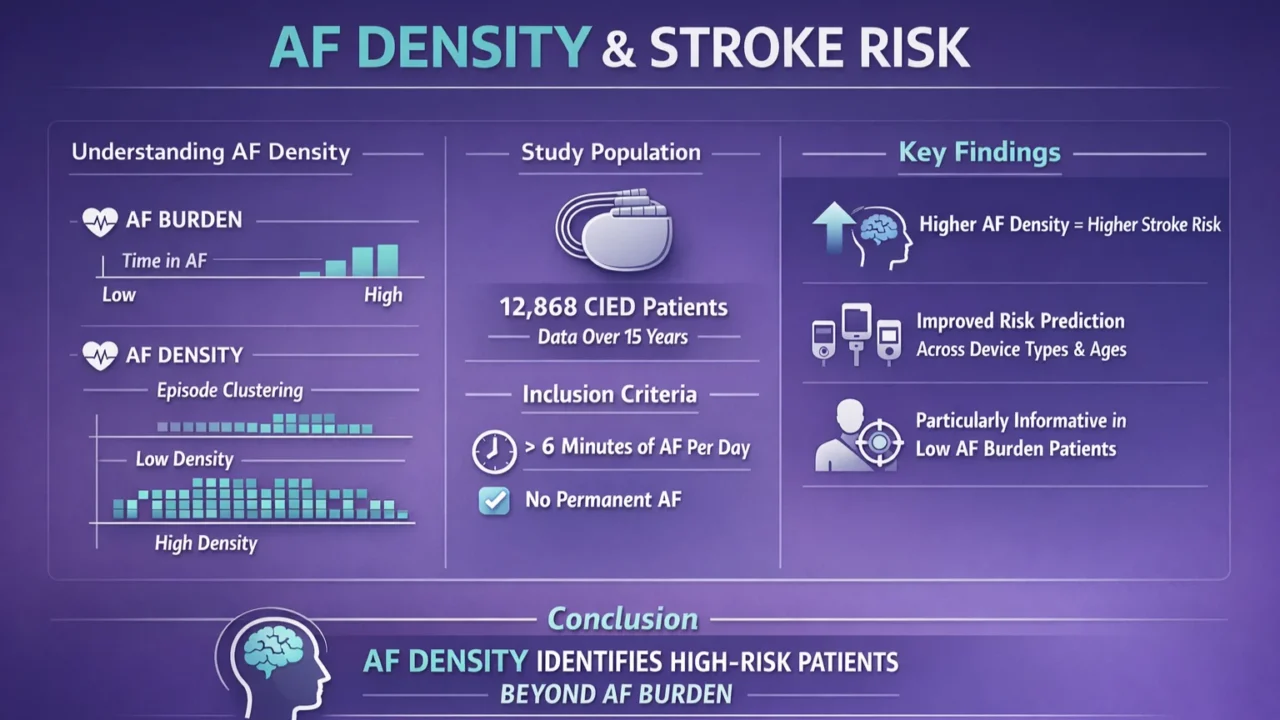
Atrial fibrillation (AF) affects millions globally and raises the risk of ischaemic stroke. Finding metrics to better assess stroke risk is essential to guide treatment. Current risk stratification focuses on AF burden, which refers to the percentage of time a patient is in AF. However, this approach does not capture the complex patterns of AF that may contribute to stroke risk.
This study introduces a new marker called AF density, which measures the clustering of AF episodes. The goal is to determine if AF density improves prediction of ischaemic stroke risk beyond traditional burden measurements.
Study Design
This study included 12868 adult patients from two large US registries who had cardiac implantable electronic devices (CIEDs), such as pacemakers or defibrillators, with data collected over a 15-year period.
Patients were included if they had a daily burden >6 minutes of AF, as this threshold is associated with increased stroke risk. Patients with permanent AF were excluded.
Methods
- AF burden and AF density were calculated over 30-day intervals and categorized from low to high on a scale from 0 to 1
- G-formula modelling was used to estimate stroke risk which accounted for factors that change over time (e.g. medications)
- A meta-analysis was used to combine the results of the two cohorts
Key Findings
A clear dose-dependent relationship was observed with stroke risk increasing as AF density increased. AF density improved risk prediction across different device types, comorbidities, and age groups. Even among patients with similar AF burden, higher density had greater stroke risk, highlighting the importance of episode clustering. AF density was particularly informative in low-burden patients, where treatment decisions are often unclear. This measure may help identify at-risk individuals, especially those without a prior stroke or not on anticoagulation, supporting more targeted prevention strategies.
Strengths
- Large population across two diverse US health systems
- Longitudinal CIED data from multiple device manufacturers
- Advanced statistical modelling (g-formula vs traditional Cox), which accounts for changing confounders
Limitations
- Low event rates limited subgroup analyses and prevented stratification by sex and race
- Retrospective data collection – stroke mechanisms could not be confirmed and the AF episodes were not independently verified
- Results may not generalize beyond CIED patients – validation in wearable and ambulatory monitor population is needed
Takeaways
AF density represents a novel biomarker that goes beyond simple AF burden. By capturing the temporal pattern of AF episodes, it improves stroke risk stratification and treatment decisions. Future validation studies can determine how AF density can be incorporated into clinical practice to enable more personalized AF management.”
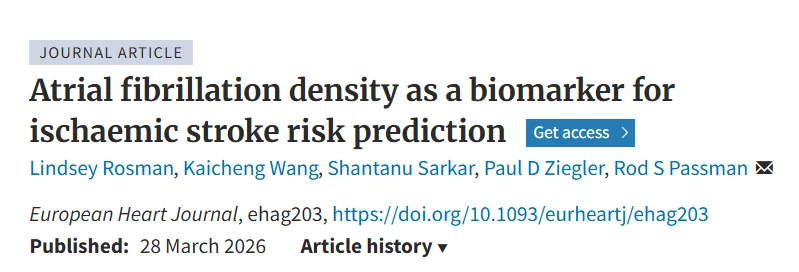
Title: Atrial fibrillation density as a biomarker for ischaemic stroke risk prediction
Authors: Lindsey Rosman, Kaicheng Wang, Shantanu Sarkar, Paul D Ziegler, Rod S Passman
Stay updated on all scientific advances with Hemostasis Today.
-
Sep 29, 2026, 03:53Nahrwan Masaoodi: Iron Deficiency Can Exist Without Anemia
-
Sep 29, 2026, 03:38Muhammad Yousaf: Iron Deficiency Beyond Diet
-
Sep 29, 2026, 03:21Parvez Ahmed Chowdhury: Synthesizing Aspirin in the Organic Chemistry Lab
-
Sep 29, 2026, 03:12Ahmed Hamandi: Building the Future of Hematopoietic Transplantation in Iraq
-
Sep 29, 2026, 03:09M V Chandrakanth: Aspirin in CRC – Old Drug, New Precision Oncology?
-
Sep 29, 2026, 03:07Caroline Pothet: Advancing Treatment Development in Sickle Cell Disease and Thalassaemia
-
Sep 29, 2026, 02:53Astha Jain: Thalassemia Care Through a Public Health Lens
-
Sep 29, 2026, 02:50Emma Groarke: Starting a New Career Path in Homeland
-
Sep 28, 2026, 19:14Aditya Sharma: An Outstanding Start to the Final Day of VSS 2026!