


Cheryl Loetscher: This Day in Drug Discovery – Wakix and H3 Receptor Inverse Agonism in Narcolepsy
Cheryl Loetscher, Founder, CEO of Quantum Biological Computing and AI Systems, shared a post on LinkedIn:
“What if wakefulness and cataplexy control could be restored without conventional stimulants by blocking the central nervous system’s presynaptic histamine off-switch? [1,2]
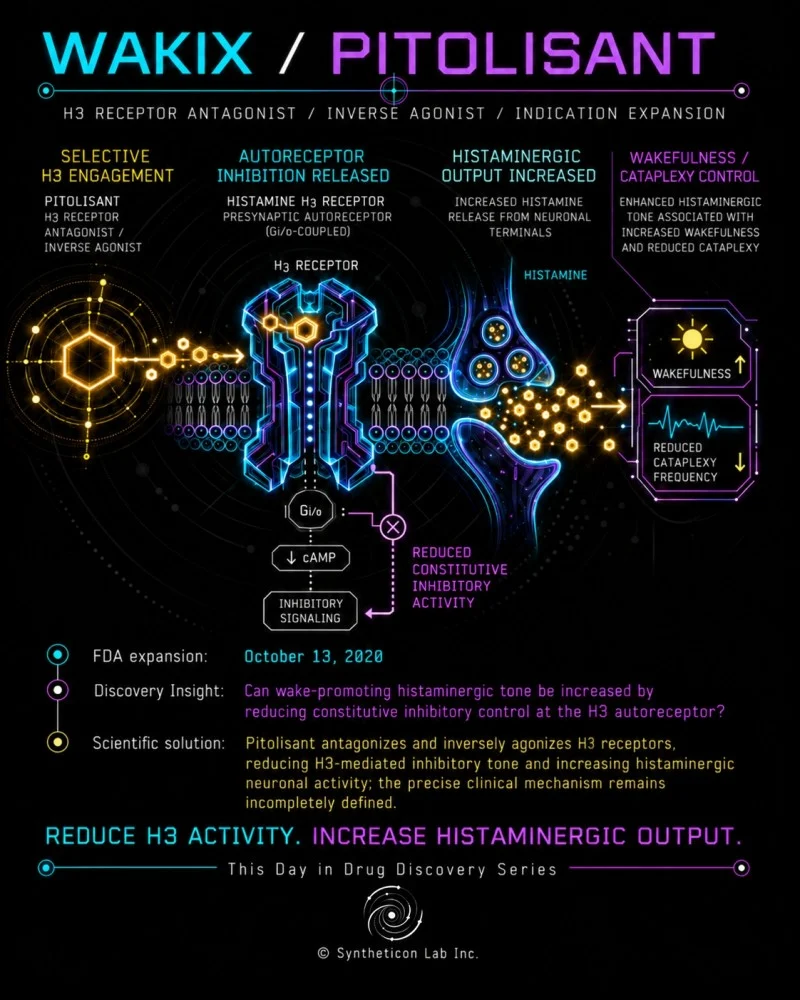
On October 13, 2020, regulatory approval was granted for an expanded indication of Wakix (pitolisant), a first-in-class histamine H3 receptor antagonist/inverse agonist developed by Harmony Biosciences and Bioprojet for the treatment of cataplexy in adult patients with narcolepsy [1,3].
By selectively engaging presynaptic H3 autoreceptors, Wakix releases constitutive inhibitory control and increases histaminergic output to manage both cataplexy and excessive daytime sleepiness without federal controlled-substance scheduling [2,4].
The Discovery Insight
Can wake-promoting histaminergic tone be increased by reducing constitutive inhibitory control at the H3 autoreceptor? [1,2]
Narcolepsy is a chronic neurological disorder driven by the loss of hypocretin/orexin neurons in the hypothalamus, resulting in profound daytime sleepiness and debilitating cataplexy (sudden loss of muscle tone) [2,3].
- Presynaptic Autoreceptor Braking: Histamine H3 receptors act as presynaptic autoreceptors coupled to Gi/o proteins, maintaining high constitutive inhibitory tone that restrains cAMP and limits the synaptic release of wake-promoting histamine [2,4].
- The Non-Scheduled Challenge: Established narcolepsy management traditionally relied on scheduled dopamine stimulants or GABA agonists with significant abuse liability; bypassing scheduled mechanisms required selectively mobilizing endogenous wake-promoting neurotransmission [1,3].
The Scientific Solution
Pitolisant antagonizes and inversely agonizes H3 receptors, reducing H3-mediated inhibitory tone and increasing histaminergic neuronal activity [1,2]:
- Selective H3 Engagement: Pitolisant binds with high affinity to presynaptic histamine H3 receptors, acting as both a competitive antagonist and an inverse agonist [2,4].
- Autoreceptor Inhibition Released: By suppressing Gi/o-mediated constitutive inhibitory signaling, pitolisant prevents the downregulation of cAMP and releases the intrinsic molecular brake on the presynaptic neuron [2,4].
- Histaminergic Output Increased: Relieving autoreceptor suppression triggers the synthesis and release of endogenous histamine from neuronal terminals across hypothalamic and cortical projections [2,4].
- Wakefulness and Cataplexy Control: Elevated histaminergic tone stimulates postsynaptic H1 receptors across central arousal networks, driving wakefulness and reducing the frequency of cataplectic episodes [1,3].
Translational and Clinical Legacy
- First-in-Class H3 Receptor Modulator: Pioneered the clinical validation of histamine H3 receptor inverse agonism as a distinct therapeutic modality in central nervous system disorders [1,2].
- Non-Scheduled Treatment Paradigm: Established the first non-scheduled (DEA non-controlled) treatment option in the United States approved for both excessive daytime sleepiness and cataplexy in adults with narcolepsy [1,3].
- Pivotal Phase 3 Proof: Validated in the Phase 3 HARMONY CTP trial, demonstrating statistically significant reductions in weekly cataplexy rates and improvements in daytime alertness [2,3].
The Synthetion Lab Take
Reduce H3 activity.
Increase histaminergic output.
Wakix demonstrated that by switching off the presynaptic H3 brake and reversing constitutive Gi/o signaling, researchers could harness the brain’s endogenous histamine pathways to restore wakefulness and suppress cataplexy [2,4].
WAKIX, you are the Wakefulness Wavemaker!
References:
[1] US Food and Drug Administration. FDA approves expanded use of Wakix (pitolisant) for cataplexy in adult patients with narcolepsy. Silver Spring (MD): FDA; 2020 Oct 13.
[2] Dauvilliers Y, Bassetti C, Lammers GJ, et al. Pitolisant versus placebo or modafinil in patients with narcolepsy: a double-blind, randomised, trial. Lancet Neurol. 2013;12(11):1068-75.
[3] Szakacs Z, Dauvilliers Y, Mikhaylov V, et al. Safety and efficacy of pitolisant on cataplexy in patients with narcolepsy: a randomised, double-blind, placebo-controlled trial. Lancet Neurol. 2017;16(3):200-7.
[4] Schwartz JC. The histamine H3 receptor: from discovery to clinical trials with pitolisant. Br J Pharmacol. 2011;163(4):713-21.”
Stay updated on all scientific advances with Hemostasis Today.
-
Oct 13, 2026, 14:30Thirunavukkarasu Angappan: FVIII vs. FIX Expressive Durability – Key Lessons from GENEr8-1 and HOPE-B Long-Term Data
-
Oct 13, 2026, 14:25Alyaa Al-Mughairy: Highlights from the 8th Omani Society of Hematology Congress
-
Oct 13, 2026, 14:21Britta Diebel: Reflections on an Unforgettable International Plasma Awareness Week
-
Oct 13, 2026, 14:14ESPHO at MAX Cancer Congress 2026: Advancing Ethiopian Pediatric Oncology on the Global Stage
-
Oct 13, 2026, 14:05Antonella Cordoba: WFH Representatives Visit the Hemophilia Foundation of Argentina
-
Oct 13, 2026, 13:56John Strouse: Screening for FNAIT – What HDN Teaches Us About Preventing Newborn Intracranial Hemorrhage
-
Oct 13, 2026, 12:29Mariam Al Mansoori: 5th International Hemophilia Conference
-
Oct 13, 2026, 12:13Hemophilia Outreach of Wisconsin Attends VWD Connect Conference
-
Oct 13, 2026, 11:41Abhishek Kumar: How Three Hemophilia Patients Helped Secure Life-Saving Treatment in Bihar