

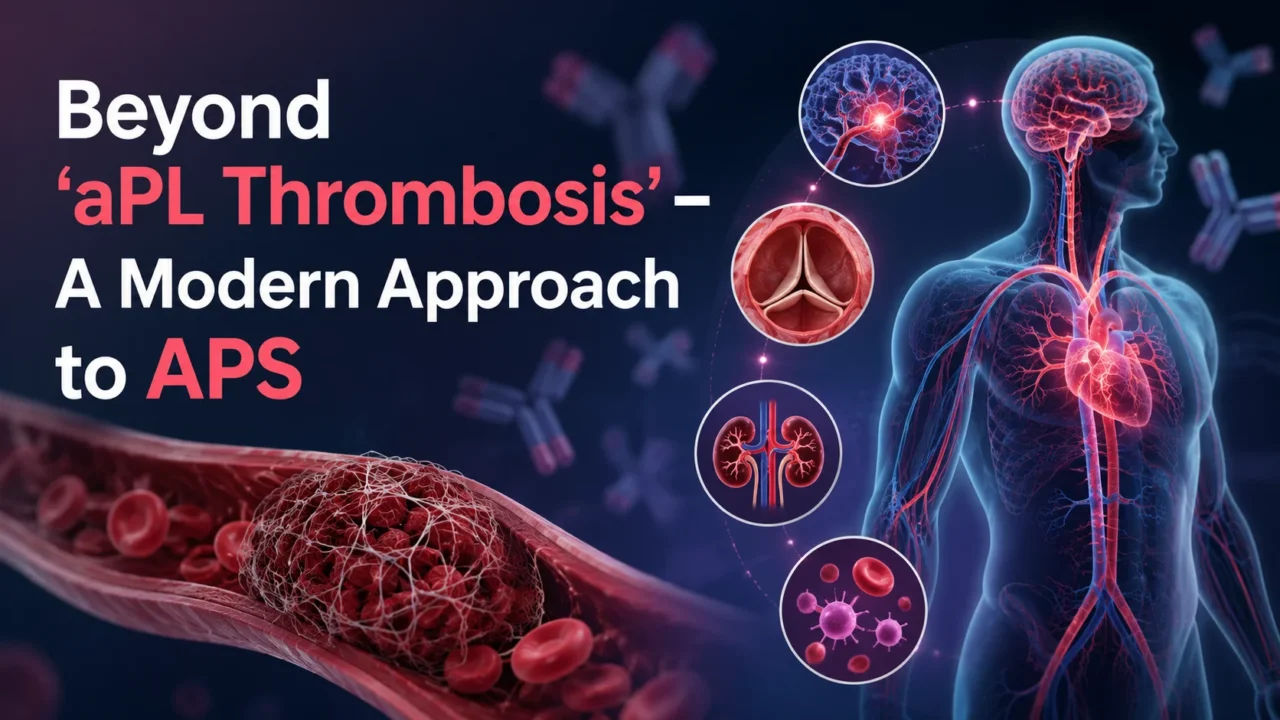
Dr. Mukesh: Beyond ‘aPL Thrombosis’ – A Modern Approach to APS
Dr. Mukesh, Assistant Professor of Clinical Immunology and Rheumatology at King George’s Medical University (KGMU), shared a post on X:
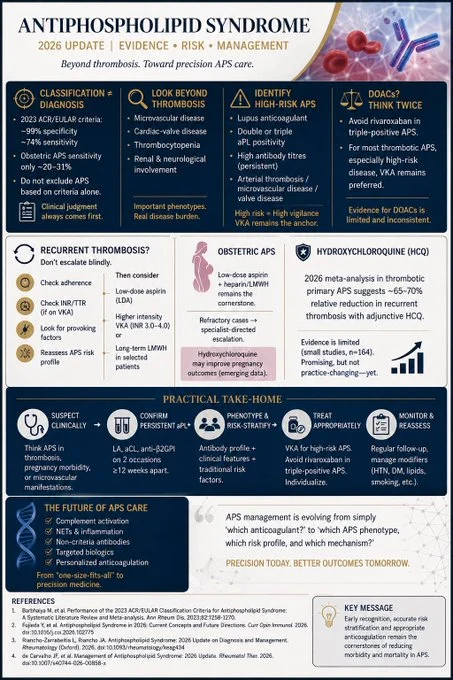
“Antiphospholipid Syndrome | 2026 update APS is no longer simply ‘aPL thrombosis.’
Think phenotype plus antibody profile plus thrombotic risk.
Classification is not diagnosis.
- 2023 ACR/EULAR criteria: approximately 99% specificity, approximately 74% sensitivity.
- Obstetric APS: sensitivity only approximately 20-31%.
Don’t rule out APS by the score alone.
Look beyond thrombosis.
- Microvascular disease,
- valve disease,
- thrombocytopenia,
- renal or neurological involvement are important APS phenotypes.
Identify high-risk APS.
- Lupus anticoagulant.
- Double or triple positivity.
- Arterial or microvascular disease.
VKA remains the anchor.
DOACs? Think twice.
Avoid rivaroxaban in triple-positive APS.
For most thrombotic APS – particularly high-risk disease – VKA remains preferred.
- Recurrent thrombosis?
Before intensifying therapy:
- Adherence – INR/TTR – provoking factors – APS risk profile.
- Then consider LDA / intensified VKA / LMWH in selected patients.
Obstetric APS
- LDA plus heparin or LMWH remains the foundation.
- Refractory disease – specialist-directed escalation; HCQ remains an emerging option.
HCQ: Promising, not practice – changing – yet
- 2026 data suggest fewer recurrent thrombotic events, but evidence remains small and heterogeneous.
Practical take-home
- Suspect clinically – confirm persistent aPL – phenotype or risk-stratify – choose anticoagulation accordingly.
High-risk APS? – VKA. Triple-positive? – Avoid rivaroxaban.
Recurrent event? – Investigate before simply escalating.
Obstetric APS? – LDA plus heparin or LMWH.
The future: precision APS care – not one-size-fits-all anticoagulation.”
Stay updated with Hemostasis Today.
-
Sep 4, 2026, 02:44Ahmed Kotb: Emergency Management of Critical Bleeding in ITP
-
Sep 4, 2026, 02:30Mario Jimenez: KDIGO 2026 – A More Proactive Approach to IV Iron in Hemodialysis
-
Sep 4, 2026, 02:18Edgardo Alania: Edoxaban in Intracranial Haemorrhage Survivors with AF
-
Sep 3, 2026, 20:33Jennifer Weinstein: Happy to Share Our New Work on the Patient Experience in VWD at the NBDF Conference
-
Sep 3, 2026, 20:31Guillaume Courbon: New Publication on Erythroid-Produced FGF23 and Its Role in Anemia
-
Sep 3, 2026, 20:30Phuong Khanh Morrow: FDA Approval Marks an Important Step Forward for the PV Community
-
Sep 3, 2026, 20:29Sarah Robins: Happy to Share This Portrait Film I Voiced for the NNHHF
-
Sep 3, 2026, 20:27Mireille Muller: Europe Needs More Plasma Donors
-
Sep 3, 2026, 17:54Tareq Abadl: Extravascular Hemolysis The High-Yield Guide