


Francisco Chacón-Lozsán: Limited Evidence Methylene Blue in Vasoplegic Shock
Francisco Chacón-Lozsán, Fellow at World Extreme Medicine, Member of European Society of Intensive Care Medicine (ESICM) and American College of Cardiology, shared a post on LinkedIn about a recent article by Shannon M. Fernando published in Journal of Critical Care:
”Methylene blue in septic shock: miracle, myth… or misunderstood tool?
We all know the scenario:
- Refractory vasoplegic shock
- Escalating norepinephrine
- Vasopressin, steroids… still hypotensive
At some point, the question comes:
Should we use methylene blue?
Mechanism
Septic shock equals NO-driven vasoplegia
Methylene blue acts by:
- Inhibiting nitric oxide synthase (NOS)
- Blocking soluble guanylate cyclase
Reducing cGMP
Restoring vascular tone
A true catecholamine-sparing strategy
What does the evidence say?
Reality check:
Use in practice is rare (0.5percent of septic shock patients)
Often used as late salvage therapy
Dosing strategies equals highly variable
But RCT signals are interesting:
- Reduced Vasopressor duration
- Shorter ICU / hospital length of stay
- Possible reduction mortality (low certainty)
Evidence is promising… but still weak
The clinical dilemma
Timing is everything:
- Early use -potential physiologic benefit
- Late use – often too late to change trajectory
- Current practice is probably backwards
What about safety?
Potential concerns:
Serotonin syndrome (with SSRIs)
Pulmonary vasoconstriction
G6PD-related hemolysis
Interference with pulse oximetry
Most serious effects seen with high doses
Take-home message
Methylene blue is not a ‘magic drug’
but it may be a physiology-driven adjunct in vasoplegic shock
The real questions are:
- Who benefits?
- When to give it?
- At what dose?
Where we’re heading
Ongoing trials (e.g., BLUSH trial) will clarify:
- Early vs late use
- Optimal dosing strategy
- True impact on mortality
This could redefine vasoplegic shock management
Clinical reflection
Next time you face refractory shock, ask:
- Is this still ‘fluid plus catecholamine problem’…
- or already a NO-mediated vasoplegia problem?
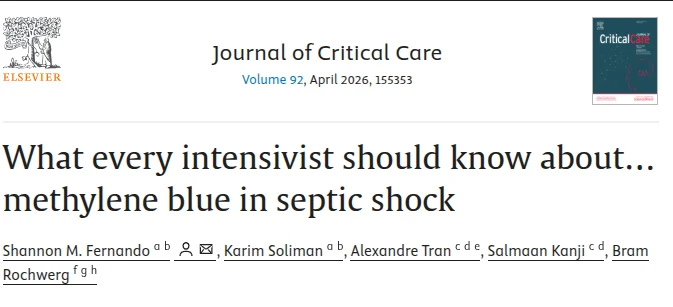
Title: What every intensivist should know about…methylene blue in septic shock
Authors: Shannon M. Fernando, Karim Soliman, Alexandre Tran, Salmaan Kanji, Bram Rochwerg
Stay updated on all scientific advances with Hemostasis Today.
-
Sep 14, 2026, 11:16Zahra Ghasemi: Breaking the Freezer Barrier in Plasma Transfusion
-
Sep 14, 2026, 09:44Mohammad Salar Amoli: Thrombin The Master Regulator of Coagulation
-
Sep 14, 2026, 09:23Claire Harrison: HemaSphere Introduces New Patient Editor Role
-
Sep 14, 2026, 09:13Eirini Zorba: Plasmapheresis in Focus Understanding Its Role in Patient Care
-
Sep 14, 2026, 08:55Abdulrahman Al-Mashdali։ Immune Checkpoint Inhibitor Associated HLH
-
Sep 14, 2026, 07:54Islam Sadek: SOHO2026 Highlights Advances in Hematologic Malignancies
-
Sep 14, 2026, 07:45Flora Peyvandi: Building a More Equitable Future for Hemophilia Care
-
Sep 14, 2026, 07:37Joseph Pierre Aboumsallem: ET Treatment Enters a New Chapter
-
Sep 14, 2026, 07:29Eric Topol: Will AI Replace Clinicians?