


Grigoris Gerotziafas Shares The APICAT Study Post Hoc Analysis
Grigoris Gerotziafas, Director of the Cancer, Vessels, Biology, and Therapeutics (CaVITE) Research Department, Head of the CRSA at Sorbonne University, shared on LinkedIn:
”APICAT study post hoc analysis, Just published: During extended treatment for cancer-associated VTE, four predictors of clinically relevant bleeding were identified in the overall population of patients treated with apixaban, with no evidence of interaction with the dosing regimen.
Anaemia and/or thrombocytopenia, age 75 years or older, pulmonary embolism as the index event, and male sex were significantly associated with an increased risk of clinically relevant bleeding.
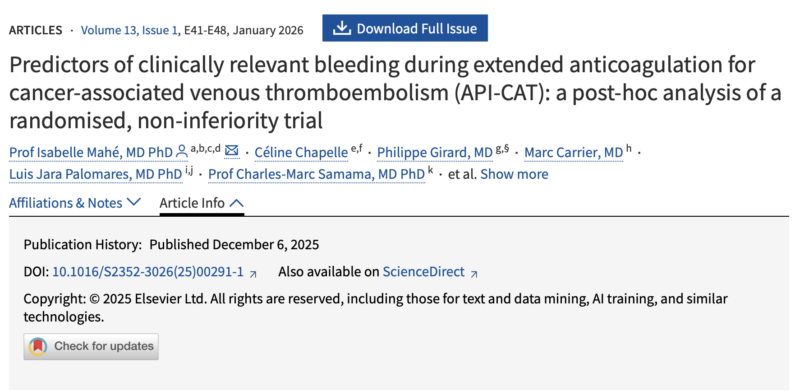
Isabelle Mahé 1 , Céline Chapelle 2 , Philippe Girard 3 , Marc Carrier 4 , Luis Jara Palomares 5 , Charles-Marc Samama 6 , Hélène Helfer 7 , Grigoris Gerotziafas 8 , Silvy Laporte 9 , Eric Vicaut 10 , Patrick Mismetti 11 ; API-CAT Study Group; API-CAT Investigators. Predictors of clinically relevant bleeding during extended anticoagulation for cancer-associated venous thromboembolism (API-CAT): a post-hoc analysis of a randomised, non-inferiority trial.
Lancet Haematol. 2026 Jan;13(1):e41-e48.”
Read the full article here.
Article: Predictors of clinically relevant bleeding during extended anticoagulation for cancer-associated venous thromboembolism (API-CAT): a post-hoc analysis of a randomised, non-inferiority trial
Authors: Isabelle Mahé, Céline Chapelle, Philippe Girard, Marc Carrier, Luis Jara Palomares, Charles-Marc Samama
Stay updated on all scientific advances with Hemostasis Today.
-
Oct 16, 2026, 18:12Adil Nawaz: Extended Dual Antiplatelet Therapy After Coronary Stenting
-
Oct 16, 2026, 17:50Elad Asher։ STORM-PE Shows Functional Benefits of Thrombectomy
-
Oct 16, 2026, 17:32Shruthi Narayan: STORM-PE and STRIKE-PE Studies Advance Understanding of Recovery After Pulmonary Embolism
-
Oct 16, 2026, 17:22Wolfgang Miesbach։ What a Near-Perfect FISH Score Fails to See
-
Oct 16, 2026, 17:06Troels Wienecke: Connecting Myeloproliferative Disease and Ischemic Stroke
-
Oct 16, 2026, 17:03Only 5 Days Left to Submit Your Research for EAHAD 2027
-
Oct 16, 2026, 16:48Abdul Rahman: Reticulocyte Count and Bone Marrow Activity
-
Oct 16, 2026, 16:44DOAC Adherence in Stroke Patients With Atrial Fibrillation – International Journal of Stroke
-
Oct 16, 2026, 16:22Shannon Farmer: Driving Patient Blood Management Forward in Australia and New Zealand