


Ifeanyichukwu Ifechidere: Choosing Between Clot-Based and Chromogenic Coagulation Assays
Ifeanyichukwu Ifechidere, Specialist Biomedical Scientist at Sheffield Teaching Hospitals, shared a post on LinkedIn:
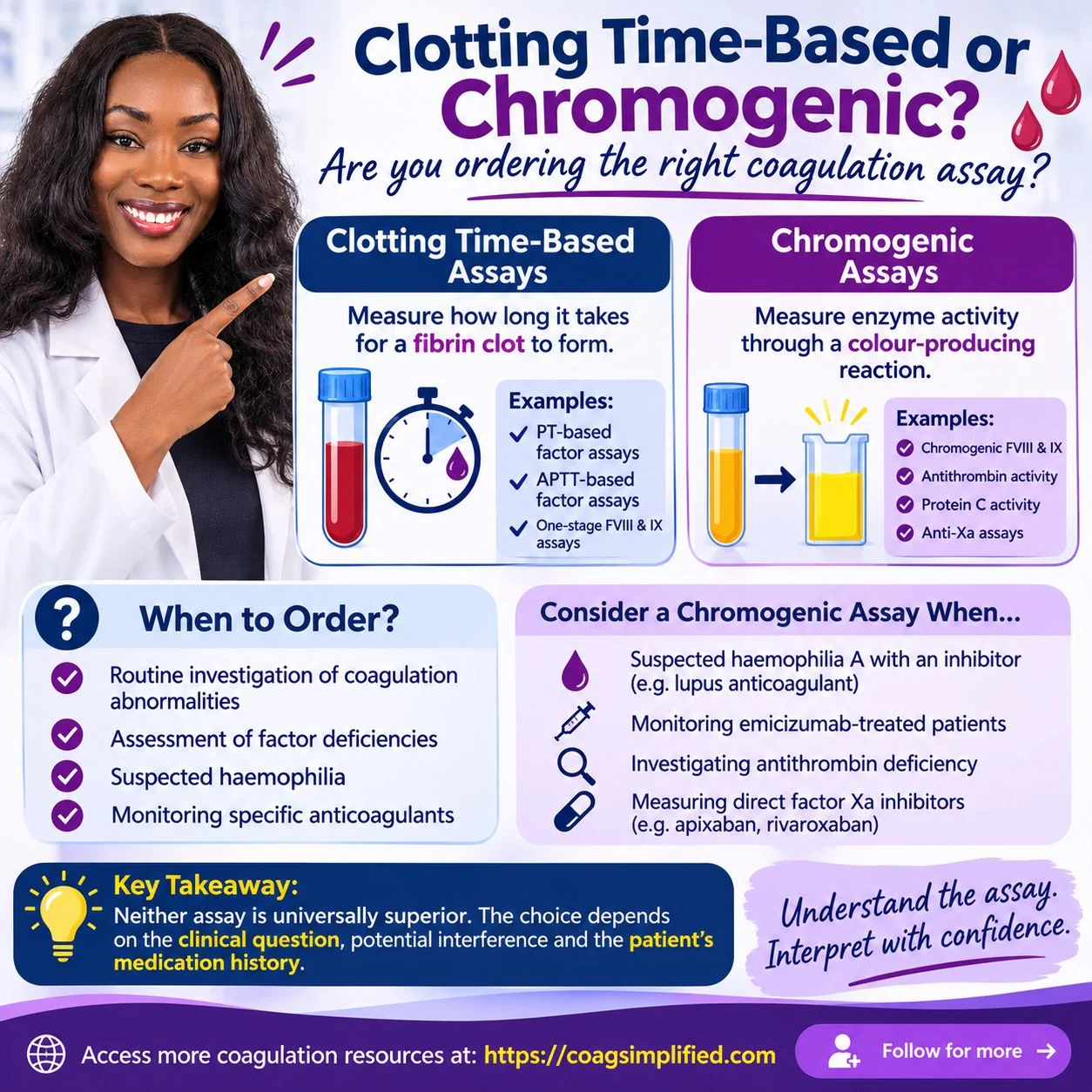
“Clot-based or chromogenic: Are you ordering the right coagulation assay?
Two assays can investigate the same clotting factor but use completely different principles to measure its activity.
Understanding the difference is essential for biomedical scientists and clinicians working in haemostasis.
Let’s break it down!
1. What are clotting time-based assays?
These assays measure how long plasma takes to form a fibrin clot after specific reagents are added.
Examples include:
- PT-based factor assays.
- APTT-based factor assays.
- One-stage Factor VIII and IX assays.
When are they useful?
- Routine investigation of coagulation abnormalities.
- Assessment of factor deficiencies.
- Initial investigation of suspected haemophilia.
2. What are chromogenic assays?
Unlike clot-based assays, chromogenic assays measure enzyme activity through a colour-producing reaction.
An active enzyme acts on a synthetic substrate, releasing a coloured product. The colour intensity is measured using a spectrophotometer and relates to the activity being measured.
Examples include:
- Chromogenic Factor VIII and IX assays.
- Antithrombin activity.
- Protein C activity.
- Drug-calibrated anti-Xa assays.
3. When should you consider a chromogenic assay?
Here are four important clinical scenarios:
- Suspected haemophilia A with assay interference
A chromogenic Factor VIII assay may help when lupus anticoagulant interferes with a one-stage FVIII assay.
- Patients receiving emicizumab
Conventional APTT-based and one-stage FVIII assays are affected by emicizumab. A bovine-reagent chromogenic FVIII assay is used to measure FVIII activity in these patients.
- Suspected antithrombin deficiency
Chromogenic antithrombin activity assays help investigate functional antithrombin deficiency.
- Measuring direct factor Xa inhibitors
Drug-calibrated chromogenic anti-Xa assays can quantify apixaban and rivaroxaban when clinically indicated.
- What should every biomedical scientist remember?
Neither method is universally superior.
The choice depends on:
- The clinical question.
- The suspected disorder.
- Potential assay interference.
- Medication history.
- The methodology and validation of the laboratory.
The real lesson?
Don’t just ask: ‘What is the result?’
Ask: ‘How was this result generated, what is the assay measuring, and could anything be interfering with it?’
That is how we move from simply performing coagulation tests to truly understanding haemostasis.
Let’s discuss:
Have you ever encountered a situation where a one-stage factor assay and a chromogenic assay produced significantly different results?
Want to build stronger practical knowledge in coagulation?
Access my practical coagulation learning resources here.”
Find more posts featuring Ifeanyichukwu Ifechidere on Hemostasis Today.
-
Nov 18, 2026, 13:06Saurabh Mehta: Daily Iron Supplementation in Children and Adolescents
-
Nov 18, 2026, 12:46Thirunavukkarasu Angappan: Fibrinogen in Postpartum Haemorrhage
-
Nov 18, 2026, 01:45Shikha Jha: My Takeaways from the 4th GANSID International Congress
-
Nov 18, 2026, 01:34Zeeshan Ahmed Khattak: Treatment of Fever and Neutropenia in Hematology/Oncology and Hematopoietic Cell Transplant Patients
-
Nov 17, 2026, 23:45Cajetan Reichardt: LAAO vs. OAC in AF – Balancing Nonprocedural Bleeding and Ischemic Stroke Risk
-
Nov 17, 2026, 23:42Brian Tegtmeyer: Expanding Pre-Hospital Administration of Low-Titer O Positive Whole Blood
-
Nov 17, 2026, 23:41Mansi Kala: Advancing Hematology – From Evidence to Clinical Excellence
-
Nov 17, 2026, 23:40Nathan Connell: Registered for the WFH Comprehensive Care Summit 2027 in Prague
-
Nov 17, 2026, 23:38Yaariv Khaykin: Does Reducing AF Burden After Ablation Change the Need for Anticoagulation?