


Jan Terje Andersen: Harnessing Placental Biology for Therapeutic Engineering
Jan Terje Andersen, Professor in Biomedical Innovation at University of Oslo, shared a post on LinkedIn, about a recent article he and his colleagues co-authored, published in Science Magazine Immunology, adding:
“From fundamental biology to new opportunities for therapeutic engineering
We are very excited to share our new study, published in Science Magazine Immunology, where we uncover a fundamental feature of placental biology – and show how it can inspire the design of next-generation biologic medicines.
Both IgG antibodies and albumin bind FcRn, which contributes to their remarkably long plasma half-lives.
But at the placenta, something striking happens: IgG is actively transported to the fetus, while albumin is largely excluded.
This led us to ask: Can we exploit this biological selectivity to engineer long-acting biologics with limited fetal exposure?
By fusing therapeutic antibodies or antibody fragments to albumin, we substantially reduced their transport across the placenta while retaining FcRn-mediated long plasma half-life.
With an engineered albumin variant, these properties could be further tuned through rational protein design.
Importantly, the findings were consistent across mouse models and an ex vivo human placental perfusion system.
In a model of fetal and neonatal alloimmune thrombocytopenia (FNAIT), restricting fetal transfer also reduced adverse effects in the offspring.
The work points toward an exciting opportunity: albumin-based engineering strategies for designing long-acting biologics with tailored fetal exposure profiles.
A huge congratulations to first author Jeannette Nilsen and to the fantastic team of national and international collaborators who made this work possible!”
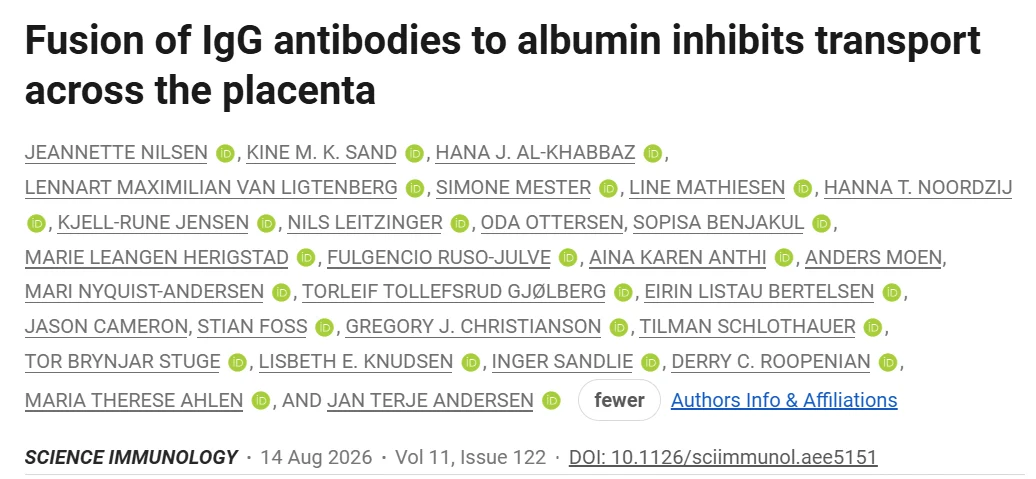
Title: Fusion of IgG antibodies to albumin inhibits transport across the placenta
Authors: Jeannette Nilsen, Kine M. K. Sand, Hana J. Al-Khabbaz, Lennart Maximilian van Ligtenberg, Simone Mester, Line Mathiesen, Hanna T. Noordzij, Kjell-Rune Jensen, Nils Leitzinger, Oda Ottersen, Sopisa Benjakul, M, Jason Cameron, Stian Foss, Gregory J. Christianson, Tilman Schlothauer, Tor Brynjar Stuge, Lisbeth E. Knudsen, Inger Sandlie, Derry C. Roopenian, Maria Therese Ahlen, Jan Terje Andersen
Stay updated on all scientific advances with Hemostasis Today.
-
Nov 18, 2026, 20:58Uma Vaidyanathan: When Hemoglobin Does Not Respond to Iron Therapy, Look Beyond Iron Deficiency
-
Nov 18, 2026, 20:57Jamil Rafiq: 5 Ways to Prevent Sample Haemolysis
-
Nov 18, 2026, 20:55Nasir Jamal: Plasmapheresis – Key Concepts at a Glance
-
Nov 18, 2026, 20:55Tarık Seller: Pulmonary Embolism – When a Blood Clot Becomes a Life-Threatening Emergency
-
Nov 18, 2026, 20:53Sandya Arunachalam: Bringing the Profession Together at the Haemostasis and Thrombosis Workshop
-
Nov 18, 2026, 15:11Vansh Yaduvanshi: Why Compatible Blood Groups Do Not Always Mean Compatible Blood
-
Nov 18, 2026, 14:49Estetrol-Based Contraception in PCOS and Its Effects on Coagulation – RPTH Journal
-
Nov 18, 2026, 14:41Factor V Deficiency: Diagnostic Challenges and the Role of Combined Factor V and VIII Deficiency
-
Nov 18, 2026, 14:29Maxime Dely: When Patient Encounters Become Life Lessons