


Leonardo Roever: Post-Stroke Seizures Should Not Be Viewed as a Single Clinical Entity
Leonardo Roever, CEO of Brazilian Evidence-Based Health Network, shared on LinkedIn about a recent article he and his colleagues co-authored, published in Journal of Clinical Medicine, adding:
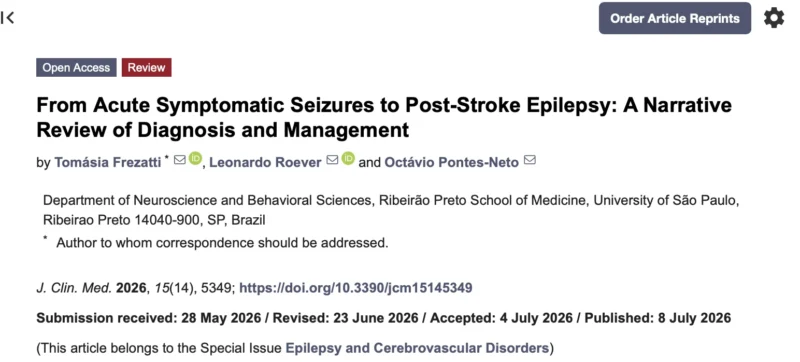
”From Acute Symptomatic Seizures to Post-Stroke Epilepsy: A Narrative Review on Diagnosis and Management
Stroke is a leading cause of acquired epilepsy in adults, particularly among the elderly.
However, post-stroke seizures should not be viewed as a single clinical entity.
Acute symptomatic seizures (ASyS) occur within the first seven days post-stroke and are considered provoked events, whereas late-onset symptomatic seizures carry a higher risk of recurrence and may meet the criteria for the practical definition of post-stroke epilepsy (PSE).
This narrative review provides a clinically focused synthesis of current evidence regarding definitions, epidemiology, pathophysiology, risk factors, predictive scores, risk stratification based on EEG and biomarkers, seizure prevention, and management with antiseizure medications (ASMs).
Current evidence does not support routine primary prophylaxis with ASMs for all stroke patients.
Conversely, documented clinical or electrographic seizures require appropriate treatment, and established PSE often necessitates individualized, long-term therapy.
Predictive tools can assist in guiding surveillance, EEG referral, counseling, and follow-up, but they should not serve as automatic triggers for prophylactic treatment.
The choice of ASM must consider seizure type, age, comorbidities, cognitive and psychiatric vulnerability, drug interactions, and secondary vascular prevention.
Future research should focus on validated biomarkers and preventive strategies capable of modifying post-stroke epileptogenesis.”
Title: From Acute Symptomatic Seizures to Post-Stroke Epilepsy: A Narrative Review of Diagnosis and Management
Authors: Tomásia Frezatti, Leonardo Roever, Octávio Pontes-Neto
Stay updated on all scientific advances with Hemostasis Today.
-
Oct 5, 2026, 15:31Irma Bagdoniene: Multidisciplinary Management of High-Risk Familial Hypercholesterolaemia and CAD
-
Oct 5, 2026, 15:00Serena Williams and Pulmonary Embolism: From Personal Crisis to Lessons in Venous Thromboembolism
-
Oct 5, 2026, 14:55Marco Moscarelli: 3D Reconstruction Enhances Volumetric Assessment of Post-TAVI Thrombosis
-
Oct 5, 2026, 13:24Abdul Muqtadir Abbasi: Diagnostic Pearls for Evaluating Isolated Thrombocytopenia in Residents
-
Oct 5, 2026, 13:16Katerina Pavenski: Rethinking What ‘Normal’ Means for Iron Deficiency
-
Oct 5, 2026, 13:09Rick Matthews: Balancing Established VTE Partnerships with Innovative Interventional Technologies
-
Oct 5, 2026, 13:01Nawsherwan Mohammad: Recognizing TTP Before the ADAMTS13 Result Arrives
-
Oct 5, 2026, 12:51Bruno Pougault: The Hidden Challenges Behind Anti Xa Testing
-
Oct 5, 2026, 12:41Syed Huzaifa Khan: Rethinking CTRP12 as a Biomarker for In Stent Restenosis